
Key takeaways
What this article covers, in order:
- Before you start
- Step 1: Understand TDS on contractor payments in India — what and why?
- Step 2: How do I automate TDS calculation and deduction with AI?
- Step 3: What accounting entries are made when deducting TDS on contractor payments?
- Step 4: How do I record and reconcile TDS payments automatically?
- Step 5: How to ensure compliance and simplify GST return filing for contractor TDS?
How to Automate Contractor TDS Deduction and Accounting Entries in Indian SMEs
This guide is for owners, finance leads, and accountants at Indian SMEs who want to reduce manual work and errors in TDS deduction on contractor payments. By the end, you will know how to automate TDS deduction and accounting entries efficiently.
Before you start
- You should have your contractor agreements with agreed payment terms.
- Your business must be registered for TDS deduction under Indian income tax laws.
- Access to your payment and accounting data systems or software.
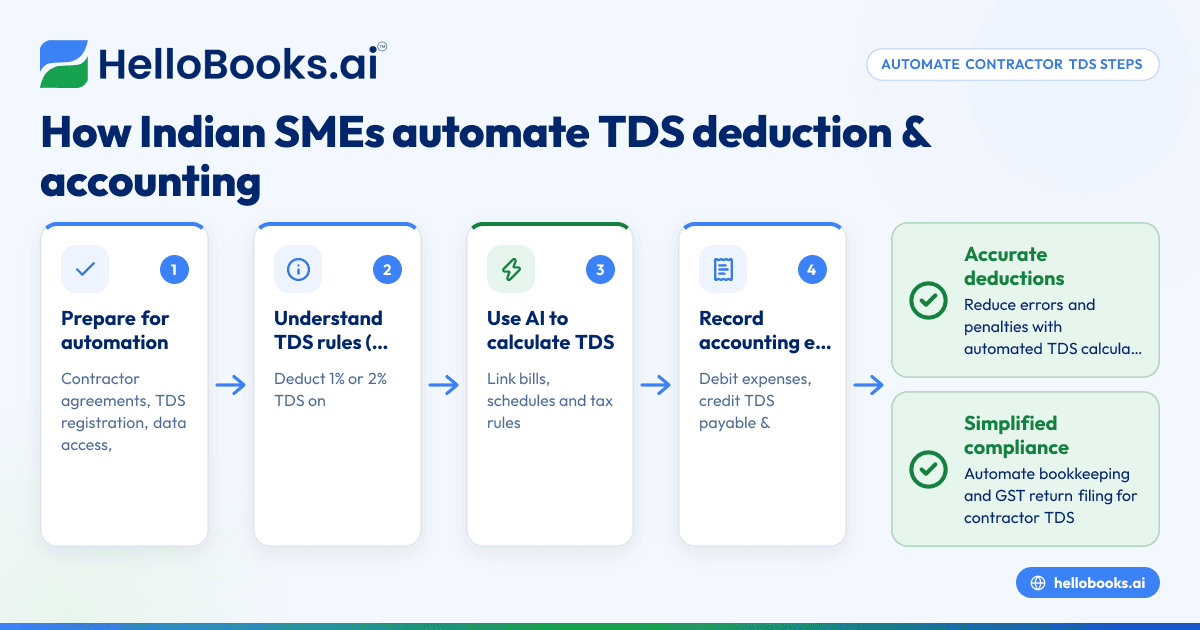
- Knowledge of current TDS rates on contractor payments (usually 1% or 2%).
Step 1: Understand TDS on contractor payments in India — what and why?
TDS or Tax Deducted at Source is tax withheld on payments to contractors under Section 194C of the Income Tax Act. It is deducted by the payer to ensure tax compliance, and the deducted amount is deposited with the government.
The TDS rate is normally 1% for individuals/HUF contractors and 2% for others like companies. This deduction is mandatory on contractor payments above ₹30,000 per transaction.
A common mistake is to ignore TDS or apply incorrect rates, leading to penalties and headaches at filing. Knowing the rules is the first step to automating TDS accurately.
Step 2: How do I automate TDS calculation and deduction with AI?
AI TDS automation uses algorithms to calculate deduction amounts based on payment details, TDS rates, and payment thresholds. Integrated tools like HelloBooks AI can link contractor bills, payment schedules, and tax rules to deduct TDS automatically as payments are entered.
This avoids errors from manual calculation and missed or incorrect deductions. Using automated TDS tools reduces tedious data entry and ensures compliance without extra effort.
People often try to do this manually in Excel or Tally, but that is time-consuming and prone to mistake, especially when reconciling payments with TDS deposits later.
Step 3: What accounting entries are made when deducting TDS on contractor payments?
When you deduct TDS on payments, you need to pass certain accounting entries to reflect the payment, tax deducted, and outstanding to the contractor.
- Debit the contractor expense account for the full invoice amount.
- Credit TDS payable (a current liability) for the deducted TDS amount.
- Credit bank or cash account for the net payment made after deduction.
Later, when remitting the TDS to the government, debit the TDS payable account and credit bank. This ensures your books correctly track TDS withheld and deposited.
A frequent mistake is to not record the TDS payable separately, which causes confusion in reconciliation and GST return filing.
Step 4: How do I record and reconcile TDS payments automatically?
Automating TDS accounting requires your payment, TDS deduction, and tax remittance records to be linked and reconciled.
Using AI bookkeeping software, you can upload bank statements that automatically match contractor payments with the deducted TDS and deposited tax challan numbers. This ensures full audit trails and error-free books.
Failing to reconcile timely leads to mismatched GST returns and tax credit denial risks.
Step 5: How to ensure compliance and simplify GST return filing for contractor TDS?
TDS deducted on contractor payments must be reported in Form 26Q quarterly and also reflected in your GST returns where applicable. Automation can pull TDS data directly from your bookkeeping system, generate Form 26Q, and alert you about due dates.
This reduces last-minute rush and manual compilation of contractor tax data. Ensure the AI system updates TDS rates and rules promptly to stay compliant with new budgets or circulars.
Common errors include late filing and incorrect challan details, which cause penalties.
Worked example: Automating TDS on ₹1,00,000 contractor payment
Suppose your Bengaluru-based SME pays a contractor ₹1,00,000 for services. The contractor is a sole proprietor, so 1% TDS applies. Your AI bookkeeping tool identifies this and calculates ₹1,000 TDS.
Accounting entries made automatically are:
- Debit Contractor Expense ₹1,00,000
- Credit TDS Payable ₹1,000
- Credit Bank ₹99,000 (net payment)
When you pay TDS online, the system records:
- Debit TDS Payable ₹1,000
- Credit Bank ₹1,000
At quarter-end, your accounting software compiles all TDS data, prepares Form 26Q for submission, and aligns it with GST returns seamlessly.
What are common pitfalls businesses face in contractor TDS automation?
Many businesses, especially in tier-2 cities, rely on manual TDS calculation or basic accounting tools that do not support automatic deduction or reconciliation. This leads to missed deductions, delayed payments, and confusion during audits.
Another issue is lack of updated contractor classification and PAN details, causing higher TDS deduction or compliances to fail.
Adopting AI tools for contractor TDS helps eliminate these problems and suits growing SMEs balancing multiple compliance requirements.
Book a personalized demo or compare plans for automated accounting and TDS management tailored to Indian SMEs at HelloBooks to see how it works in practice.
What should I do next to start automating TDS on contractor payments?
Begin by reviewing your current contractor payments and TDS deduction practices. Collect contractor PAN details and update your payment records in your accounting system. Next, trial AI-powered accounting software in India that supports TDS automation to streamline data entry and compliance.
By moving away from manual processes, you reduce errors, save time on monthly GST and income tax filings, and improve cash flow visibility. Take the next step for your SME’s accounting efficiency and compliance by exploring automated TDS software options like HelloBooks.
Automating TDS on contractor payments using AI accounting tools not only saves bookkeeping time but also ensures timely compliance with income tax and GST regulations in India. The reduced manual work frees you to focus on growing your business with peace of mind that tax deduction and accounting entries are done right. Check out HelloBooks for smart, automated TDS management to reduce paperwork and stay audit ready.
Related reading
- How AI Bookkeeping Automates Data Entry for Small Businesses in India, Supported with Caveats
- How to Reconcile Payment Gateway Settlements with Bank Statements for Indian SMEs
Read next
This article covers one part of a bigger topic. For the complete picture, read our guide to supported with caveat.