
Key takeaways
What this article covers, in order:
- When should I choose manual bookkeeping for reverse charge mechanism entries?
- When does traditional accounting software work well for reverse charge entries?
- How does AI bookkeeping simplify reverse charge mechanism entries?
- How can I be sure my AI reverse charge bookkeeping tool keeps me GST compliant?
- What questions should I ask before choosing an AI reverse charge bookkeeping tool?
- When is AI bookkeeping the best choice for reverse charge mechanism entries?
Managing GST reverse charge mechanism entries in books accurately can be a tedious and error-prone task for small businesses in India. The compliance complexities, timing of entries, and tax computations under reverse charge make manual bookkeeping inefficient. This often leads to missed input tax credit claims or GST filing errors. The one factor that typically decides how you manage reverse charge entries is automation – particularly AI-powered bookkeeping solutions that reduce manual data entry and simplify compliance.
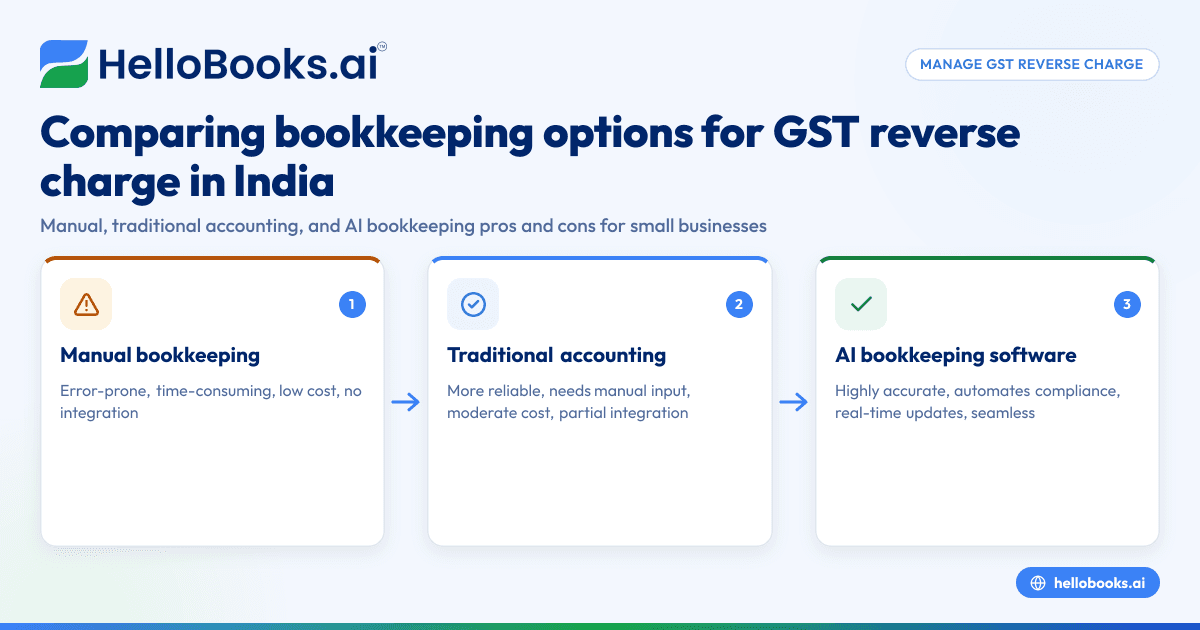
Here’s a quick comparison of manual bookkeeping, traditional accounting software, and AI bookkeeping software to handle reverse charge mechanism entries in your business books.
| Criteria | Manual Bookkeeping | Traditional Accounting Software | AI Bookkeeping Software |
|---|---|---|---|
| Accuracy of Reverse Charge Entries | Prone to errors and omissions | More reliable but requires manual inputs | High accuracy with automated data extraction and classification |
| Time Spent | Time-consuming and repetitive | Moderate time, manual reconciliations still needed | Saves significant time with automation and real-time updates |
| GST Reverse Charge Compliance | Risk of non-compliance | Helps track liabilities but requires tax knowledge | Automates GST return data, e-invoicing and compliance checks |
| Input Tax Credit (ITC) Tracking | Difficult and manual | Visible if entries are timely entered | Real-time tracking and automatic ITC claims suggested |
| Ease of Use | Complex for non-accountants | Requires training or accountant support | User-friendly, minimal manual intervention needed |
| Cost | Low direct cost but inefficient | Moderate license fees | Scalable pricing with higher ROI due to saved time and penalties |
| Integration with Bank and GST Portals | None/Manual upload | Limited integration | Seamless bank feeds and GST portal integration |
When should I choose manual bookkeeping for reverse charge mechanism entries?
Manual bookkeeping suits very small businesses with low reverse charge transaction volume. It works when you want simple tracking with minimal costs and do not mind spending significant time checking GST compliance yourself.
Although manageable initially, manual bookkeeping risks errors and misses timely ITC claims as your transaction complexity grows. It becomes inefficient and prone to compliance lapses.
For growing businesses, manual bookkeeping is no longer practical due to GST’s complex rules for reverse charge, including self-invoicing and reconciliation with multiple suppliers.
When does traditional accounting software work well for reverse charge entries?
Traditional software like Tally or Busy works best when you need standard GST reporting and moderate accuracy but can dedicate staff or accountants for manual data entry. These tools provide built-in GST ledgers and formats to ease compliance.
They help reduce basic errors compared to manual books but still require ongoing manual input, especially in matching supplier invoices and e-invoice reconciliation.
They suit businesses with some bookkeeping capacity but without the need or budget for automation-heavy AI tools.
Traditional software lacks full automation; it may not catch subtle compliance issues like timely reverse charge application or mismatched supplier data.
How does AI bookkeeping simplify reverse charge mechanism entries?
AI bookkeeping software automatically extracts data from invoices, classifies reverse charge transactions correctly, and updates your accounts in real time. It reduces manual work and improves compliance by continuously cross-checking supplier details and GST regulations.
For businesses with many reverse charge suppliers or complex invoicing — such as those using WhatsApp or Razorpay payments — AI saves hours weekly by automating ledger entries and reconciling GST returns.
AI reverse charge features detect unregistered suppliers, manage self-invoicing, and alert you to missing documents, making GST filing easier and more reliable.
How can I be sure my AI reverse charge bookkeeping tool keeps me GST compliant?
Buying AI bookkeeping software does not remove your compliance responsibility. Verify the software updates automatically with latest GST rates and notifications from CBIC related to reverse charge.
Check that it supports correct GSTR-3B filing with reverse charge transactions and integrates well with GST e-invoice systems.
Ensure the software signals mismatches in supplier data to avoid blocked ITC or penalties.
Use it as a tool to catch errors early, but always review AI suggestions against your invoice records.
What questions should I ask before choosing an AI reverse charge bookkeeping tool?
Ask if the software reliably connects with Indian GST portals and supports e-invoicing and filing. Check how accurately it identifies reverse charge vendors and applies the correct tax treatment automatically.
Confirm it imports bank and payment gateway data from platforms like Razorpay and UPI, popular in Indian SMEs.
Find out whether it can handle multi-branch setups common in tier-2 and tier-3 cities.
Assess the internal controls it provides for detecting missing GST documents or mismatches.
Check ease of generating audit-ready reports and summaries for GST compliance.
When is AI bookkeeping the best choice for reverse charge mechanism entries?
AI bookkeeping is ideal if your Indian business deals with numerous reverse charge transactions—such as services from unregistered suppliers, import-related invoices, or specified goods.
It saves time, cuts errors, and ensures continuous GST compliance, especially important for growing teams relying on WhatsApp, IndiaMART leads, or digital payments.
Businesses in cities like Mumbai, Bengaluru, or Pune benefit the most from AI’s real-time automation and integration features.
If you want a Tally alternative or a QuickBooks alternative tuned to Indian GST reverse charge complexities, AI bookkeeping like HelloBooks.ai is a practical solution.
Try it yourself by booking a demo or comparing plans for your business needs.
Accurately managing reverse charge mechanism entries helps avoid GST mistakes and penalties. While manual bookkeeping or traditional software have limits, using AI reverse charge bookkeeping software streamlines processes tailored to Indian SMEs. It reduces errors, speeds compliance, and lets your team focus on growing your business instead of complex tax entries.
Related reading
- AI bookkeeping
- How Small Businesses in Dadra and Nagar Haveli Can Simplify GST Return Filing Using AI Bookkeeping
- How Small Businesses Can Transition From Manual to AI Bookkeeping in India
Read next
This article covers one part of a bigger topic. For the complete picture, read our guide to supported with caveat.