


Key takeaways
What this article covers, in order:
- Key takeaways
- What are quarterly estimated tax payments for US small businesses?
- How do quarterly estimated tax payments affect cash flow forecasting?
- How can AI assist with quarterly estimated tax payments?
- What is the best way for US small businesses to estimate quarterly tax payments accurately?
- How do small businesses integrate quarterly estimated tax payments into their cash flow forecasts?
Quarterly estimated tax payments are advance tax prepayments that US small businesses make to the IRS and state tax authorities throughout the year. These payments prevent large tax bills at year-end and require careful cash flow forecasting to ensure funds are available when due.
Key takeaways
- Quarterly estimated taxes cover income, Social Security, and Medicare taxes for businesses with insufficient withholding.
- Regular payments reduce working capital and must be included in cash flow forecasting.
- Accurate quarterly tax estimates prevent penalties and excessive cash tied up in refunds.
- AI quarterly estimated tax tools automate calculations and reminders to improve accuracy.
- Cash flow forecasting with tax payments helps plan expenses, payroll, and investments.
- Accounting software for small business can streamline bookkeeping and tax compliance.
What are quarterly estimated tax payments for US small businesses?
Quarterly estimated tax payments are advance payments small business owners and self-employed individuals must make if they expect to owe $1,000 or more in federal income tax when filing. Unlike employees who have taxes withheld, these taxpayers pay estimated taxes quarterly to cover income, Social Security, and Medicare taxes.
The IRS deadlines are generally April 15, June 15, September 15, and January 15. Most states also require similar quarterly payments. Missing these payments can incur penalties, making timely compliance essential. Balancing these payments is critical to avoid cash flow strain or overpayment.
How do quarterly estimated tax payments affect cash flow forecasting?
Quarterly estimated taxes impact cash flow by requiring businesses to reserve cash for periodic payments, reducing funds available for operations. Cash flow forecasting helps predict when these payments are due and their amounts, enabling better liquidity management.
By including tax payments in forecasts, businesses can plan vendor payments, payroll, and investments more effectively. Neglecting these payments risks cash shortages or borrowing costs. Well-planned cash flow forecasting incorporates these obligations to maintain smooth operations.
How can AI assist with quarterly estimated tax payments?
AI quarterly estimated tax systems analyze your income, expenses, and past tax data to automatically calculate tax obligations each quarter. They issue timely reminders and generate payment information, reducing errors and missed deadlines.
Using AI tools in bookkeeping gives you real-time, accurate tax forecasts that adapt as your revenue changes. Businesses in cities like Chicago and Houston use AI-driven software to match fluctuating income with consistent tax payments and maintain healthy cash flow.
What is the best way for US small businesses to estimate quarterly tax payments accurately?
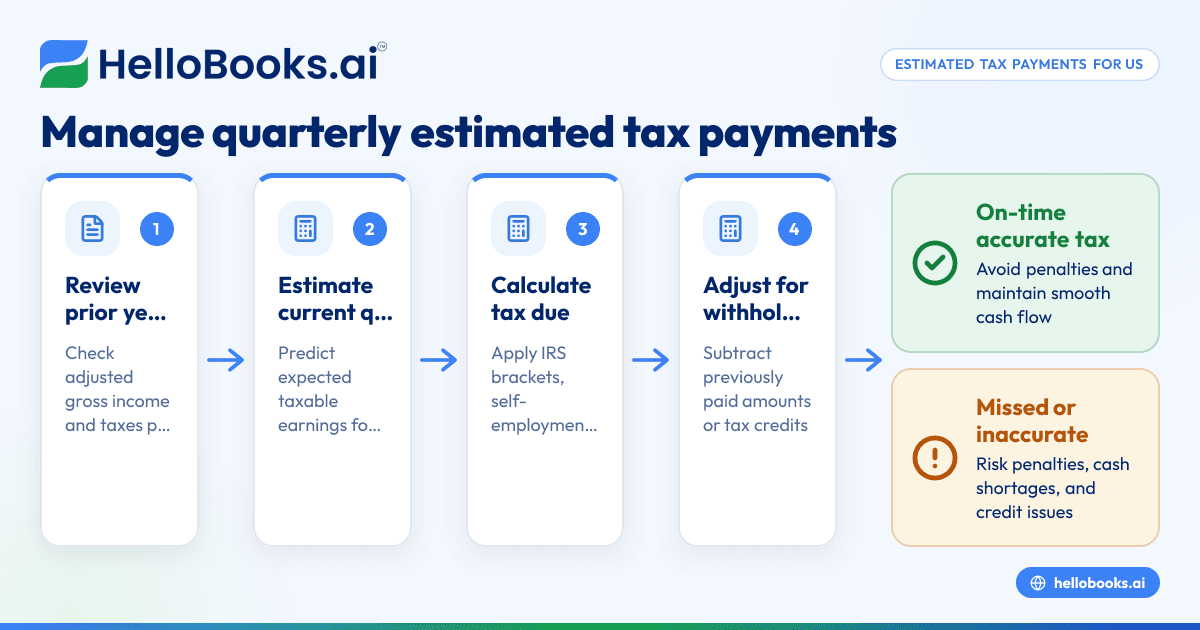
Accurate quarterly tax estimation requires calculating expected taxable income and deductions regularly to reflect income variations. The process generally involves:
- Reviewing prior year’s adjusted gross income and tax paid.
- Estimating current quarter income.
- Applying current IRS tax brackets and self-employment tax rates.
- Including applicable state taxes.
- Subtracting any withholdings or credits.
- Dividing estimated taxes into four payments and adjusting if needed.
Using IRS tools like Form 1040-ES helps, but AI accounting software can automate these steps and reduce estimation mistakes.
How do small businesses integrate quarterly estimated tax payments into their cash flow forecasts?
To include tax payments in cash flow:
- Add due dates and estimated payment amounts explicitly in your cash flow tool.
- Adjust discretionary spending or arrange financing around payment dates.
- Update estimates as actual income changes during the year.
- Use software functionalities or reminders to avoid missing deadlines.
Platforms with bank reconciliation software or expense management software make monitoring tax payments alongside other expenses easier.
What common mistakes should US small businesses avoid regarding quarterly estimated tax payments?
Common pitfalls include:
- Underpaying and incurring penalties or overpaying and limiting cash availability.
- Ignoring state-specific tax requirements.
- Using outdated tax rates or brackets.
- Failing to adjust payments for income fluctuations.
- Missing payment deadlines, resulting in interest and fees.
Regular reviews and automated tax tools can minimize these errors.
Can quarterly estimated tax payments affect access to business credit?
Yes. Demonstrating consistent, timely tax payments signals financial responsibility to lenders reviewing cash flow and tax histories. Missed payments or penalties can damage creditworthiness, reducing loan prospects for sectors like manufacturing or services.
What is the impact of quarterly estimated taxes on business budgeting?
Quarterly tax payments reduce funds available for payroll, marketing, or equipment. Incorporating them into budgets ensures you balance tax obligations with operational needs. Using accounting software for small business that integrates tax forecasting helps visualize these trade-offs.
When should US small business owners review their quarterly tax forecasts?
Review forecasts at least before each payment deadline. For businesses with variable income or expenses, monthly reviews are beneficial. Leveraging tools like HelloBooks streamlines reconciliations and forecast updates, preventing surprises and maintaining liquidity.
How do quarterly estimated tax payments differ from withholding taxes?
Withholding taxes are deducted from employee wages by employers and sent to tax authorities. Estimated tax payments are made directly by self-employed individuals or business owners with income not subject to withholding. Understanding this distinction improves tax planning.
Quarterly estimated tax payments are essential for US small businesses and require proactive cash flow management. Leveraging AI bookkeeping and automation tools makes managing these payments easier and reduces surprises. Discover how HelloBooks can simplify your bookkeeping and tax estimates tailored for your business. Book a demo at /book-a-demo or compare plans at /pricing.
Frequently asked questions
How are quarterly estimated tax payments calculated?
They’re based on your expected annual taxable income minus withholdings and credits. The IRS advises paying 90% of current year tax or 100% of last year’s to avoid penalties. Calculations include federal, Social Security, Medicare, and applicable state taxes.
What happens if I miss a quarterly estimated tax payment?
Penalties and interest may apply on the unpaid amount. You should pay as soon as possible and catch up on later installments. Using reminders or AI accounting software reduces the risk of missed payments.
Can I adjust my quarterly estimated tax payments based on actual income?
Yes. Updating estimates each quarter to match actual income, especially with variable earnings, helps avoid underpayment penalties and cash flow issues.
Are quarterly estimated tax payments required for all small businesses?
No. If your withholding covers your total tax liability, estimated payments may not be necessary. Many self-employed individuals and LLCs do need to pay them. Consult your accountant for your circumstances.
How do estimated tax payments affect my business’s cash flow?
They reduce available cash when payments are due, so including these outflows in cash flow forecasts avoids liquidity problems.
Is there an advantage to using AI tools for quarterly estimated tax payments?
Yes. AI automates calculations, reminders, and reporting, cutting errors and administrative effort while keeping forecasts current and accurate.
Read next
This article covers one part of a bigger topic. For the complete picture, read our guide to quarterly estimated tax.


