
Key takeaways
What this article covers, in order:
- The real question behind "how often"
- Monthly: the baseline for almost everyone
- Weekly: the sweet spot for growing businesses
- Daily: when cash moves every day
- Side-by-side comparison
- Different accounts, different rhythms
Most small businesses should do a full bank reconciliation at least once a month, as soon as the statement closes. If you have a lot of transactions, tight cash, or card sales landing every day, a quick weekly (or even daily) review on top of the monthly reconciliation pays for itself. The right answer depends on volume and risk, not on what feels tidy.
The real question behind "how often"
Nobody actually wants to reconcile more. What you want is to catch problems while they're still cheap to fix. A $38.00 duplicate charge spotted on the 9th takes two minutes and one email. The same duplicate spotted eleven months later, mixed into a few thousand transactions, can eat an afternoon, and the vendor might not even remember the order.
So the useful way to think about frequency is this: how much can go wrong between checks, and how hard will it be to untangle?
Monthly: the baseline for almost everyone
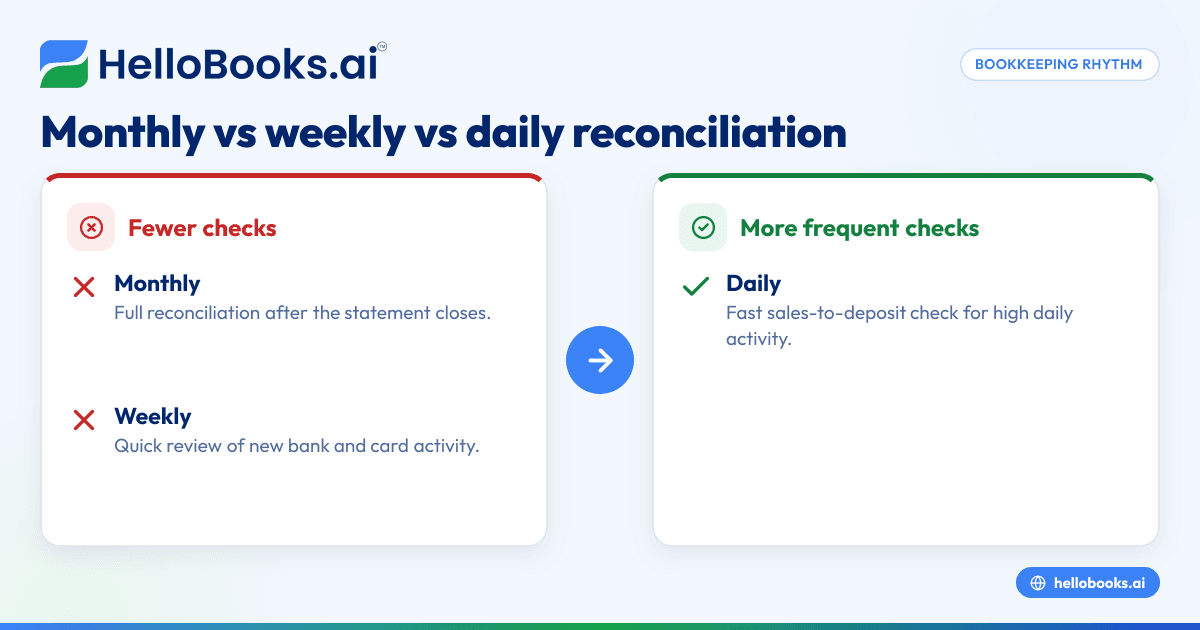
A monthly reconciliation lines up with your bank statement. The bank fixes an ending balance for a date, you match your books to it, done.
Who it suits:
- Freelancers and solo consultants with a few dozen transactions a month
- Service businesses that invoice monthly and get paid by ACH or check
- Landlords with a handful of rent deposits and repair bills
- Anyone just getting their books under control for the first time
What it catches: missed fees, interest, unrecorded deposits, duplicates, uncashed checks, and most data-entry errors.
What it misses: anything time-sensitive. If a fraudulent debit hits on the 2nd, monthly reconciliation might not surface it until the 5th of the following month. Banks generally expect prompt reporting of unauthorized transactions, so that lag matters.
Honest trade-off: monthly is the minimum, not the ideal, for a busy business. If your monthly reconciliation regularly takes more than two hours, that's a sign you need a lighter check in between.
Weekly: the sweet spot for growing businesses
A weekly review isn't a full formal reconciliation against a statement. It's a short session where you:
- Pull in the week's bank and card transactions.
- Categorize anything new.
- Match deposits to customer invoices.
- Flag anything you don't recognize.
Then the monthly reconciliation becomes a quick final check, because 90% of the work is already done.
Who it suits:
- Businesses with roughly 150 or more transactions a month
- Teams where more than one person spends on company cards
- Anyone running close to zero on cash and making payment decisions weekly
- E-commerce sellers with frequent processor payouts
Take Priya, who runs a small catering business in Austin. (She's an example, not a customer.) She has about 220 transactions a month across a checking account and two cards. Reconciling once a month took her nearly three hours, mostly spent figuring out what charges from five weeks ago were for. Switching to a 20-minute Friday review cut her month-end reconciliation to about 30 minutes. Same total effort, roughly, but far less detective work, and she catches odd charges within days.
Daily: when cash moves every day
Daily reconciliation sounds extreme, and for most businesses it is. But for some, it's just how the business runs.
Who it suits:
- Restaurants, food trucks and retail shops with daily card batches and cash drawers
- Businesses with high-volume payment processor deposits
- Anyone who has had fraud on an account and wants close monitoring
For these businesses, "daily" usually means a 5 to 10 minute check: did yesterday's card batch deposit the amount the POS said it would, after fees? Did the cash deposit match the drawer count? It's less a bank reconciliation and more a sales-to-deposit check. If you run a truck or a counter, our pages for food trucks and restaurants go into that daily flow.
Honest trade-off: daily checks only work if they're quick. If it takes 40 minutes a day, it won't survive a busy week, and a skipped habit is worse than a reliable monthly one.
Side-by-side comparison
| Monthly | Weekly | Daily | |
|---|---|---|---|
| Typical time per session | 30 min to 3 hours | 15 to 30 minutes | 5 to 10 minutes |
| Formal reconciliation to a statement? | Yes | No, a review | No, a deposit check |
| Best for | Low volume, simple businesses | Growing teams, multiple cards | Restaurants, retail, high card volume |
| Catches fraud within | Weeks | Days | A day |
| Risk if skipped once | Low | Low | Moderate |
| Still need monthly reconciliation? | It is the monthly | Yes | Yes |
Notice the last row. Weekly and daily routines don't replace the monthly reconciliation; they make it fast.
Different accounts, different rhythms
You don't need one schedule for everything. A sensible mix for a small business might look like this:
- Main operating checking: weekly review, monthly reconciliation
- Company credit cards: weekly review, reconcile each statement as it closes
- Savings or reserve account: monthly reconciliation (it barely moves)
- Payment processor clearing account: daily or weekly deposit check
- Loan accounts: monthly, against the lender's statement
Credit cards are worth calling out. Card statements often close mid-month, like the 18th or 25th, not on the last day. Reconcile cards to their own closing date, not to month-end.
Signs you need to reconcile more often
- You've been surprised by your balance more than once in the last quarter.
- Your monthly reconciliation keeps leaving unexplained differences.
- Several people have company cards.
- You found a fraudulent or duplicate charge only after the dispute window was tight.
- Your transaction count has grown, but your routine hasn't.
Signs you can relax a bit
- Fewer than 40 transactions a month.
- One account, one card, one person spending.
- Your last six monthly reconciliations closed cleanly on the first pass.
In that case, monthly is plenty. Keep it consistent and you're in good shape.
How HelloBooks helps
Frequent reviews are only realistic if transactions arrive on their own. HelloBooks lets you connect most US banks and credit cards, with CSV statement import as a fallback, so the weekly review is about checking rather than typing. On Starter ($14.99/month) and up, AI auto-categorization suggests accounts for new transactions, so a Friday review can be mostly approvals. If AI credits run out, categorization pauses but the books keep working. Bank-feed and CSV transactions land in a review list where you confirm or change categories, which is what a Friday review really is. Then at month-end, the reconcile screen suggests a match for each statement line, with a confidence score and the reason, so you're only working the exceptions. When the month is signed off you can lock it, and reopening it later is logged, which keeps last month's work from shifting under next month's. The Free plan includes 1 live bank feed and up to 200 transactions per year; if you're reviewing weekly because you're busy, you'll likely outgrow that, and Starter's 3 bank connections or Pro's unlimited connections may fit better. Compare them on the US pricing page.
FAQs
Is monthly reconciliation enough for a small business?
For a low-volume business with one account and one card, yes. If you have more than about 150 transactions a month or several people spending, add a weekly review.
What's the difference between a weekly review and a reconciliation?
A reconciliation ties your books to a bank statement's ending balance on a fixed date. A weekly review categorizes and matches new transactions so the monthly reconciliation is quick. Both are useful; they're not the same.
When should I reconcile a credit card?
After each statement closes, using the statement's closing date and balance, which often isn't the last day of the month.
Should I reconcile daily if I run a restaurant?
A daily check that card batches and cash deposits match your sales is a good habit for restaurants. You still do a full bank reconciliation monthly.
What if I've already fallen behind?
Start with the oldest unreconciled month and work forward. Once you're current, pick the rhythm from this post that you'll actually keep.
Pick the rhythm you'll stick with, put it on the calendar, and let the habit do the work.
Start free, no credit card. Try HelloBooks Free