Key takeaways
What this article covers, in order:
- Before you start
- Step 1: What are the bank reconciliation steps I need to perform?
- How does AI bank reconciliation work?
- Step 2: How does AI bank reconciliation software help?
- Step 3: What are the practical steps to implement AI-powered bank reconciliation for my business?
- Can AI bank reconciliation software help with GST compliance in Bengaluru?
This post is for small and growing businesses in Bengaluru looking to streamline their bank reconciliation process. By the end, you will know the main bank reconciliation steps and how AI-powered software can simplify them to save you time and reduce errors.
Before you start
- Gather your bank statements and accounting records (ledger, bills, receipts) for the period to be reconciled.
- Ensure you have access to your accounting system or software where your transactions are recorded.
- Familiarize yourself with the basics of bank reconciliation concepts — matching transactions in your books to those in your bank statements.
- Have a clear business process for recording expenses, invoices, and receipts so your books are up to date.
Step 1: What are the bank reconciliation steps I need to perform?
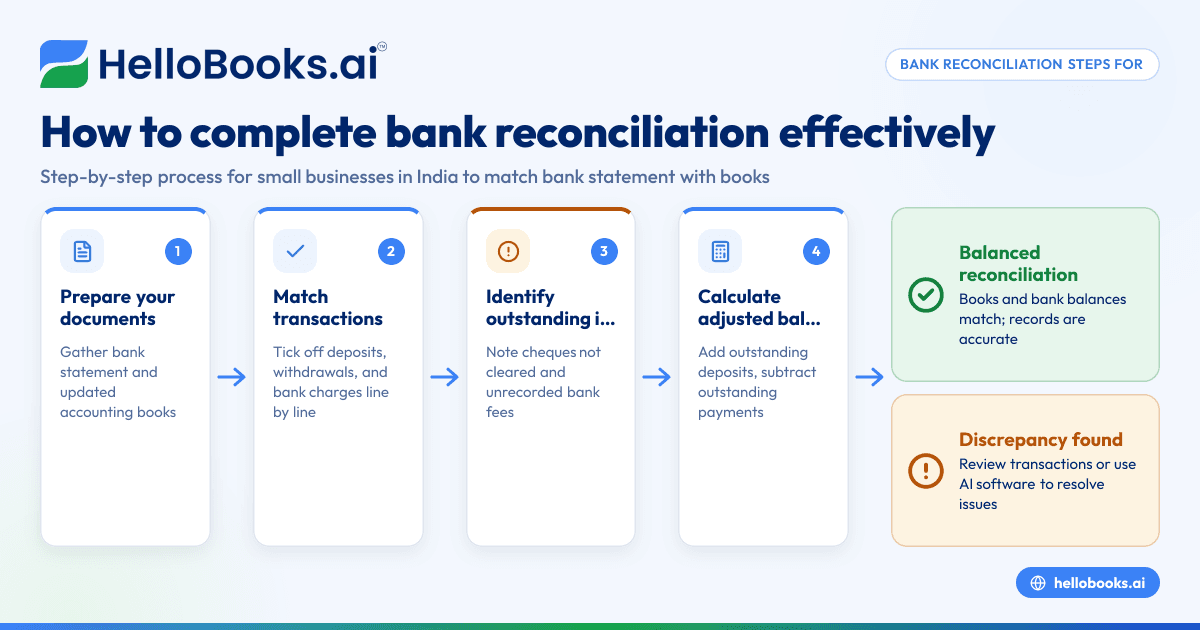
Bank reconciliation requires matching every transaction recorded in your accounting books with the corresponding transaction on your bank statement for a given period. The key steps are:
- Obtain bank statements for the period (usually monthly).
- List all transactions (debits and credits) recorded in your accounting software or books.
- Compare each transaction in your books with those in the bank statement.
- Identify transactions appearing in one record but not the other (unmatched items).
- Investigate reasons for mismatches such as delayed payments, bank charges, errors, or missing entries.
- Adjust your books for legitimate differences like bank fees or interest income.
- Reconcile the final balance to confirm your accounting records match your bank’s records after adjustments.
Mistake people make: Trying to do reconciliation manually with spreadsheets can mean spending hours on data entry and searches, increasing the chance of errors and outdated books.
How does AI bank reconciliation work?
AI bank reconciliation uses intelligent algorithms to automatically match transactions in your accounting records with your bank statement. It reduces manual effort by importing digital bank data, identifying discrepancies quickly, and learning your business patterns to improve accuracy over time.
This approach cuts down hours of repetitive work, allowing you to focus on resolving exceptions and maintaining clean books easily.
The software imports bank statements digitally and extracts transaction data, then reads your accounting entries to match them automatically. It flags mismatches with suggestions, enabling faster resolution while continuously syncing your records, which keeps your books up to date and compliant.
Step 2: How does AI bank reconciliation software help?
AI bank reconciliation software automates much of the matching and analysis process by using algorithms to:
- Import bank statements digitally and extract transaction data quickly.
- Read your accounting entries and match them automatically with bank transactions.
- Flag discrepancies and provide possible reasons or suggestions for quick resolution.
- Perform continuous reconciliation by syncing data in real-time, reducing month-end workload.
- Generate clear reconciliation reports and alerts on unmatched or suspicious transactions.
By automating repetitive tasks and reducing human error, AI software saves SMEs in Bengaluru several hours each month that can be better used for business growth activities.
Mistake people make: Assuming AI tools are only for big companies or too complex for small businesses stops many SMEs from benefiting from faster and more accurate reconciliation.
Step 3: What are the practical steps to implement AI-powered bank reconciliation for my business?
- Choose accounting software or a platform that supports AI bank reconciliation or integrates with tools offering this feature.
- Set up bank feeds or import statements automatically from your bank (many Indian banks support e-statements or API integrations).
- Map your chart of accounts and transactions so the AI can categorize and understand your bookkeeping structure.
- Train your team or yourself on using the AI tools for reviewing matches and resolving flagged issues.
- Run your first reconciliations and adjust settings or approve exceptions as the software learns your business patterns.
- Schedule periodic reconciliation reviews, ideally monthly, to keep your books accurate and compliant with GST reporting.
Mistake: Not investing time upfront in proper setup or ignoring reconciliation alerts can reduce the benefits of AI, leading to unresolved discrepancies and compliance issues.
Can AI bank reconciliation software help with GST compliance in Bengaluru?
Yes, bank reconciliation closely ties into GST compliance, especially for SMEs filing monthly GST returns. Correctly matched transactions ensure your purchase and sales records reflect actual cash flows, assisting in accurate Input Tax Credit (ITC) claims and tax payments.
Many AI bookkeeping solutions automatically tag GST codes and generate reports needed for returns filing. Reconciliation discrepancies can highlight unrecorded transactions or payment delays that impact your GST calculations.
Keeping your bank and books in sync supports easier GST audit readiness and quicker filing deadlines compliance, essential for Bengaluru’s fast-growing SME sector.
Mistake: Ignoring reconciliation delays or errors risks underreporting or overstating taxable figures, inviting notice from GST authorities.
Step 4: What does it cost and how do I choose the right software?
AI bank reconciliation software pricing varies based on features and business size. Typically, providers charge monthly subscriptions based on the number of transactions or users.
Look for software that offers:
- Seamless integration with your existing accounting system or acts as a strong alternative.
- Automated bank feeds compatible with major Indian banks.
- Customized workflows for your SME’s needs.
- Reliable data security compliant with India’s DPDP Act 2023.
- Responsive support and training resources.
Before committing, book a demo to see the user experience and test integrations with your bank and accounting data. Comparing plans on pricing pages helps identify options that fit within your budget and provide scalable features as your Bengaluru business grows.
Worked example: Bank reconciliation steps for a small Bengaluru restaurant owner
Radha runs a small restaurant in Koramangala, Bengaluru. Her accounting was manually done in spreadsheets. Each month she found her closing bank balance on her spreadsheet didn’t match the SBI bank statement, wasting hours reconciling manually.
She switched to AI bookkeeping software with automated bank reconciliation. For April 2024, here is what happened:
- Bank statement showed ₹2,50,000 closing balance.
- Books showed ₹2,70,000, a ₹20,000 difference.
- AI matched 95% of transactions automatically, identified ₹10,000 in delayed customer payments, ₹5,000 wrongly recorded as ₹50,000 by manual error in books, and ₹5,000 in bank charges missing from books.
- Radha corrected her books by adjusting the error and added bank charges expense.
- Final books balance post-adjustment matched ₹2,50,000 in the statement.
- Time spent dropped from 7 hours manually to 40 minutes reviewing AI exceptions.
- GST reports generated automatically, confirming Input Tax Credit claims matched actual payments.
Radha now completes bank reconciliation faster monthly, with less stress and confident financial accuracy.
What should I do next?
Bank reconciliation is essential for accurate bookkeeping in Bengaluru’s busy SME environment. Using an AI bank reconciliation tool not only accelerates this process but also reduces errors and supports compliance needs like GST.
Begin by selecting a reputable tool, setting up your bank feeds, and running your first automated reconciliations. Over time, you’ll see considerable time savings and improved financial control.
For a hands-on look at how AI bookkeeping can ease your bank reconciliation steps, you can book a demo or compare plans today. Make your accounting work smarter, not harder.
Related reading
- bank reconciliation software
- How AI Bookkeeping Software Can Simplify Bank Reconciliation for Small Businesses in the United States
- How Delaware Small-Business Owners Can Choose AI Accounting Software to Simplify Sales Tax and Bank Reconciliation
Read next
This article covers one part of a bigger topic. For the complete picture, read our guide to supported with caveat.