
Key takeaways
What this article covers, in order:
- What petty cash automation actually means in India
- Why manual petty cash causes bigger GST and bookkeeping problems
- The records a small business should keep for petty cash
- How AI software reduces petty cash work without losing control
- Petty cash, GST, and when not to force input credit
- An illustrative and invented scenario shows the workflow better than theory
India small businesses can automate petty cash recording by moving it out of notebooks and Excel into bookkeeping software that captures receipts, classifies expenses, updates the cash ledger, and helps reconcile what was spent against vouchers and uploaded bank statements. For Indian firms, the real benefit is not just speed: it is cleaner GST records, fewer missing bills, better control over rupee-level spending, and books that are easier to match with the GST portal, TDS entries, and month-end reports.
What petty cash automation actually means in India
Petty cash is usually where bookkeeping starts to break down. A tea run, courier charge, auto fare, loading labour, emergency stationery, a small repair, or a same-day local purchase gets paid in cash or reimbursed fast. The amount may be small in ₹ terms, but the volume adds up across a month.
In India, that matters because these small transactions often touch compliance and reporting even when the payment itself feels informal. A purchase bill may carry GST. A vendor may or may not give a proper tax invoice. An expense might belong to one branch GSTIN and not another. A reimbursement may need a supporting bill for internal control even if it does not create input tax credit. If those details live in a pouch of paper slips or a WhatsApp trail, month-end bookkeeping becomes guesswork.
Automating petty cash means the business records each small spend in a system as it happens or soon after, with the bill attached where available. Software can use OCR to read supplier bills from a photo or PDF, suggest the expense category, and post it to the books without repeated manual entry. That is especially useful when the same person handling sales, inventory and collections is also trying to maintain accounts.
Why manual petty cash causes bigger GST and bookkeeping problems
The obvious issue with a paper petty cash register is delay. The less obvious issue is distortion.
When entries are written late, the description becomes vague: “office expense,” “local purchase,” “misc.” That creates trouble later when the business tries to review spending, prepare financial reports, or support claims based on purchase documents. Under the Central Goods and Services Tax Act, 2017 and related rules administered by the Central Board of Indirect Taxes and Customs (CBIC) through the GST Network and the GST portal, the eligibility and documentation for GST treatment depend on the nature of the document and transaction. Current requirements are published on the CBIC and GST portal websites.
A second problem is duplication. One employee pays cash, another records the reimbursement, and a third uploads the supplier bill again during month-end. Without one ledger and one source document, duplicate booking becomes common.
A third problem is leakage. Petty cash rarely fails because of one large fraud; it fails because many rupee-sized entries cannot be traced back to a bill, approver or purpose. In a business doing even a few lakh of annual spend across branches, small unsupported expenses can materially affect the profit and loss account.
Finally, manual petty cash makes reconciliation harder. If cash purchases are entered in one sheet, vendor bills in another, and bank reimbursements are seen only after a NEFT or IMPS transfer hits the bank statement, the accountant has to stitch the story together afterwards.
The records a small business should keep for petty cash
The right setup is simpler than many owners think. For most small businesses in India, each petty cash entry should capture:
- date of spend
- person who spent or requested reimbursement
- supplier name, if known
- amount in INR or rupees
- payment mode, such as cash, UPI, or reimbursement through bank transfer
- expense category
- attached bill, photo or note
- GST details only when supported by a valid document and relevant to the business
- branch or GSTIN, if the company operates in more than one state
This matters because the books are not just for management. They also support reporting under the Income-tax Act, 1961, company record-keeping where relevant under the Companies Act, 2013 overseen by the Ministry of Corporate Affairs (MCA), and GST compliance under the CGST Act and state GST laws. Current legal requirements and filing instructions are published by the Income Tax Department, MCA, CBIC and GSTN on their official portals.
Software helps by making these fields part of the normal workflow instead of an afterthought. A team member can photograph the bill on a phone, and the system can read the vendor name, amount and date. If the bill is incomplete or unclear, the reviewer sees that immediately instead of three weeks later.
How AI software reduces petty cash work without losing control
The useful part of AI in bookkeeping is not magic classification. It is removing repetitive typing while preserving an audit trail.
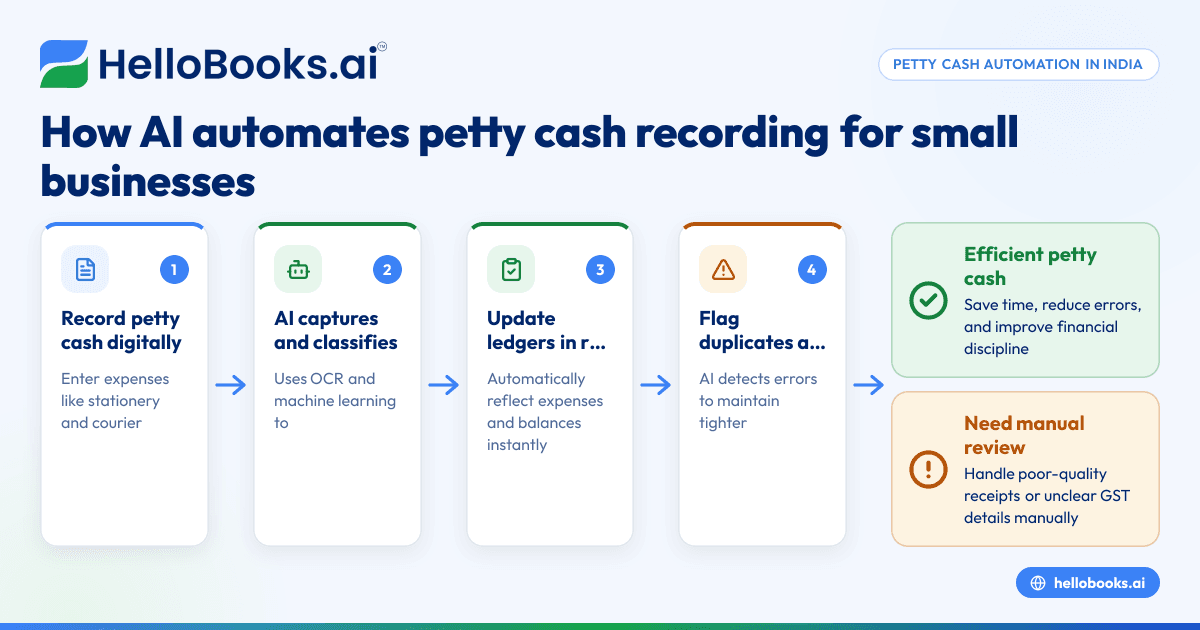
For petty cash, that usually means four things.
First, receipt capture. OCR can pull data from a kirana-style printed bill, courier receipt, parking slip, or PDF invoice and create a draft expense entry. Some entries will still need review, especially handwritten bills, but the team no longer starts from a blank screen.
Second, category suggestions. If the software has seen the same vendor or description before, it can suggest whether the expense belongs under courier, office supplies, repairs, travel, loading charges, or another ledger. The accountant accepts or edits the draft instead of keying every field.
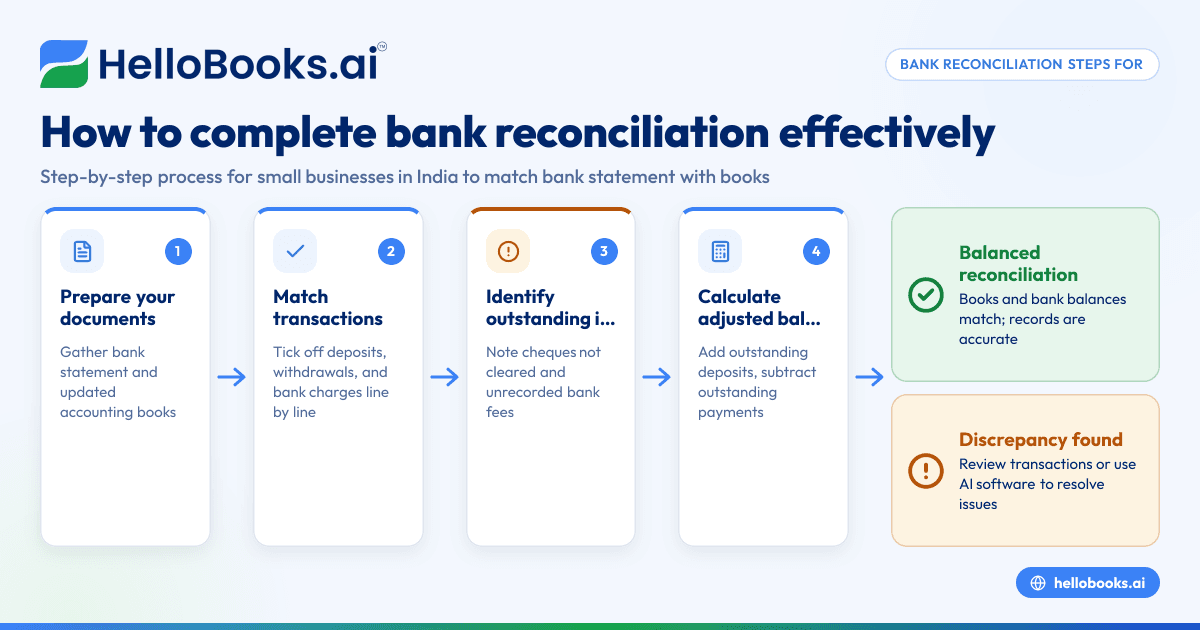
Third, matching and reconciliation. Where petty cash is replenished from the bank, the business can upload a bank statement and let the software help match reimbursements and withdrawals to ledger entries. This is practical in India because many businesses mix cash, UPI, RTGS, NEFT and reimbursement transfers across the same month. A statement upload is often enough to identify what was settled and what remains pending.
Fourth, reporting. Once petty cash lives in the same books as sales, purchases and inventory, it stops being “miscellaneous” and starts appearing properly in monthly reports, expense trends and branch-wise analysis.
That is where HelloBooks is relevant: a small business can use OCR for purchase bills to capture petty expenses, upload bank statements for AI-assisted reconciliation in India, and keep the resulting entries inside the same accounting records that drive GST invoicing, GSTR-1 and GSTR-3B filing, inventory and financial reports. If the company has more than one GSTIN, the same login can separate transactions by registration instead of mixing state-level books.
Petty cash, GST, and when not to force input credit
A common Indian bookkeeping mistake is trying to squeeze GST input tax credit out of every small expense. That is risky.
Whether GST is charged, whether a document qualifies as a tax invoice, whether reverse charge applies in a specific case, and whether input tax credit is available are legal questions under the CGST Act, 2017, the Integrated Goods and Services Tax Act, 2017 where relevant, and associated rules under CBIC administration. The current rules, notifications and advisories are published on cbic.gov.in and the GST portal. Any live eligibility decision should be checked there or with a qualified professional.
In practice, petty cash software should help you separate three buckets:
- expenses with a proper tax invoice and usable GST details
- business expenses with support, but no valid GST claim basis
- unsupported or exceptional spends that need management review
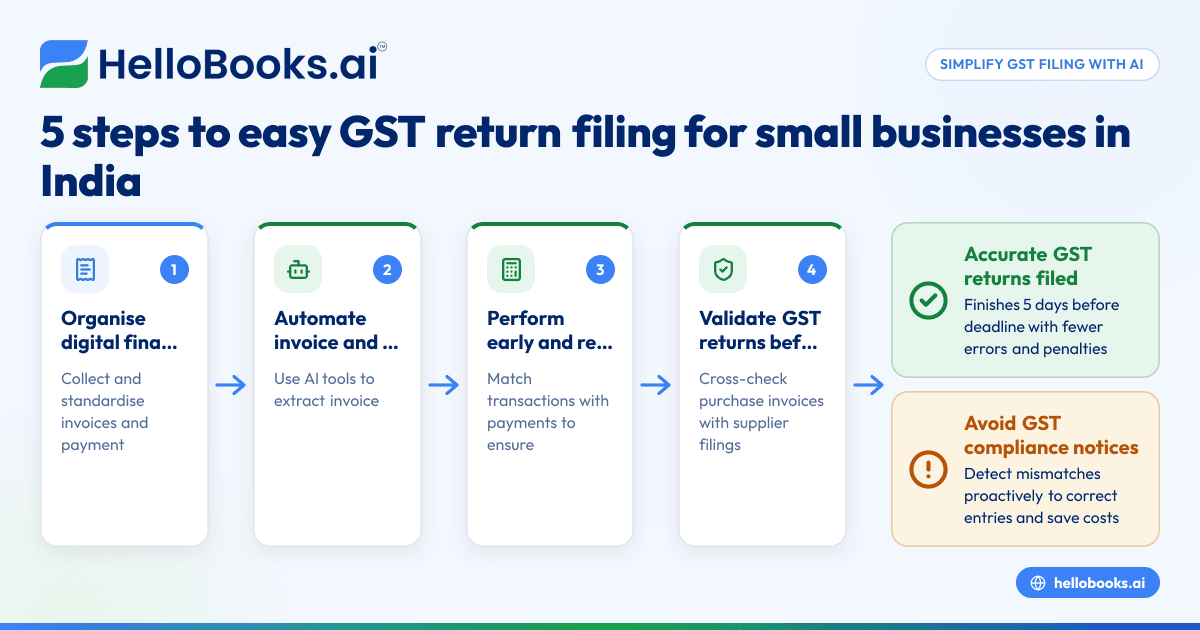
This is more valuable than automatic tax optimism. A system that tracks bills against entries and helps compare purchase records with GSTR-2A/2B later is usually better than one that blindly posts every slip as eligible ITC.
If your team raises internal invoices, the same discipline helps on the outward side too. A business that uses smart invoicing and GST return filing software is less likely to end up with sales and expenses living in different tools and telling different stories.
An illustrative and invented scenario shows the workflow better than theory
Suppose, purely as an illustrative and invented case, a Jaipur distributor gives its office admin a petty cash float of ₹12,000 for local running costs. During one week, the admin pays ₹640 for stationery, ₹185 for courier, ₹420 for packaging material, and ₹310 for a local electrician. One sales employee also spends ₹260 on auto fare and asks for reimbursement. These figures are invented for explanation and leave out legal questions such as whether each bill supports GST credit, whether any expense is capital or revenue in nature, and whether any special disallowance applies under tax law.
In a manual process, the business may only learn at month-end that one bill is missing, one entry was posted twice, and the reimbursement was booked under travel while the cash spend sat under miscellaneous expense.
In an automated process, each bill is photographed on the same day. The software reads the amount and supplier details where possible, suggests categories, and creates draft entries. The accountant reviews the electrician bill because the wording is unclear, marks the auto fare as employee reimbursement, and posts the rest. Later, when the owner transfers money from the company bank account to replenish the petty cash box, the bank statement is uploaded and matched against the replenishment entry. The result is not perfect automation; it is faster review with cleaner evidence.
If that distributor also tracks stock, using inventory in the same system matters because small packaging or local purchase entries can affect item cost or indirect expenses instead of disappearing into a generic ledger.
Internal controls matter more than the software brand
No tool can fix weak petty cash discipline on its own. Indian small businesses get the best result when they pair automation with a few basic rules:
- one custodian for each petty cash box or branch float
- one approval path for reimbursements
- same-day or next-day bill capture
- a rule for how to record UPI-versus-cash spends
- periodic cash counts
- review of expenses without bills
- branch and GSTIN tagging where relevant
This is also where privacy and employee handling should be considered. If expense bills contain personal information, the business should handle records carefully under applicable Indian data protection requirements, including the Digital Personal Data Protection Act, 2023 where relevant. Current obligations and notifications should be checked from official government publications. Software helps with centralisation, but your process decides who can upload, approve, edit or delete entries.
HelloBooks is useful here not because it promises to remove all review, but because unlimited users can participate without forcing the business to pass around one accountant login, and the mobile app can capture expenses close to the time they happen instead of after the paper fades.
Choosing software for petty cash in India
If petty cash is your starting problem, choose software that fits Indian bookkeeping rather than generic expense tracking.
Look for these practical outcomes in the workflow:
- bills can be captured from phone photos and PDFs
- GST treatment can be reviewed in the same books as purchases and sales
- reimbursements can be matched after a bank statement upload
- reports show petty cash by branch, person, category, and month
- multiple GSTINs can be kept separate
- you can migrate from Tally or keep continuity during transition
That last point matters. Many Indian businesses already have years of accounting history in Tally. If petty cash automation requires a painful clean break, adoption slows down. A smoother path is to move gradually, with a Tally alternative or comparison workflow that lets operations improve before every legacy process is redesigned.
If you want to validate GST details around vendor bills before posting them, HelloBooks also offers India-specific checks such as the GSTIN validator and GST reconciliation checker. These tools are useful when a petty cash purchase unexpectedly turns into a compliance question.
When automation is worth it for a small business
Petty cash automation becomes worthwhile well before a business feels “large.” You do not need crore-level turnover to benefit. If any of the following are true, the time savings and control improvements usually justify the move:
- more than one person incurs routine expenses
- reimbursements happen every week
- receipts arrive over WhatsApp, paper and email
- the owner reviews spending only at month-end
- GST purchases are getting mixed with non-GST spend
- one business operates from multiple locations or GST registrations
At that point, petty cash is no longer a side register; it is part of the accounting system. Bringing it into one place supports cleaner books, more reliable rupee-level reporting, and easier follow-through into GST returns and management review.
For businesses evaluating options, the most relevant HelloBooks pages are accounting software India, AI bookkeeping, and the India pricing page at pricing. If you want to see the workflow on your own bills and petty cash process, book a demo.
The practical bottom line
Petty cash automation in India is useful because it turns scattered low-value spend into auditable bookkeeping. The software should help your team capture bills, classify expenses, separate GST and non-GST treatment carefully, reconcile reimbursements after bank statement upload, and keep branch-wise records straight. That reduces manual re-entry, but more importantly, it gives the business a clearer trail from a ₹120 courier slip to the monthly P&L, the GST portal view, and the cash balance you can actually verify.