
Key takeaways
What this article covers, in order:
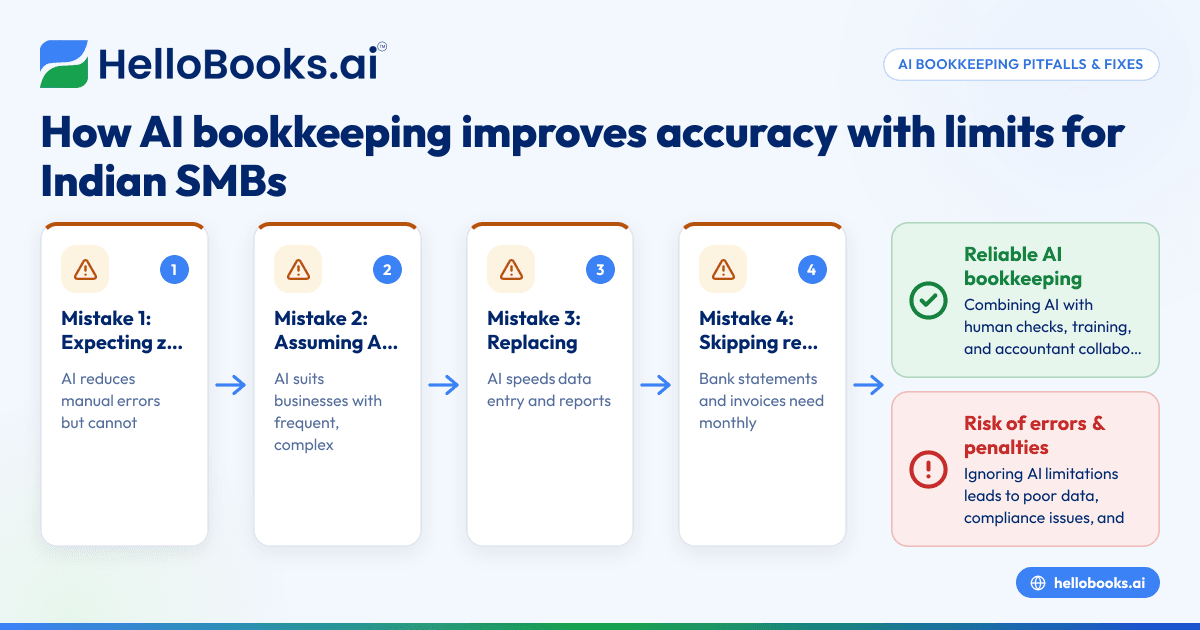
- Mistake 1: Thinking AI bookkeeping means zero data errors
- Mistake 2: Is AI bookkeeping really suitable for all small businesses?
- How does AI bookkeeping improve GST compliance?
- Mistake 3: Expecting AI bookkeeping to fully replace accountants
- What are the limits of automated AI bookkeeping regarding data privacy?
- Mistake 4: Overlooking the need for regular data reconciliation
How AI Bookkeeping Ensures Data Accuracy with Limitations for Small Businesses in India
=========================================================================================
Getting bookkeeping wrong can cost small businesses in India dearly — incorrect GST filings, missed invoices, or tax errors can lead to penalties, delayed payments, and strained supplier relations. Manual entry errors, reconciliation mismatches, and compliance slips consume time and resources best spent growing the business. AI bookkeeping for small business offers a practical way to improve accuracy, but it is important to understand what it can and cannot do.
Mistake 1: Thinking AI bookkeeping means zero data errors
Many business owners believe that adopting an AI-powered bookkeeping system automatically eliminates data entry mistakes. This expectation arises because AI tools often boast about automated processes and error reduction. While AI software can detect and correct common problems such as duplicate invoices or mismatched payments, it cannot fix poor-quality input data or inconsistencies that originate outside the system.
AI bookkeeping mostly reduces manual typing errors and automates data classification using machine learning models trained on Indian financial documents. However, if original bills, receipts, or bank statements are unclear or incorrect, the AI will process flawed data. The fix is to use AI as an assistant to speed up workflows but retain human checks. For example, a finance lead should review flagged transactions before filing GST returns.
Mistake 2: Is AI bookkeeping really suitable for all small businesses?
AI bookkeeping solutions are not one-size-fits-all. Small businesses differ widely—from Mumbai-based retailers managing thousands of sales invoices monthly to Pune freelancers with simple expense tracking needs. AI automation works best when the volumes and variety of transactions justify the upfront setup and customization effort.
For micro-businesses or sole proprietors using spreadsheets only occasionally, AI tools might feel overwhelming or unnecessary. In contrast, SMBs with Tally or QuickBooks users familiar with digitization can benefit from enhanced bank reconciliation software and automated GST filing through AI-powered workflows. The fix is to evaluate how complicated your bookkeeping is, and the time spent on manual reconciliation—then decide if an AI tool will help or add complexity.
How does AI bookkeeping improve GST compliance?
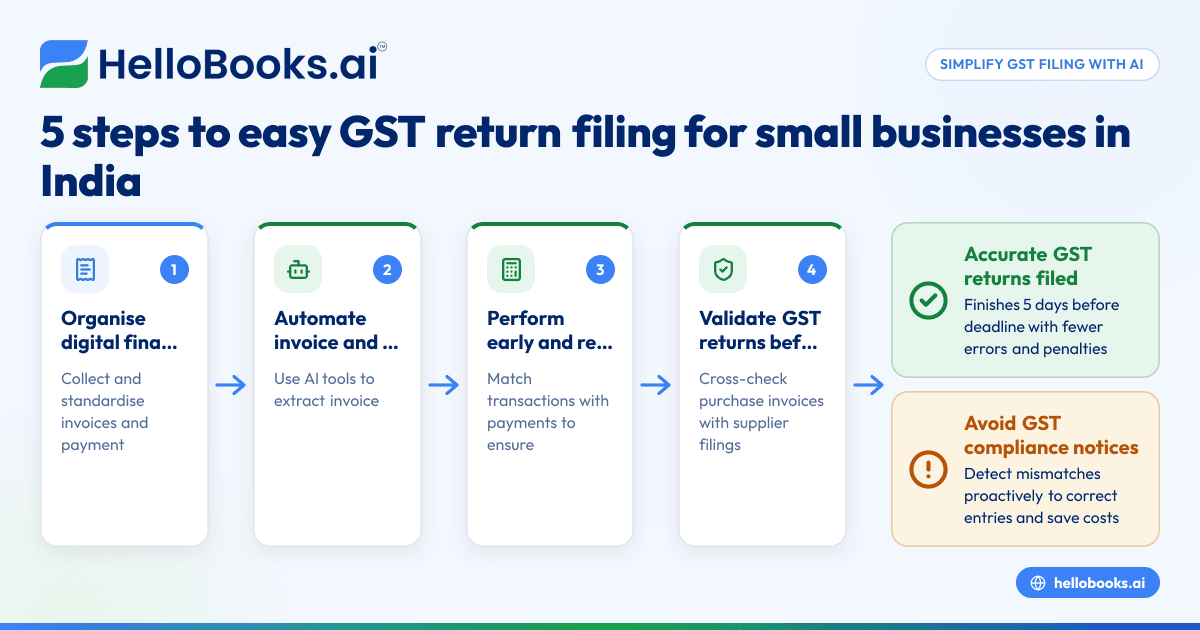
AI bookkeeping software improves GST compliance by auto-matching invoices against purchase and sales ledgers, detecting anomalies like missing GSTINs or wrong tax rates. It helps prepare error-free GST returns ready for filing through GST return filing software that integrates seamlessly.
The system continually learns from Indian GST rules updated by government notifications, reducing human confusion over due dates or e-way bill requirements. This AI-powered oversight cuts the risk of late submissions and penalties. Still, final returns must be carefully reviewed by knowledgeable staff or your chartered accountant, as AI cannot interpret ambiguous transactions needing professional judgment.
Mistake 3: Expecting AI bookkeeping to fully replace accountants
Some business owners hope that automated bookkeeping with AI will eliminate the need for accountants. Although AI software can speed up data entry, bank reconciliations, and generate financial reports, it cannot replace the insights, tax planning, or compliance advice accountants provide.
AI tools work best as extensions of your finance team, enabling accountants to focus on higher-value tasks rather than routine data processing. The fix is to adopt an AI bookkeeping system that integrates with your accountant’s workflow rather than cut them out, ensuring smooth collaboration and accuracy.
What are the limits of automated AI bookkeeping regarding data privacy?
Automated AI tools store sensitive financial and personal data—customer details, PAN, Aadhaar numbers, bank info—which fall under the new Data Protection laws in India such as the DPDP Act, 2023. While AI software vendors implement encryption and secure access protocols, compliance with these regulations remains the responsibility of your business.
The AI automation helps maintain audit trails and controlled data access but cannot handle legal consent management or resolve disputes. Your business should implement proper policies and data handling procedures alongside technical safeguards in the AI tool for secure bookkeeping.
Mistake 4: Overlooking the need for regular data reconciliation
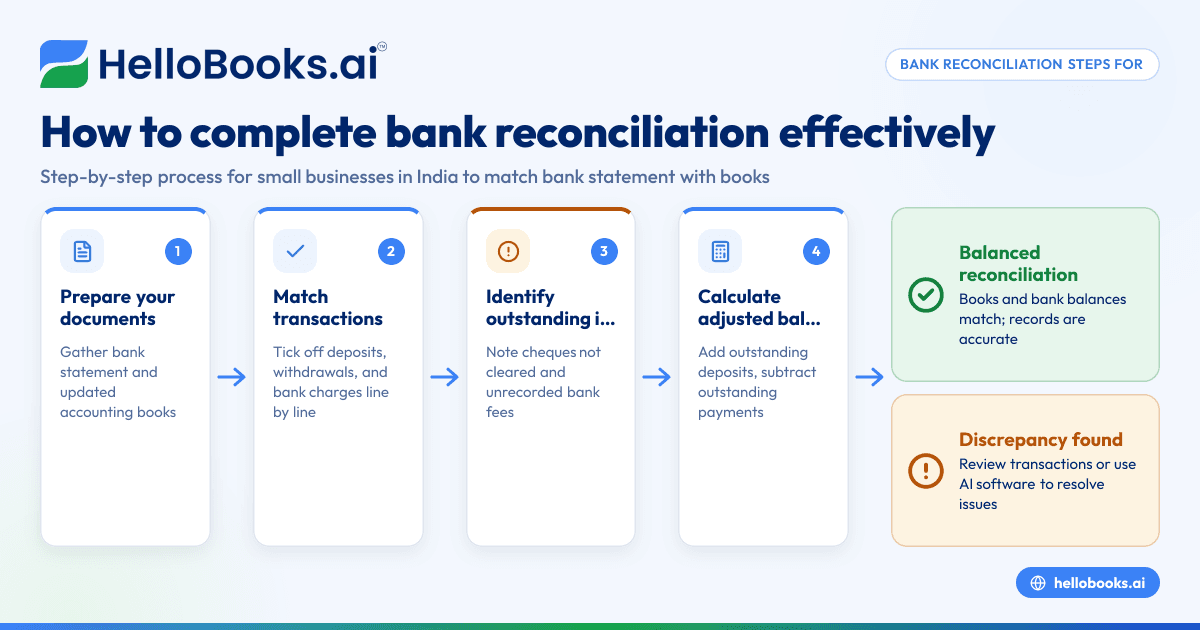
AI bookkeeping solutions often offer bank reconciliation software that syncs with your bank and payment gateways like Razorpay or UPI. However, users sometimes assume these tools work fully hands-free. In reality, bank statements may not match invoices 100% due to timing differences or manual payment entries outside automated channels.
If you do not regularly reconcile mismatches or exceptions flagged by AI, errors compound and lead to inaccurate financials. The fix is a simple monthly routine of reviewing AI-suggested reconciliations and investigating unmatched transactions, ensuring ledger reliability.
Mistake 5: Relying solely on AI without training your accounting team
Businesses implement AI software but neglect proper onboarding and training for their staff. Without understanding how the AI tool analyses data and flags issues, teams ignore alerts or override suggestions blindly.
This defeats the purpose of using automated with AI software. The fix is to invest time in staff training—explaining AI workflows, error types, and review procedures. Empowered teams better leverage AI features, handle exceptions, and maintain high data integrity.
A simple routine to avoid them
- Weekly check: Review flagged errors or duplicate invoices detected by your AI bookkeeping tool.
- Monthly reconciliation: Use your bank reconciliation software to match every bank and digital payment entry with invoices and expenses.
- GST return prep: Cross-verify GSTINs, tax rates, and turnover data on AI-generated reports ahead of filing.
- Team training: Schedule a monthly discussion with accounts staff to explain new AI features and resolve common misunderstandings.
- Data quality audit: Randomly sample bills and receipts for clarity and completeness to prevent garbage-in, garbage-out errors.
- Privacy review: Ensure your data handling policies comply with Indian laws alongside vendor security measures.
- Accountant coordination: Share AI-prepared reports regularly with your accountant to review complex or ambiguous cases.
Using the above routine keeps AI-powered bookkeeping reliable and accurate for your small business finances.
AI bookkeeping for small business is already transforming how Indian SMEs cut down manual errors and manage compliance. However, the best results come when you combine automated with AI tools and human expertise. By recognising AI’s limits and applying practical fixes, you can ensure trustworthy books and focus on scaling your business.
To see how AI bookkeeping can work for your operation and gain full clarity on pricing, you can book a demo or compare plans at HelloBooks.ai today.
Related reading
- AI bookkeeping
- How Small Businesses Can Use AI Bookkeeping Tools Without Losing Control, Supported with Caveats
- How HelloBooks AI Simplifies Bookkeeping for Small Businesses in India
Read next
This article covers one part of a bigger topic. For the complete picture, read our guide to supported with caveat.