
Key takeaways
What this article covers, in order:
- Key takeaways
- What is AI sales tax and how does it work?
- How can AI bookkeeping help small businesses handle state and local sales tax?
- How does AI bookkeeping stay current with changing sales tax laws?
- Can AI bookkeeping handle sales tax for online and multi-state sales?
- How does AI bookkeeping improve the accuracy of sales tax reports?
AI bookkeeping automates the tracking and calculation of state and local sales tax for small businesses in the United States. It ensures accurate tax collection and reporting by integrating sales data, keeping up with changing tax laws, and simplifying compliance workflows with minimal manual effort.
Key takeaways
- Sales tax compliance varies widely across U.S. states and localities, requiring multiple rate tracking.
- AI bookkeeping software automates correct sales tax calculations based on location and product taxability.
- AI sales tax tools update tax rates and rules automatically to maintain compliance.
- Using AI reduces errors and saves time in sales tax reporting and filing.
- Multi-state and online sales tax obligations are managed more easily with AI bookkeeping.
- Integration with existing finance systems helps streamline sales tax workflows.
What is AI sales tax and how does it work?
AI sales tax uses artificial intelligence within bookkeeping software to automatically identify and apply the correct sales tax rate based on transaction details like location and product type. This automation updates tax rules dynamically and flags exceptions to ensure accurate tax collection.
AI-equipped bookkeeping connects to sales data sources such as POS or e-commerce platforms. It applies the right rates for each sale without manual lookups. This helps businesses stay compliant and prepare precise returns easily.
Further details: The AI engine maintains a current database of state and local tax rates and product classifications. It recognizes applicable rules by analyzing address data and purchase information. For small businesses in cities like Chicago or Houston, AI sales tax software handles the complexity of overlapping tax jurisdictions and exemptions.
How can AI bookkeeping help small businesses handle state and local sales tax?
Short answer: AI bookkeeping automates sales tax tracking, calculation, and reporting, saving time and reducing errors.
Handling sales tax manually can lead to mistakes like charging incorrect rates or missing deadlines. AI bookkeeping software helps you:
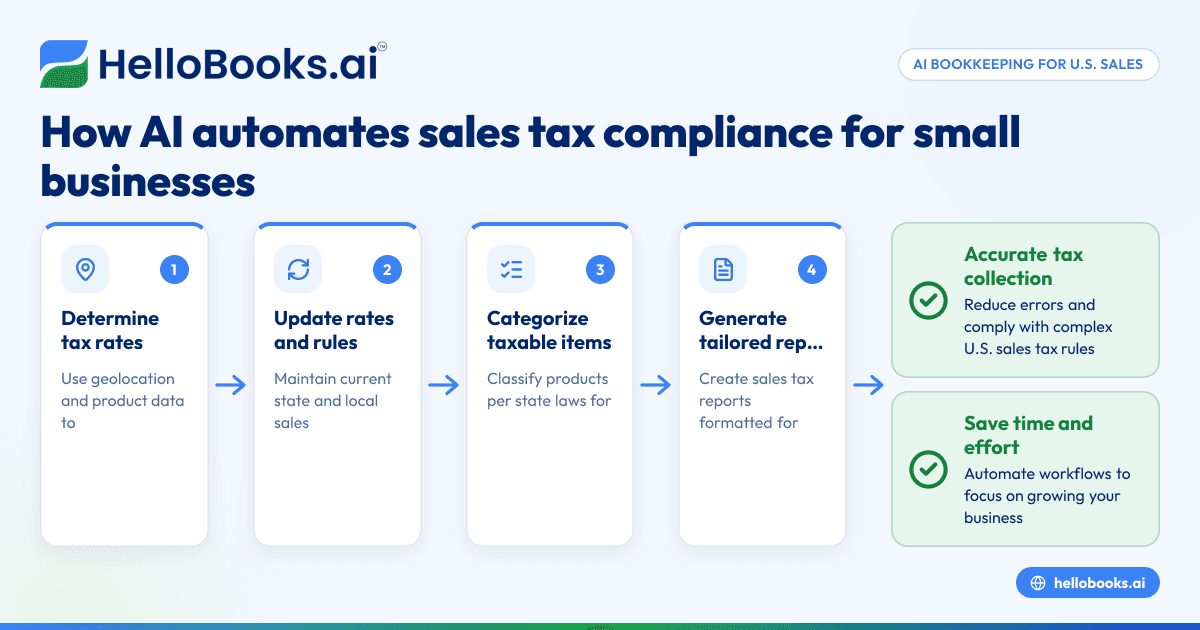
- Automatically determine applicable sales tax rates per transaction by using geolocation and product data.
- Maintain up-to-date tax rate databases that reflect current rates and exemptions.
- Categorize taxable versus non-taxable items according to state laws.
- Generate detailed sales tax reports tailored for each state’s filing requirements.
- Set reminders for filing deadlines to avoid penalties.
- Integrate tax data automatically with accounting processes to avoid duplication.
By automating these steps, your business reduces compliance risks while freeing up time for growth activities.
How does AI bookkeeping stay current with changing sales tax laws?
AI bookkeeping software relies on cloud-based updates and expert-maintained tax rule databases to stay aligned with the latest state and local sales tax changes. This eliminates manual rate tracking.
When a jurisdiction updates rates or exemptions, the AI system applies the changes in real-time across your transactions. For example, if Houston adjusts its local sales tax rate, the software updates your tax calculations automatically, ensuring accurate filings.
Can AI bookkeeping handle sales tax for online and multi-state sales?
Yes, AI bookkeeping manages complex sales tax needs for online platforms and multiple states by automating jurisdiction determination and filing support.
Online sellers must comply with economic nexus rules, which require tax collection after certain sales thresholds. AI bookkeeping tracks these limits and applies appropriate tax collection across states.
Integration with e-commerce platforms and payment processors captures sales data accurately. AI calculates tax by buyer location and product taxability, simplifying compliance for nationwide online sellers from cities like Austin or Phoenix.
Many tools also prepare and file sales tax returns electronically, reducing manual submission effort.
How does AI bookkeeping improve the accuracy of sales tax reports?
AI bookkeeping minimizes human mistakes such as data entry errors and incorrect tax code application. The AI engine cross-checks data and flags anomalies.
Generated sales tax reports break down liabilities by jurisdiction and product type, formatted for state filing. Early error detection reduces audit risk and costly penalties.
For example, a small retail business in Seattle can generate Washington state tax reports automatically reconciled with bank and POS data, saving manual reconciliation time.
What are the practical steps for a small business to adopt AI bookkeeping for sales tax?
Start by evaluating your current bookkeeping and tax processes to spot pain points. Then:
- Choose AI bookkeeping software tailored for U.S. small businesses with tax automation.
- Integrate the software with your sales channels, payment processors, and bank accounts for seamless data flow.
- Map your products and services to proper sales tax categories within the system.
- Allow the AI to analyze recent transactions to calculate taxes accurately.
- Use dashboards and reports to monitor liabilities and prepare filings.
- Set reminders for sales tax return deadlines across all relevant states and localities.
- Stay current on software updates reflecting tax law changes.
Following these steps ensures compliance and reduces bookkeeping effort.
Why should small businesses consider AI bookkeeping over traditional accounting tools for sales tax compliance?
Manual sales tax calculations and spreadsheet upkeep are time-consuming and error-prone. AI bookkeeping automates rate application, rule updates, and reporting, lowering risk of mistakes.
Integrated automation with invoicing, bank reconciliation, and expense management saves time and cost. It also offers insights into sales tax trends that can inform business decisions.
Overall, AI bookkeeping helps small businesses maintain effortless compliance and avoid penalties.
How secure is AI bookkeeping when dealing with sensitive sales tax data?
Trusted AI bookkeeping software for U.S. businesses employs strong encryption, secure cloud storage, and user controls to protect sales tax information.
Selecting vendors with regular security audits minimizes data breach risks. For businesses needing SOC 2 standards, choose providers meeting recognized security requirements to safeguard your financial data.
Secure handling builds trust and satisfies privacy expectations during your sales tax management.
Using AI bookkeeping powered by hellobooks.ai can simplify your sales tax compliance and bookkeeping tasks. To explore how our software can fit your small business needs, book a demo or compare plans today.
Frequently asked questions
What is the difference between state and local sales tax?
State sales tax is levied by the state government and applies statewide. Local sales tax is an additional tax imposed by cities, counties, or districts. Both combine to form the final sales tax rate applicable in each location.
Can AI bookkeeping handle exemption certificates for tax-exempt sales?
Yes, many AI bookkeeping tools let you upload and track exemption certificates. The software applies exemptions correctly when certificates are valid, helping avoid incorrect tax charges.
How often do I need to file sales tax returns in the U.S.?
Filing frequency varies by state and sales volume, commonly monthly, quarterly, or annually. AI bookkeeping software can track deadlines and generate returns according to each taxing authority’s rules.
What if my business sells both taxable and non-taxable products?
AI bookkeeping classifies products per tax laws and applies sales tax only where required. This ensures proper tax charges without over- or under-collecting.
Does AI bookkeeping replace the need for a CPA or accountant?
No, AI bookkeeping automates calculations and reporting but does not substitute professional tax advice. Many businesses use AI tools alongside accountants for review and planning.
How does AI bookkeeping handle changes in sales tax law?
Software providers maintain updated databases of tax rates and rules. Changes issued by states or localities are incorporated promptly, keeping your calculations accurate with no manual updates needed.
Read next
This article covers one part of a bigger topic. For the complete picture, read our guide to sales tax.