
Key takeaways
What this article covers, in order:
- Where AI bookkeeping saves the most time in India
- Accuracy problems Indian businesses actually run into
- GST accuracy improves when bookkeeping starts at the invoice
- Bank reconciliation is where AI feels most practical
- Purchase bills, ITC tracking and month-end confidence
- Inventory, reports and the end of parallel spreadsheets
India’s small businesses can use AI bookkeeping to reduce manual entry, catch bookkeeping mismatches earlier, and keep GST records closer to return-ready through the month. In practice, that means faster bank reconciliation after UPI, NEFT, RTGS or IMPS receipts, cleaner purchase capture from bills, and fewer invoice mistakes around GSTIN, place of supply, CGST, SGST or IGST. The exact compliance rules, thresholds and deadlines depend on the tax, the law and the regulator—typically the Central Goods and Services Tax Act, 2017 and related rules administered by CBIC through GSTN and the GST portal, with current figures published on official portals.
Where AI bookkeeping saves the most time in India
For many Indian businesses, the real bookkeeping burden is not “accounting” in the abstract. It is repeated admin around sales invoices, purchase bills, bank statements, GST working papers, stock updates, and month-end chasing.
A retailer, trader, agency or small manufacturer may receive money over UPI, collect part-payments by bank transfer, dispatch goods with an e-way bill, record vendor invoices from PDFs, and still rely on a spreadsheet or Tally export to tie it all together. That is where delays start. The same sale gets typed more than once. The same purchase bill sits in a drawer until GSTR-2B is checked. The same receipt is manually matched against an invoice line by line.
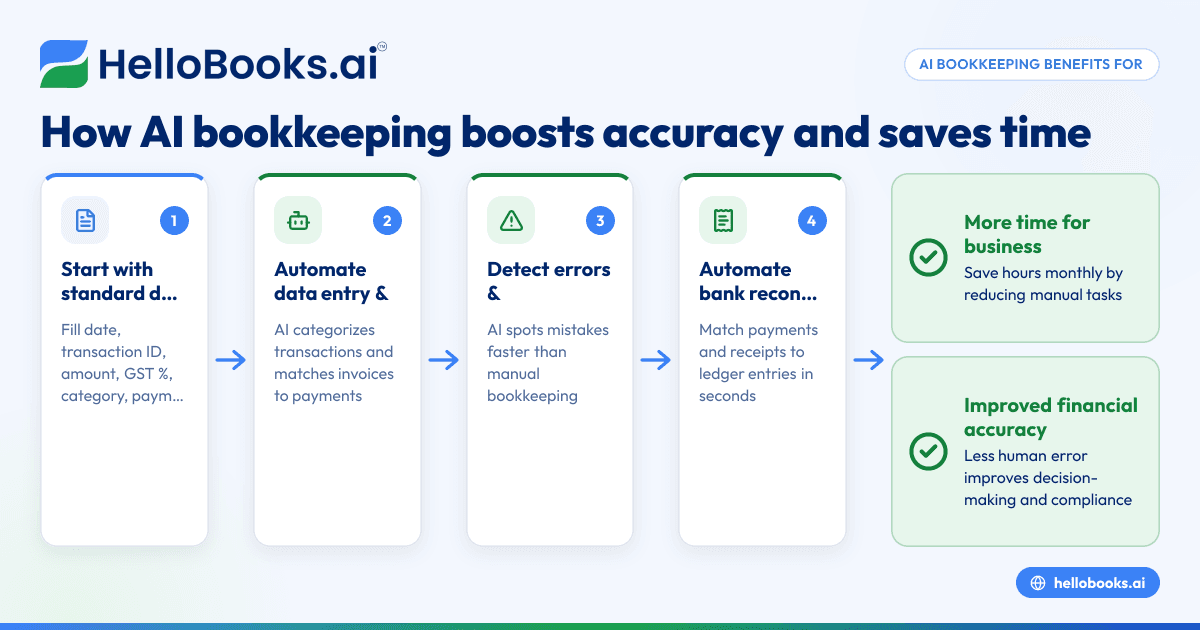
AI bookkeeping helps most when it removes re-entry. If a system reads purchase bills using OCR, creates GST invoices with the right tax-head split, lets you upload a bank statement for AI-assisted reconciliation, and builds GSTR-1 and GSTR-3B from the books already recorded, the business stops maintaining separate versions of the truth.
That matters in India because compliance and cash flow are closely linked. If receivables ageing is wrong, working capital planning is wrong. If ITC tracking is weak, the GST position may be overstated or understated. If inventory is stale, margins can look healthier than they are.
Accuracy problems Indian businesses actually run into
The bookkeeping errors that hurt small businesses here are often routine and local rather than technical:
- an intra-state sale is invoiced as IGST instead of CGST plus SGST, or the reverse on an inter-state sale
- the customer GSTIN is entered incorrectly, affecting invoice quality and later reconciliation
- a supplier bill is recorded in the purchase register but does not appear as expected in GSTR-2A or GSTR-2B
- bank receipts collected through UPI or IMPS are left unmatched because the narration differs from the invoice name
- inventory quantities move in one system while accounts are updated in another
- TDS or reverse charge entries are kept in side sheets instead of the books
These are not just “data cleanliness” issues. They change returns, reports, and decisions.
Under the GST framework administered by CBIC and implemented on the GST portal through GSTN, invoice details, tax-head allocation, and return consistency all matter. Under the Income-tax Act, 1961, clean books matter for income computation and support for expenses, while company records may also intersect with requirements under the Companies Act, 2013 overseen by MCA for relevant entities. If customer, vendor and payment data includes personal information, data handling also needs attention under India’s Digital Personal Data Protection Act, 2023, commonly called the DPDP Act. AI bookkeeping does not remove these obligations; it helps produce cleaner records for them.
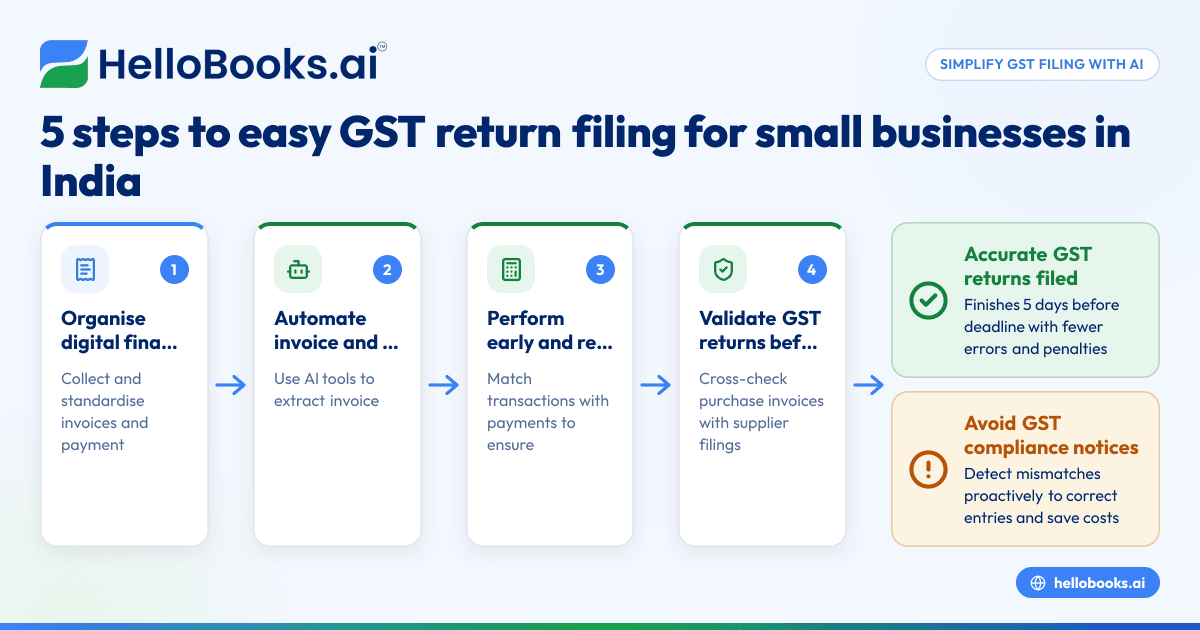
GST accuracy improves when bookkeeping starts at the invoice
In India, bookkeeping accuracy often improves most at the point where the transaction is first created: the invoice or purchase entry.
If the software uses the customer’s GSTIN and place of supply to prepare a GST invoice with the appropriate CGST, SGST or IGST split, the downstream books become more reliable. The legal fields for tax invoices come from the GST law and rules—such as the Central Goods and Services Tax Act, 2017 and the CGST Rules, 2017 under CBIC—and the latest operational requirements are published on the GST portal and CBIC notifications. The point is not that software “knows the law” on its own; it is that software can keep required fields consistent across hundreds of invoices.
This becomes even more useful where e-invoicing applies. The current applicability criteria and technical rules for e-invoice are published by CBIC and GSTN on official channels. When IRN generation and the signed QR are handled while saving the invoice, the accounts team does not need a separate JSON upload habit for every eligible document. That reduces mismatch risk between the commercial invoice, the GST record and the books.
For movement of goods, generating the e-way bill from invoice data also helps avoid retyping transporter and consignment details into another workflow. Again, the current requirements are set under GST law and published through the official e-way bill and GST portals.
HelloBooks is useful here because the bookkeeping record, GST invoice, e-invoice details and e-way bill workflow can sit close together instead of being spread across multiple files and portals.
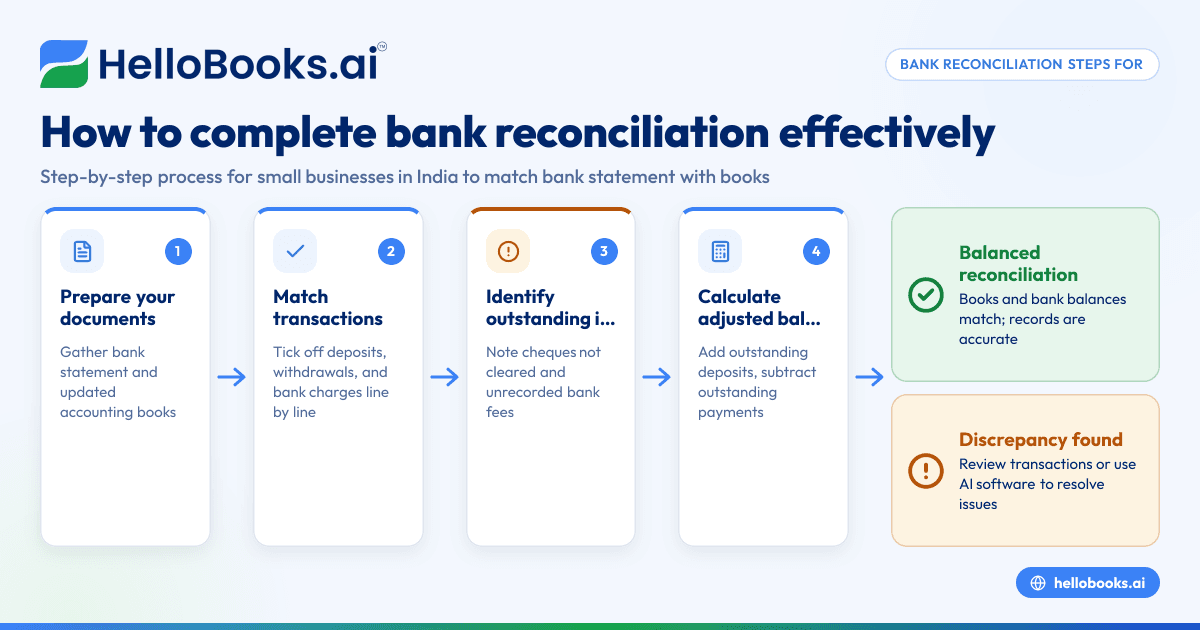
Bank reconciliation is where AI feels most practical
Owners usually notice the value of AI bookkeeping not in a dashboard but when reconciling the bank.
In Indian small businesses, the bank book often becomes messy because payments arrive in fragments: one invoice is paid by two UPI transactions, another by NEFT after a phone reminder, another adjusted against a credit note. Without automation, someone must inspect every line manually.
Uploading a bank statement and using AI-assisted reconciliation can shorten that work significantly. The software can suggest matches based on amount, date, narration and open invoices, leaving the bookkeeper to review exceptions rather than start from scratch. That is especially useful where a business handles many low-value receipts in rupees and a few larger B2B transfers in the same account.
An illustrative and invented scenario makes the point. Suppose a Jaipur wholesaler has INR 4,80,000 in receipts in a month spread across dozens of entries, including UPI collections from retailers and NEFT transfers from institutional buyers. In the same month, it has open sales invoices of INR 5,10,000 and some customers pay short after deducting an illustrative and invented TDS amount. If the owner uploads the bank statement, AI reconciliation may identify likely matches between receipts and invoices faster than a manual check. This illustration leaves out bank charges, bounced entries, credit notes and accounting policy choices; it is only to show the workflow, not a compliance outcome.
HelloBooks fits this part of the job because Indian users upload the bank statement and the system assists reconciliation against invoices and ledger entries, instead of forcing every receipt to be keyed in line by line.
Purchase bills, ITC tracking and month-end confidence
Sales are only one side of accuracy. In many businesses, purchase-side bookkeeping is where month-end stress begins.
Vendor bills arrive as paper slips, PDFs on email, or phone photos in WhatsApp chats. Someone later types them into a spreadsheet, often without checking GSTIN, taxable value, tax breakup, or whether the supplier document matches what appears in GSTR-2B. Then, just before filing, the business scrambles to identify missing invoices and uncertain ITC.
OCR-based bill capture helps by pulling core fields from purchase invoices into the books sooner. That does not replace review; supplier documents still need human checks. But it reduces the backlog that builds when entries are postponed.
The stronger gain comes when purchase capture is tied to GSTR-2A/2B reconciliation and ITC tracking. Under the GST system administered by CBIC via GSTN, eligibility and timing of input tax credit depend on the law, rules and the taxpayer’s facts, with current guidance published on the GST portal, CBIC circulars and notifications. Software cannot decide legal entitlement in every case, but it can show which booked supplier invoices are missing or mismatched in the available statements before figures are pushed into GSTR-3B.
That is often the difference between a calm filing cycle and a last-minute hunt through email attachments.
Inventory, reports and the end of parallel spreadsheets
A lot of bookkeeping errors happen because operations and accounts are disconnected. Stock is updated in one place, invoices in another, and the P&L is reviewed from a third sheet prepared at month end.
For a distributor or small manufacturer, inventory-linked bookkeeping matters because cost of goods sold, closing stock, dispatches and purchase timing all affect financial reports. If stock movements are recorded with sales and purchases, the business gets a more current picture of margins and fast-moving items.
Financial reports then become more trustworthy. A receivables ageing that pulls from actual invoices and matched receipts is more useful than a manually maintained debtor list. A P&L built from the same entries used for GST working reduces the chance that management accounts say one thing while return data says another.
An illustrative and invented case: a Ludhiana parts trader sells goods worth INR 8,40,000 in a month and purchases INR 5,90,000, with inventory opening and closing figures updated continuously in the system. Because sales invoices, purchase bills and stock movement are linked, the owner can review gross margin and debtor ageing without waiting for a separate spreadsheet prepared at month end. This illustration is simplified and leaves out freight, discounts, valuation policy, returns and non-operating items.
HelloBooks is relevant here because inventory movement, GST-ready invoicing and financial reports are connected, which makes the books more usable for day-to-day decisions rather than only for filing.
Useful if you already work with Tally, multiple GSTINs or a CA
Indian businesses rarely adopt bookkeeping software in a clean-slate way. Many already have historic data in Tally, rely on a CA for review, or operate more than one GSTIN across states.
That reality matters. A good AI bookkeeping setup should reduce friction, not create a migration project that stalls for months. If your accountant still needs Tally data or comparative records, a Tally migration path or connector is more practical than a forced rip-and-replace. If you manage branches or registrations in more than one state, multi-GSTIN handling matters because place of supply, tax head split and filing need to remain separated correctly.
The same applies to collaboration. Small businesses often involve the owner, an accounts executive, an outside accountant and a CA. Unlimited user access is helpful not as a feature slogan but because bookkeeping quality improves when the people actually doing invoicing, purchase entry and review can work in the same system.
If you want to explore that transition, Tally alternative and HelloBooks vs Tally pages are more useful than generic software comparisons.
What AI bookkeeping does not replace
AI bookkeeping can automate repetitive work, but it does not replace judgment on tax positions, documentation or law.
It cannot independently decide whether a supply should be treated in a disputed way under GST, whether a specific expense is allowable under the Income-tax Act, or whether a contract creates a TDS obligation in a particular fact pattern. Those outcomes depend on the statute, notifications, circulars, case law and the regulator’s current guidance. For GST, look to the GST portal, CBIC notifications and GSTN advisories; for direct tax, consult the Income Tax Department’s official publications and the Income-tax Act, 1961; for company law matters, check MCA publications under the Companies Act, 2013.
It also does not remove the need for document discipline. Bills still need to be preserved. Vendor masters still need review. Exceptions still need a human to inspect. AI is best thought of as a faster first pass and a consistency layer.
That is why the strongest use case is not “replace your accountant.” It is “stop wasting your accountant’s time on preventable data entry and mismatch cleanup.”
How to choose a system that suits Indian workflows
A small business in India should judge AI bookkeeping software against the workflows it actually has:
- Can it create GST invoices correctly for local and inter-state sales?
- If e-invoicing applies, can it handle IRN and the signed QR inside the invoicing process?
- Can it prepare and directly file GSTR-1 and GSTR-3B from the books?
- Can it reconcile purchase data with GSTR-2A or GSTR-2B and help track ITC?
- Can you upload bank statements and reconcile receipts from UPI, NEFT, RTGS and IMPS without heavy manual work?
- If you hold stock, does inventory move with sales and purchases?
- If you already use Tally, is the transition realistic?
HelloBooks is strongest when you want those specific India workflows in one place: smart invoicing, GST return filing software, bank reconciliation software, e-invoicing software, and inventory. If you are comparing fit and rollout for your team, start from India, see pricing, or book a demo.
For quick checks before you commit to any software, the free tools can also help validate common GST data points, such as a GSTIN validator or GST reconciliation checker.
Used well, AI bookkeeping does something very practical for Indian small businesses: it turns bookkeeping from a month-end rescue exercise into an ongoing record that is more accurate, more reviewable and much closer to compliance-ready every day.