
Key takeaways
What this article covers, in order:
- Key takeaways
- What is the difference between GSTR-1 and GSTR-3B?
- Why do GSTR-1 and GSTR-3B need to match?
- What do small businesses need to check every month?
- How should you reconcile GSTR-1 and GSTR-3B each month?
- Which mistakes cause the most GSTR-1 vs GSTR-3B mismatches?
GSTR-1 and GSTR-3B are both important GST returns, but they do different jobs. GSTR-1 reports your outward supplies invoice-wise, while GSTR-3B is a summary return where you declare tax liability, input tax credit and tax payable for the period. For small businesses in India, the real work is not just filing both returns, but making sure the numbers match across sales, purchases, credit notes, bank receipts and GST records.
Key takeaways
- The gstr-1 vs gstr-3b difference is simple: GSTR-1 is detailed sales reporting, and GSTR-3B is a summary tax payment return.
- If values in GSTR-1 and GSTR-3B do not match, you may face notices, reconciliation work and delayed clean-up.
- You should check taxable value, GST amount, credit notes, amendments and B2B invoices before filing every month.
- Small businesses using spreadsheets or Tally often make errors when sales, collections and GST are updated in different places.
- A monthly closing checklist and timely reconciliation reduce filing stress and year-end corrections.
- Using GST return filing software and AI bookkeeping can help catch mismatches earlier.
What is the difference between GSTR-1 and GSTR-3B?
GSTR-1 is your detailed return of outward supplies. GSTR-3B is your summary declaration of tax liability, eligible input tax credit and net tax payable for the same period.
In practice, think of GSTR-1 as the sales register you report to GST, and GSTR-3B as the monthly tax summary you file and pay against. If your GSTR-1 says one thing and your GSTR-3B says another, the mismatch can create compliance problems.
Here is the core difference in plain language:
GSTR-1
GSTR-1 captures outward supplies in detail. This includes B2B invoices, some B2C supplies, credit notes, debit notes and amendments where applicable. It mainly answers one question: what did you sell, to whom and with how much GST?
This return also matters to your customers. Their input tax credit visibility depends on correct reporting of your invoices.
GSTR-3B
GSTR-3B is a summary return. It captures total outward taxable supplies, tax liability, eligible input tax credit, exempt supplies where relevant and the final tax payable after set-off. It answers a different question: how much GST is due for the period after considering credits?
GSTR-3B is not invoice-wise. It is a consolidated return, but it must still be backed by clean records.
Why small businesses confuse them
Many businesses in Mumbai, Pune and Bengaluru record sales in one system, receipts in another and GST workings in spreadsheets. Then, at filing time, the accountant must stitch everything together. That is where the gstr-1 vs gstr-3b difference gets blurred. Teams may wrongly assume both returns can be prepared from one rough sales total.
They cannot. GSTR-1 needs invoice-level accuracy. GSTR-3B needs correct summary values and tax set-off. Both must align with your books.
Why do GSTR-1 and GSTR-3B need to match?
They need to match because both returns describe the same tax period from different angles. GSTR-1 reports detailed outward supplies, while GSTR-3B reports the tax impact of those supplies in summary. If the underlying sales, notes and tax amounts do not align, the mismatch can trigger notices or later corrections.
For a small business, mismatch usually starts with simple issues:
- an invoice missed in GSTR-1
- a sales entry booked in the wrong month
- a credit note reduced in books but not reflected correctly
- GST calculated manually in Excel
- amendments done in one place but not another
- e-commerce or marketplace sales posted late
- advance receipts or adjustments handled inconsistently
Even a small monthly difference can snowball across a quarter or year. A business doing ₹35 lakh in monthly turnover may think a ₹18,000 gap is minor. But repeated over several months, it becomes a larger reconciliation problem.
What a mismatch can lead to
A mismatch does not always mean wrongdoing. Often, it reflects weak process discipline. But it can still lead to:
- extra time spent on reconciliation
- follow-up from your accountant or finance team
- difficulty explaining differences during review
- delayed closure of monthly books
- pressure near year-end or audit time
This is one reason many growing businesses move from spreadsheet-based filing to accounting software in India or AI accounting software that keeps sales and GST records closer together.
What do small businesses need to check every month?
Check sales, GST values, credit notes, purchase credit and filing-period cut-offs before filing. The goal is simple: make sure your books, GSTR-1 and GSTR-3B tell the same story for the month.
Below is a practical monthly checklist.
1. Reconcile your sales register first
Start with your outward supplies from books. Use the final sales register for the month, not a draft list from WhatsApp orders, dispatch sheets or a team member’s Excel file.
Verify:
- invoice number sequence
- invoice date and tax period
- customer GSTIN for B2B invoices
- place of supply where relevant
- taxable value
- CGST, SGST or IGST values
- credit notes and debit notes
If you raise invoices from multiple branches or teams, consolidate them before return preparation.
2. Match books with GSTR-1 data
Once your sales register is final, compare it with the data prepared for GSTR-1. Every B2B invoice and every relevant adjustment should be reflected correctly.
Pay attention to:
- invoices omitted from upload
- duplicate invoices
- wrong GSTIN
- wrong tax rate
- amendments tagged to the wrong period
- credit notes shown in books but not in return data
For businesses issuing many invoices, invoice software or e-invoicing software can reduce manual re-entry.
3. Match tax liability in GSTR-3B to outward supplies
Now compare summary tax liability in GSTR-3B with your outward supplies after adjustments. If GSTR-1 shows higher taxable value than GSTR-3B, ask why. If GSTR-3B shows lower tax, trace whether an invoice, note or amendment was left out.
This is where many teams struggle with the ai gstr-1 vs GSTR-3B review inside modern systems. The tool may flag differences quickly, but the business still needs a disciplined process to resolve the reason.
4. Review input tax credit separately
GSTR-3B also includes input tax credit, which is not part of GSTR-1. That means your final payment number can look very different from your gross outward tax liability.
Before filing, review:
- purchase register
- eligible ITC only
- expense classification
- blocked or doubtful credit, where relevant
- vendor invoice completeness
- timing differences between booking and availability
This article is general information, not tax or legal advice. If ITC treatment is unclear for a specific transaction, confirm it with your GST adviser.
5. Check cash, bank and collections
GST returns are not bank statements, but bank data still helps validate your month. If sales in books are ₹12 lakh but collections and dispatch records suggest much more business was done, pause and review.
A final pass through receipts, UPI collections, Razorpay settlements and bank credits often helps identify missed invoices or duplicate postings. If this takes too long every month, bank reconciliation software and expense management software can reduce the manual effort.
How should you reconcile GSTR-1 and GSTR-3B each month?
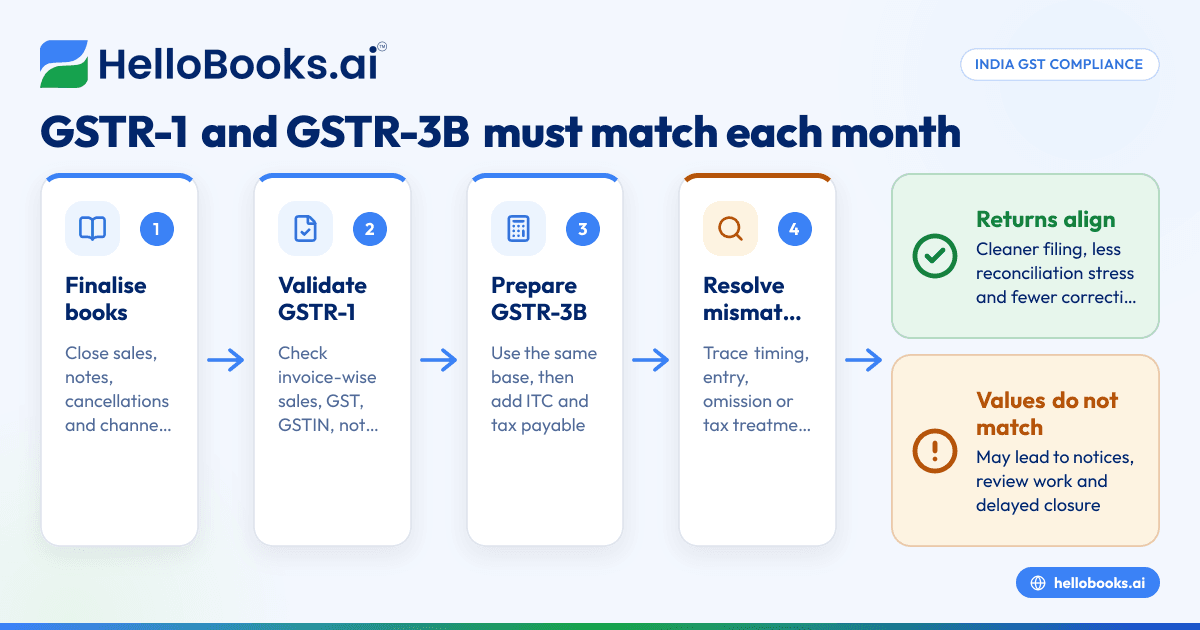
Reconcile in this order: finalise books, freeze the sales register, verify GSTR-1 invoice data, compare summary tax liability with GSTR-3B, then review credit notes and ITC separately. Do this before filing, not after.
Here is a simple monthly workflow for small businesses.
Step 1: Close the sales period
Do not start with GST portal data. Start with your own books.
Freeze:
- sales invoices for the month
- sales returns and credit notes
- debit notes
- cancelled invoices
- branch-wise or channel-wise sales data
If you sell through distributors, retail counters and direct B2B invoices, bring all channels into one register.
Step 2: Prepare outward supply totals
Create a summary by:
- taxable value
- tax rate
- interstate and intrastate split
- B2B and B2C split where needed
- export or special category transactions, if applicable
This gives you the control sheet against which both returns can be checked.
Step 3: Validate GSTR-1 line items
Before filing GSTR-1, compare the upload data to your control sheet. The total taxable value and tax amount should tie back to books. Investigate every difference, even if it is small.
Common reasons include:
- invoice date in the wrong month
- GSTIN typo
- note entered twice
- amendment not linked properly
- sales from one branch missing
Step 4: Prepare GSTR-3B from the same base
Do not create GSTR-3B from a separate rough worksheet if possible. Use the same validated base data from books and outward supply summary.
Then add:
- eligible ITC
- reverse charge, where relevant
- exempt or nil-rated figures, where relevant
- final tax payable after set-off
The principle is simple. One source of truth reduces mismatch risk.
Step 5: Resolve differences before filing
If GSTR-1 and GSTR-3B do not match, classify the issue:
- timing issue
- data entry issue
- tax treatment issue
- omission
- amendment issue
Do not just “adjust next month” without a proper note. Repeated temporary adjustments make future reconciliation harder.
Which mistakes cause the most GSTR-1 vs GSTR-3B mismatches?
Missed invoices, wrong month posting, unrecorded credit notes, manual tax errors and disconnected systems cause most mismatches. The bigger the gap between invoicing, accounting and filing, the higher the risk.
Below are the most common patterns in small businesses.
Sales recorded in one place, filed from another
A common setup is invoices in Tally, corrections in Excel and GST workings in a separate sheet managed by the accountant. This creates version confusion. One file may have a late invoice that another file does not.
If this sounds familiar, it may be time to review whether a Tally alternative or accounting software for small business would simplify monthly work.
Credit notes handled loosely
Credit notes are a frequent source of mismatch. A sales team may promise a discount over WhatsApp. Finance may adjust the receivable. But the tax note may be created later, or not reflected correctly in return data for the same period.
Cut-off errors at month-end
A business dispatches goods on 31/08/2026, but the invoice is entered on 02/09/2026. Or a late invoice is backdated in books without matching changes in GST workings. These cut-off issues are common in fast-growing teams.
Wrong summary mapping in GSTR-3B
Because GSTR-3B is a summary return, businesses often underestimate it. They may manually enter totals from a rough report without checking whether the report includes all amendments, debit notes or tax buckets.
ITC confusion hiding output tax issues
Sometimes the final payment looks reasonable because input tax credit reduces the amount payable. That can hide the fact that outward tax itself was incorrectly reported. Always reconcile output tax first, then ITC.
Can software help reduce GSTR-1 and GSTR-3B errors?
Yes. Good software reduces manual re-entry, keeps invoice and accounting data closer together, and highlights mismatches before filing. It does not replace review, but it makes review faster and more reliable.
For small businesses, the biggest benefit is not “automation” as a buzzword. It is fewer places where data can change unnoticed. If sales, expenses, bank entries and GST reports live across spreadsheets, email and desktop files, monthly filing will stay stressful.
Practical features to look for include:
- invoice creation tied to books
- GST-ready sales and purchase registers
- easy bank matching
- expense capture
- monthly reconciliation reports
- audit trail of edits and changes
- cleaner collaboration with your accountant
If your current process depends on last-minute Excel clean-up, consider moving to accounting software in India that supports routine GST work more cleanly. If you still rely on desktop-led workflows and heavy manual exports, evaluating a QuickBooks alternative may also make sense if your team wants a simpler month-end process.
A practical monthly checklist for owners and finance leads
Even if you have an accountant, owners and finance leads should review a few key numbers every month. This takes 15 to 20 minutes and can prevent bigger issues later.
Owner review checklist
Ask these questions before filing:
- Does monthly turnover in books look reasonable compared to operations?
- Do major customer invoices appear in the sales register?
- Were any large discounts, returns or cancellations processed?
- Does GSTR-3B output tax broadly align with sales for the month?
- Are there unusual drops in tax payable that need explanation?
Accountant review checklist
Your accountant or finance team should also confirm:
- GSTR-1 invoice totals match books
- GSTR-3B output tax matches validated summary
- ITC review is complete
- amendments and notes are documented
- bank and receipt patterns do not reveal missing sales
- month-end working papers are saved
When records are scattered across teams, it can help to find an accountant who is comfortable with monthly digital review processes, not just year-end clean-up.
Final word: filing is not enough, matching is the real control
For small businesses in India, the gstr-1 vs gstr-3b difference is easy to understand but harder to manage consistently. One return is detailed, one is summary, and both must tie back to clean books. If you build a monthly routine around sales reconciliation, note tracking, ITC review and bank checks, GST filing becomes much less painful.
If you want a simpler way to manage bookkeeping, invoicing, reconciliation and GST workflows in one place, you can book a demo or compare options on our pricing page.
Frequently asked questions
Is GSTR-1 the same as GSTR-3B?
No. GSTR-1 is a detailed return of outward supplies, while GSTR-3B is a summary return for tax liability, ITC and payment. They cover the same period but serve different purposes.
What happens if GSTR-1 and GSTR-3B do not match?
A mismatch can lead to extra reconciliation work and questions during review. It is best to identify the reason before filing or correct it through a documented process in the appropriate period.
Should I prepare GSTR-3B from GSTR-1?
You should prepare both from the same validated books and GST working papers. GSTR-1 helps establish outward supply details, but GSTR-3B also needs correct ITC and other summary values.
Do small businesses need monthly reconciliation even with low invoice volume?
Yes. Even with fewer invoices, one missed B2B invoice or one wrong credit note can create a mismatch. Monthly reconciliation is easier than fixing several months together.
Can software fully automate GST filing checks?
Software can reduce manual errors and flag differences early, but review is still necessary. A person should always verify sales, tax liability, ITC and period cut-off before filing.