
Key takeaways
What this article covers, in order:
- Key takeaways
- What GST return filing in Singapore involves
- Who should pay close attention to GST return filing
- Records you should keep before filing
- Step-by-step process for GST return filing in Singapore
- Common GST return filing errors in Singapore
GST return filing in Singapore means reporting your business’s GST collected on sales and GST paid on purchases to IRAS for each prescribed accounting period. For small businesses, the work is usually straightforward if your records are complete, your invoices are accurate and your figures agree with your books.
Key takeaways
- GST return filing in Singapore is mainly about reporting the right output tax, input tax and taxable turnover to IRAS on time.
- Good records matter more than last-minute fixes. Clean sales, purchase and bank data make filing much easier.
- Common errors include using the wrong GST treatment, claiming input tax without proper support and reporting figures that do not match accounting records.
- InvoiceNow and structured digital invoicing can help reduce manual mistakes, especially for growing businesses.
- This article is general information, not tax or legal advice. If your GST treatment is unclear, confirm it with a qualified adviser or IRAS guidance.
What GST return filing in Singapore involves
If your business is GST-registered in Singapore, you need to file GST returns for each accounting period assigned by IRAS. In simple terms, the return tells IRAS:
- how much GST you charged customers
- how much GST you paid on business purchases and expenses
- what your taxable sales and purchases were
- whether you need to pay GST to IRAS or can claim a refund
For many small businesses, the filing process becomes difficult for one reason. The books are not fully ready when the deadline approaches. Sales invoices may be missing. Supplier bills may still be in email inboxes. Bank transactions may not be reconciled. A few manual spreadsheets then become a stressful month-end exercise.
That is why GST filing is not only a tax task. It is also a bookkeeping task. If your bookkeeping is weak, the GST return will likely be weak too.
Businesses in Singapore that still rely on spreadsheets or disconnected tools often face the same issues:
- duplicate entries
- missing expense records
- GST amounts entered manually
- unreconciled bank transactions
- invoice dates in the wrong period
- poor document storage
Using structured workflows, or a proper accounting software for small business, can reduce these risks and make each filing cycle much more predictable.
Who should pay close attention to GST return filing
GST return filing matters most for:
- small companies registered for GST
- growing businesses with rising transaction volume
- service firms billing local and overseas customers
- retail and wholesale businesses with many supplier invoices
- agencies, consultancies and online sellers with mixed transaction types
In Singapore, this can include a marketing agency in Singapore billing both local and overseas clients, a wholesale trader importing products, or a small F&B operator managing many purchase invoices each month.
The larger your transaction volume, the greater the risk of small mistakes adding up. A few wrong tax codes across dozens of transactions can distort the return. If that happens across several periods, fixing it later becomes time-consuming.
Why small businesses struggle
Small businesses often do not have a full finance team. The founder approves expenses. An admin person raises invoices. A part-time accountant updates the books. Records sit across bank statements, WhatsApp messages, PDFs and spreadsheets.
That setup can work at very low volume. It usually stops working once the business grows. GST return filing then becomes a rush to reconstruct what happened.
Records you should keep before filing
The quality of your GST return depends on the quality of your records. Before you file, make sure the underlying books are complete and organised.
Sales records
Keep clear records of:
- sales invoices issued
- credit notes and debit notes
- receipts for cash sales
- customer refunds
- cancelled invoices
- export or overseas sales support where relevant
For each sale, your records should show the invoice date, customer, amount before GST, GST amount and total amount. If you have different types of supplies, the GST treatment should be clear in your books.
Purchase and expense records
For purchases and business expenses, keep:
- supplier invoices
- receipts
- import documents where relevant
- staff expense claims with supporting proof
- credit notes from suppliers
- records of business purpose
This is especially important when claiming input tax. A supplier invoice alone may not always be enough if the transaction is unclear or partly personal. Keep enough support to show the expense is business-related.
A dedicated expense management software workflow can help collect receipts early rather than chasing them at filing time.
Bank and payment records
Your GST return should tie back to your accounting records, and your accounting records should broadly reflect your money movements. That means you should maintain:
- bank statements
- payment gateway reports
- petty cash records
- credit card statements
- loan or financing statements where relevant
Bank reconciliation is a major control point. It helps you spot missing sales, duplicate expenses and incorrect dates before they affect your GST return. If reconciliations are delayed, filing becomes much harder. A good bank reconciliation software process can save a lot of manual checking.
Document retention and data handling
Records should be stored securely and be easy to retrieve if IRAS asks for support later. If you collect customer or employee personal data in invoices or expense records, handle it carefully under Singapore’s PDPA. Good accounting hygiene includes both tax readiness and sensible data handling.
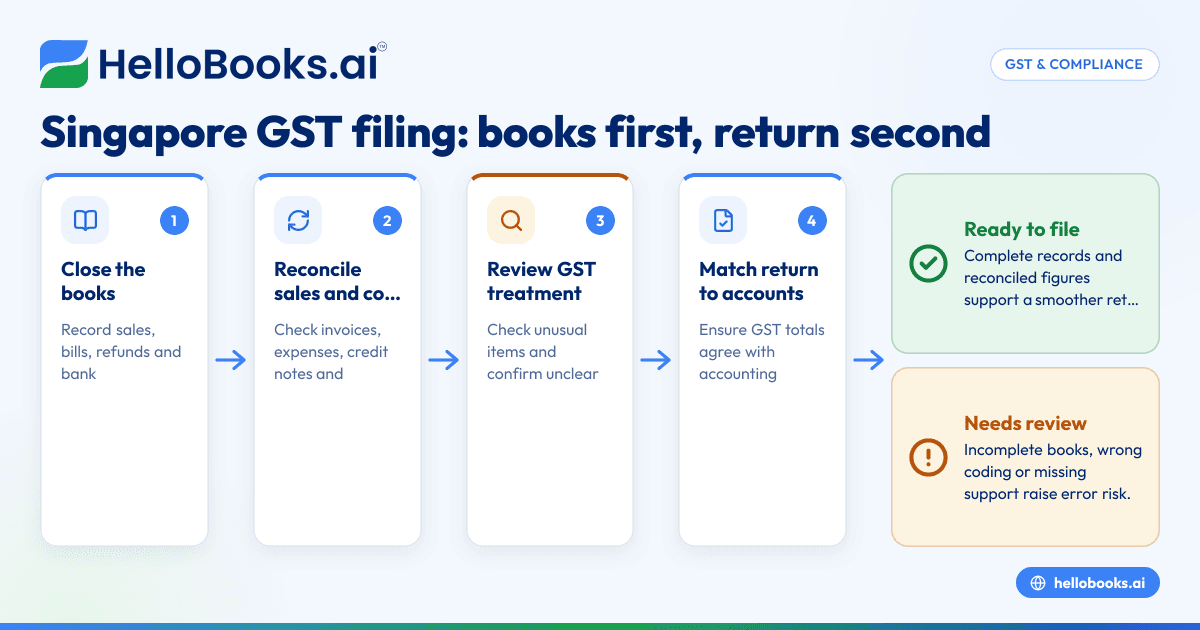
Step-by-step process for GST return filing in Singapore
Below is a practical process that works well for most small businesses.
1. Close your books for the filing period
Start by making sure all transactions for the period are recorded. This includes:
- sales invoices issued during the period
- supplier bills and expenses received
- credit notes and refunds
- bank receipts and payments
- payroll-related entries if relevant to the accounts
Do not jump straight to the GST return. First close the books properly.
2. Reconcile sales
Next, compare your sales register with supporting records such as contracts, invoice logs, payment reports and bank receipts. Look for:
- missing invoices
- duplicate invoices
- cancelled invoices still included in revenue
- wrong invoice dates
- GST charged incorrectly
If your business uses digital invoicing, standardised invoice data can make this step much faster. For businesses moving towards InvoiceNow workflows, better invoice structure can reduce manual entry errors over time. Some businesses also benefit from invoice software or e-invoicing software to keep invoice data consistent.
3. Reconcile purchases and expenses
Review supplier invoices, staff claims and recurring expenses. Check that:
- expenses belong to the filing period
- GST amounts are recorded correctly
- non-business expenses are excluded
- duplicate bills are removed
- credit notes are reflected
This is where many input tax mistakes happen. Businesses often over-claim because one expense is entered twice, or because a claim is made without complete support.
4. Review GST treatment for unusual items
Ordinary local sales and purchases may be easy. The harder items are usually:
- overseas transactions
- deposits and advance payments
- bad debts and write-offs
- reimbursements
- discounts and rebates
- private or non-business use
- import-related purchases
If you are unsure, review IRAS guidance for the relevant transaction type before filing. Do not guess based on a spreadsheet formula from last year.
5. Reconcile the GST figures to your accounts
Before submission, compare the GST return totals with your accounting reports. Ask:
- Do sales values match the revenue reports for the period?
- Do purchase figures match the expense and supplier records?
- Does output tax align with GST charged on sales?
- Does input tax align with eligible GST on purchases?
- Is the net GST payable or refundable reasonable compared with prior periods?
A sharp change is not always wrong. But it should be explainable.
6. File the return with IRAS
Once the numbers are reviewed, file the GST return through the official IRAS filing process for your business. Save a copy of the submitted return and any working papers used to prepare it.
7. Pay GST due, or track the refund
If your return shows GST payable, make sure payment is arranged by the required timeline set by IRAS. If the return results in a refund, keep all support ready in case questions arise later.
8. Archive support for future review
After filing, save the final reports, reconciliations, invoices and notes used for the return. This saves time during future reviews, corrections or audits.
Common GST return filing errors in Singapore
Most GST filing mistakes are not caused by complex tax law. They come from weak processes and rushed reviews.
1. Filing from incomplete books
This is the most common issue. A business files before all invoices, bills or bank entries are posted. The GST return may then understate sales, overstate purchases or miss adjustments.
A simple rule helps here. If your books are not closed, your GST return is not ready.
2. Using the wrong GST code
Wrong tax coding can affect both output tax and input tax. This often happens when staff choose a code by habit rather than reviewing the transaction. One wrong default setting can affect dozens of entries in a month.
3. Claiming input tax without proper support
Input tax claims need proper business records. Problems usually arise when:
- receipts are faded or missing
- supplier invoices are incomplete
- the expense is partly personal
- there is no clear business purpose
- the same document is claimed twice
4. Putting transactions in the wrong period
A sale may be raised late. A supplier bill may be entered when paid rather than when it belongs. Credit notes may be missed until the next cycle. These timing issues can distort the return.
5. Ignoring credit notes, refunds and adjustments
Businesses often focus on invoices and forget the reversals. But credit notes and customer refunds can materially affect GST figures. If they are not recorded properly, output tax may be overstated.
6. Failing to reconcile to the bank
Unreconciled cash movement is a warning sign. It can point to missing transactions, duplicate entries or misclassified items. Filing without bank reconciliation increases the chance of mistakes.
7. Over-relying on spreadsheets
Spreadsheets are flexible, but they break easily. Formulas get overwritten. Tabs go out of sync. One copied number can flow into the final return without anyone noticing. This is one reason many businesses move to AI bookkeeping tools or AI accounting software as transaction volume grows.
How to make GST return filing easier each period
The best GST process is not a heroic one. It is a repeatable one.
Build a monthly close routine
Do not wait until filing week. Instead, close your books monthly. Even if your GST return is not due every month, monthly discipline keeps errors small and visible.
A practical monthly checklist includes:
- raise and review all sales invoices
- collect supplier bills and receipts
- reconcile bank and card accounts
- review GST coding exceptions
- clear duplicate or unmatched transactions
- store supporting documents in one place
Standardise invoicing and expense capture
If every invoice looks different and every receipt arrives by a different channel, GST review becomes slow. Standard formats help. So do clear staff rules for expense claims.
For Singapore SMEs, InvoiceNow can be relevant if you want cleaner digital invoice exchange and less rekeying. It is not a complete finance process on its own, but it can support better invoicing discipline.
Use review reports before filing
Before every return, review:
- sales by month
- GST on sales
- purchases by supplier
- GST on purchases
- large or unusual journal entries
- negative lines or reversals
- changes from prior period
These reports help you catch outliers early.
Separate bookkeeping from approval
One person should not create, approve and review everything without oversight. Even in a small business, simple separation helps. For example, an admin can upload bills, the owner can approve payments and an accountant can review coding.
Keep an audit trail
Write short notes for unusual entries. Save emails or contracts behind non-standard transactions. Future you will thank present you when a question comes up months later.
When software helps more than spreadsheets
Software becomes useful when the business has enough volume, complexity or growth pressure that manual control breaks down. This usually happens earlier than founders expect.
You may need better systems if:
- you process many invoices each month
- you have more than one bank or payment channel
- your team submits many expense claims
- you bill both local and overseas customers
- you spend days preparing each GST return
- you are fixing recurring errors every period
The right system should help with bookkeeping accuracy first. GST filing then becomes a cleaner output of reliable books. If you are comparing options, look for tools that support invoicing, expense capture, bank matching and reporting in one workflow, not just end-stage tax reports.
Businesses moving away from legacy setups sometimes compare newer tools with a QuickBooks alternative or other workflow-focused options. What matters most is whether the system reduces data entry and improves review control.
A simple GST filing checklist for small businesses
Use this checklist before you submit each return:
- All sales invoices for the period are recorded.
- Credit notes and refunds are posted.
- Supplier bills and receipts are complete.
- Bank and card accounts are reconciled.
- GST codes have been reviewed for unusual items.
- Duplicate transactions are removed.
- Input tax claims are supported by proper records.
- Return totals agree with accounting reports.
- Large changes from prior periods are explained.
- Filing support is saved after submission.
This checklist is simple on purpose. Most mistakes happen because one of these basics is skipped.
If your business wants a faster, cleaner way to manage books, invoicing and GST workflows, you can explore HelloBooks and see whether it fits your process. You can book a demo or compare options on the pricing page.
Frequently asked questions
What does GST return filing in Singapore usually include?
It usually includes reporting GST charged on sales, GST paid on eligible business purchases, and the related values for the filing period. The exact fields and treatment depend on your business activities and the guidance that applies to your transactions.
How often do small businesses need to prepare for GST filing?
You should prepare continuously, not only near the filing date. Monthly bookkeeping, reconciliations and document collection make each return much easier, even if your prescribed accounting period is longer than one month.
Can I file my GST return from spreadsheets?
Yes, some small businesses do. But spreadsheets become risky as transaction volume increases. Missing formulas, duplicate entries and weak document control often lead to filing errors.