


Key takeaways
What this article covers, in order:
- Why this comes up / what goes wrong
- Step-by-step
- Example (fictional figures)
- Common mistakes
- Doing this in HelloBooks
- Frequently asked questions
GST return due dates are crucial for small business owners to avoid penalties and maintain compliance. Depending on your turnover and scheme, you must file monthly or quarterly returns. This article covers the applicable deadlines, filing requirements, a worked example, common mistakes, and how HelloBooks can help with GST invoicing and filing.
Why this comes up / what goes wrong
Small business owners often struggle with remembering the correct GST return due dates. Filing late or missing returns can lead to penalties and interest charges. Many businesses keep books in Excel or Tally and manually prepare returns, which increases the risk of errors and delays. Understanding if you need to file monthly or quarterly and the exact deadlines helps you plan and avoid last-minute rushes.
Step-by-step
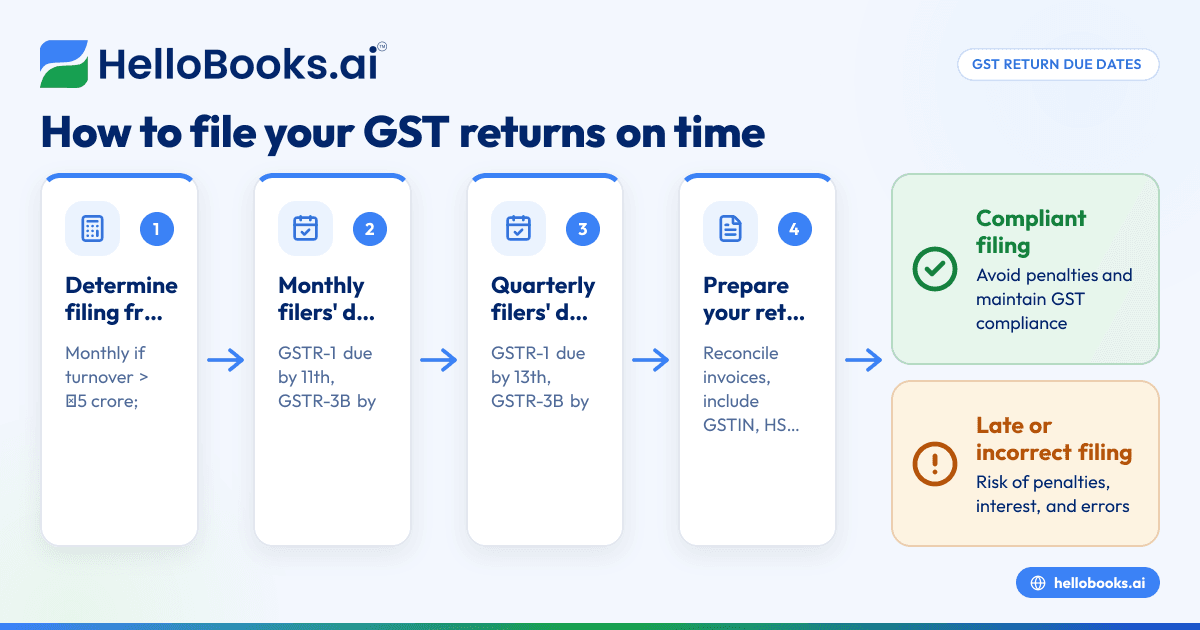
- Determine your filing frequency:
- Businesses with an aggregate turnover above ₹5 crore generally file monthly returns.
- Taxpayers under the QRMP (Quarterly Return Monthly Payment) scheme with turnover up to ₹5 crore file quarterly returns.
- Monthly filers must submit:
- GSTR-1 (Outward supplies): Due by the 11th day of the month following the tax period. [gstr1-due-date/gstr1-monthly-11th]
- GSTR-3B (Summary return and payment): Due by the 20th day of the month following the tax period. [gstr3b-due-date/gstr3b-monthly-20th]
- Quarterly filers under QRMP scheme must submit:
- GSTR-1: Due by the 13th day of the month following the quarter.
- GSTR-3B: Due by the 22nd or 24th day of the month following the quarter, depending on your State or Union Territory. [qrmp-scheme/qrmp-dates]
- Prepare your returns:
- Gather invoice data and reconcile with your books.
- Fill in all mandatory particulars on invoices as per Rule 46, including GSTIN, HSN/SAC codes, tax rates, and place of supply. [cgst-rule-46/rule46-particulars]
- File your returns online on the GST portal before the due date.
For detailed guidance on filing, see GST return filing (GSTR-1, GSTR-3B).
Example (fictional figures)
Assume a business with a turnover above ₹5 crore files monthly returns for July 2023.
- Total outward taxable supplies in July: ₹12,00,000
- GST rate assumed: 18% (9% CGST + 9% SGST)
Calculate GST on supplies:
₹12,00,000 × 9% = ₹1,08,000 (CGST)
₹12,00,000 × 9% = ₹1,08,000 (SGST)
Total GST = ₹1,08,000 + ₹1,08,000 = ₹2,16,000
Due dates:
- GSTR-1 for July due by 11/08/2023
- GSTR-3B for July due by 20/08/2023
The business must file GSTR-1 by 11th August showing outward supplies worth ₹12,00,000 and GST ₹2,16,000. Then file GSTR-3B by 20th August summarising the tax liability and payment.
Common mistakes
- Missing the exact due date: Many businesses confuse the GSTR-1 and GSTR-3B due dates or miss the QRMP quarterly deadlines. Keep a calendar reminder for 11th, 13th, 20th, 22nd, and 24th as applicable.
- Incorrect invoice details: Not including mandatory particulars like GSTIN, HSN/SAC codes, or tax rates leads to errors in returns. Use GST-compliant invoicing formats to avoid this.
- Filing late or incomplete returns: Late filing attracts penalties and interest. Prepare returns in advance and verify completeness.
- Confusing monthly and quarterly filing: Ensure you know your turnover and scheme to file the correct return type and frequency.
- Manual data entry errors: Manual reconciliation and entry can cause mismatches. Use software tools to reduce errors.
For help with accurate invoicing, see GST invoicing.
Doing this in HelloBooks
HelloBooks supports direct filing of GSTR-1 and GSTR-3B returns built from your recorded invoices, ensuring figures match perfectly. Its GST invoicing feature creates compliant tax invoices with the correct CGST/SGST or IGST split and HSN/SAC codes from your customer's GSTIN, meeting Rule 46 requirements consistently. This reduces manual errors and saves time. Learn more at HelloBooks for India.
Frequently asked questions
What is the GST return due date for monthly filers?
Monthly filers must file GSTR-1 by the 11th and GSTR-3B by the 20th day of the month following the tax period. For example, July returns are due in August on these dates. [gstr1-due-date/gstr1-monthly-11th], [gstr3b-due-date/gstr3b-monthly-20th]
When is the quarterly GST return due date under QRMP?
Under the QRMP scheme, GSTR-1 is due by the 13th day of the month after the quarter, and GSTR-3B by the 22nd or 24th depending on your State or UT. This applies to taxpayers with turnover up to ₹5 crore. [qrmp-scheme/qrmp-dates]
What happens if I miss the GST return due date?
Late filing can lead to penalties and interest on tax dues. It is important to file returns on time to avoid these charges and maintain compliance.
How can I ensure my tax invoices comply with GST rules?
Invoices must include supplier and recipient GSTIN, HSN/SAC codes, tax rates, and other details as per Rule 46. Using GST-compliant invoicing software helps ensure these fields are correctly filled. [cgst-rule-46/rule46-particulars]
Can I file GSTR-1 and GSTR-3B directly from HelloBooks?
Yes, HelloBooks allows direct filing of GSTR-1 and GSTR-3B returns built from your invoices, reducing manual work and errors. GST return filing (GSTR-1, GSTR-3B)
Key takeaways
- Monthly GSTR-1 is due by the 11th and GSTR-3B by the 20th of the following month.
- Quarterly filers under QRMP file GSTR-1 by the 13th and GSTR-3B by the 22nd or 24th.
- Accurate invoice details as per Rule 46 are mandatory for GST compliance.
- Missing due dates leads to penalties; plan and file on time.
- Use GST-compliant invoicing and filing tools to reduce errors and save time.
Start managing your GST returns easily with HelloBooks. Start on the Free plan (200 transactions a year, GSTR-1 and 3B filing for one GSTIN).
This article is general information, not tax or legal advice. Rules change; confirm the current position on gst.gov.in or with your chartered accountant before acting.


