


Key takeaways
What this article covers, in order:
- Why this comes up / what goes wrong
- Step-by-step
- Example (fictional figures)
- Common mistakes
- Doing this in HelloBooks
- Frequently asked questions
GST registration under Rule 14A requires certain persons to register for GST even if their turnover is below the usual threshold. This rule applies mainly to those making inter-State supplies of goods or services or supplying through e-commerce platforms. Complying with Rule 14A ensures that businesses avoid penalties and can issue valid GST invoices.
Why this comes up / what goes wrong
Small business owners often believe they do not need GST registration because their turnover is below the standard threshold. However, Rule 14A mandates registration regardless of turnover if the business makes inter-State supplies or supplies through e-commerce operators. Failure to register when required can lead to penalties, invalid invoices, and problems claiming input tax credit.
Step-by-step
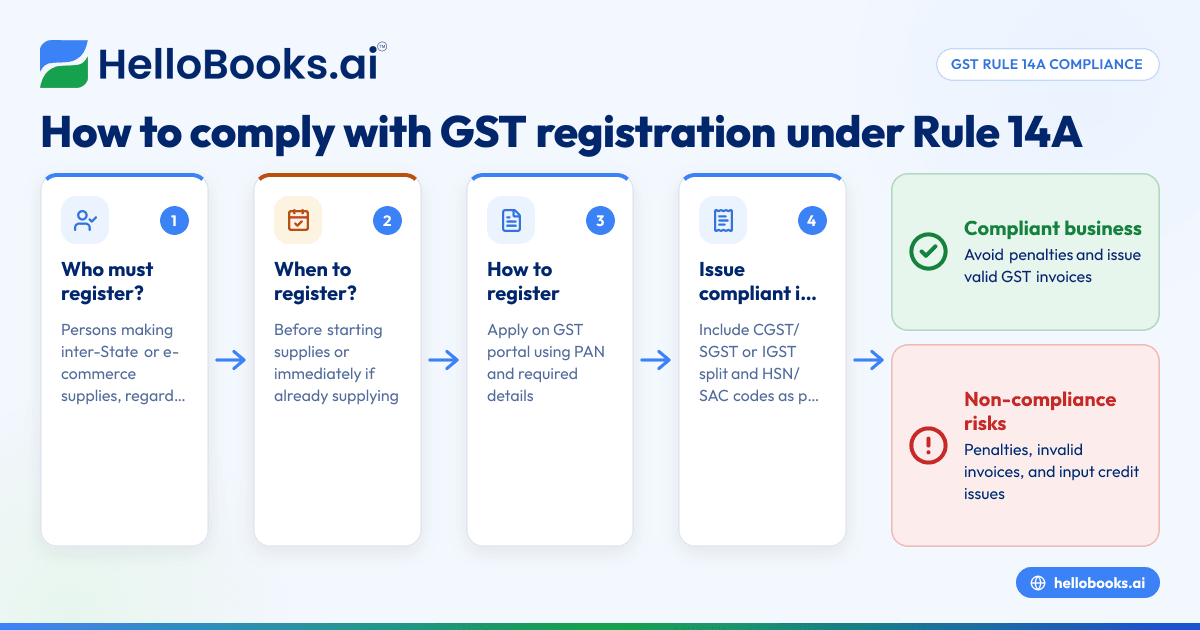
- Who it applies to: Persons making inter-State taxable supplies of goods or services, or those supplying via an e-commerce operator, must register under GST regardless of turnover.
- Threshold/Condition: Registration is required even if aggregate turnover is below the usual threshold if the person makes inter-State supplies or supplies through e-commerce.
- What must be done: The person must apply for GST registration on the GST portal using their PAN and other required details.
- By when: Registration must be obtained before commencing inter-State supplies or supplying through e-commerce. If already supplying, registration should be obtained immediately upon becoming liable.
- Post-registration compliance: After registration, the person must issue GST-compliant invoices containing particulars as per Rule 46, including CGST/SGST or IGST split and HSN/SAC codes. They must file returns such as GSTR-1 and GSTR-3B by their due dates.
For details on invoicing, see GST invoicing. For filing returns, see GSTR-1 and GSTR-3B filing.
Example (fictional figures)
Mr. Verma runs a small business in Bangalore with an annual turnover of ₹12,00,000, below the usual GST registration threshold. On 01/08/2023, he starts supplying goods to customers in Tamil Nadu, an inter-State supply.
Since he makes inter-State supplies, Rule 14A requires him to register for GST before 01/08/2023.
- Turnover: ₹12,00,000 (below threshold)
- Inter-State supplies start date: 01/08/2023
- Registration required on or before: 01/08/2023
If Mr. Verma delays registration, he cannot issue valid GST invoices for his inter-State supplies and risks penalties.
Calculation of tax on a supply of ₹50,000 (assumed illustrative rate 18%)
Taxable value = ₹50,000
CGST @ 9% = ₹50,000 × 9% = ₹4,500
SGST @ 9% = ₹50,000 × 9% = ₹4,500
Total tax = ₹4,500 + ₹4,500 = ₹9,000
Total invoice value = ₹50,000 + ₹9,000 = ₹59,000
This split must be reflected correctly in the invoice as per Rule 46.
Common mistakes
- Assuming no registration is needed due to low turnover
- Prevent by checking if you make inter-State or e-commerce supplies that require registration under Rule 14A.
- Delaying registration after starting inter-State supply
- Prevent by applying for registration before starting such supplies.
- Issuing invoices without correct GST particulars
- Prevent by using invoicing tools that include all required fields as per Rule 46, such as HSN/SAC codes and tax splits.
- Missing GST return deadlines
- Prevent by tracking due dates: monthly GSTR-1 by 11th, GSTR-3B by 20th of the following month (see QRMP scheme dates).
- Not reconciling invoices with GSTR-1 and GSTR-3B
- Prevent by maintaining accurate books and using software that links invoices to returns.
Doing this in HelloBooks
HelloBooks creates GST-compliant invoices with the correct CGST/SGST or IGST split and HSN/SAC codes derived from the customer's GSTIN, ensuring Rule 46 requirements are met. It also builds your GSTR-1 and GSTR-3B returns directly from recorded invoices, helping you file accurate returns on time without manual entry. Learn more about HelloBooks for India.
Frequently asked questions
Who must register under GST Rule 14A?
Persons making inter-State taxable supplies or supplying through e-commerce operators must register under GST regardless of turnover, as per Rule 14A.
What is the deadline for registration under Rule 14A?
Registration must be obtained before commencing inter-State supplies or supplying through e-commerce. If already supplying, registration should be done immediately upon becoming liable.
What details must a GST invoice contain after registration?
A tax invoice must include the supplier's and recipient's name, address, GSTIN, HSN or SAC codes, tax rates and amounts, place of supply, and other particulars as specified in Rule 46. See GST invoicing for details.
How do I file GST returns after registering under Rule 14A?
You must file GSTR-1 (details of outward supplies) and GSTR-3B (summary and payment) by the due dates. Monthly GSTR-1 is due by the 11th of the following month, and GSTR-3B by the 20th. See QRMP scheme dates.
Can I use HelloBooks to comply with Rule 14A requirements?
Yes, HelloBooks helps create compliant GST invoices and files GSTR-1 and GSTR-3B directly from your recorded transactions.
Key takeaways
- Rule 14A mandates GST registration for persons making inter-State or e-commerce supplies, regardless of turnover.
- Registration must be obtained before starting such supplies or immediately if already supplying.
- GST invoices must comply with Rule 46 particulars, including tax splits and HSN/SAC codes.
- Timely filing of GSTR-1 and GSTR-3B is essential to avoid penalties.
- Using software that links invoices and returns reduces errors and saves time.
Register promptly if Rule 14A applies to your business. To manage invoicing and GST filing efficiently, consider using HelloBooks. You can start on the Free plan (200 transactions a year, GSTR-1 and 3B filing for one GSTIN) today.
This article is general information, not tax or legal advice. Rules change; confirm the current position on gst.gov.in or with your chartered accountant before acting.


