
Key takeaways
What this article covers, in order:
- Key takeaways
- What is GST reconciliation in India?
- Why matching GSTR-2B with the purchase register matters
- GSTR-2B vs purchase register: what exactly should match
- Common causes of ITC mismatches in India
- How to do GST reconciliation step by step
GST reconciliation in India means matching the GST data in your books with the data available on the GST portal, especially GSTR-2B, to confirm eligible input tax credit (ITC). In practice, it helps you spot missing vendor invoices, wrong GSTINs, duplicate claims and timing differences before they become cash-flow or compliance problems.
Key takeaways
- GST reconciliation in India is mainly about matching your purchase register with GSTR-2B and resolving differences fast.
- The goal is to claim correct ITC, avoid duplicate or excess claims and keep vendor follow-up under control.
- Most mismatches happen because of vendor filing issues, data entry errors, credit notes, amendments or invoices booked in different months.
- A monthly process works best, especially for businesses handling many suppliers across cities and branches.
- Good reconciliation needs clean invoice data, a clear exception list and accountability for each mismatch.
- Software can reduce manual work by importing purchase data, matching invoices and highlighting exceptions.
What is GST reconciliation in India?
GST reconciliation in India is the process of comparing your internal GST records with the data reflected in GST returns and statements on the GST portal. For purchase-side checks, the most important match is between your purchase register and GSTR-2B.
Why does this matter? Because ITC is one of the biggest levers in business cash flow. If you miss valid ITC, you pay more tax than necessary. If you claim ITC incorrectly, you may face reversals, interest or notices later.
For many businesses, the pain starts when accounts teams maintain purchases in Excel, Tally or multiple branch files. Then they download GSTR-2B, compare line by line and chase vendors on WhatsApp for corrected filings. That may work for 50 invoices. It breaks down at 500 or 5,000.
A proper GST reconciliation process brings order to this monthly cycle. It tells you:
- which invoices appear in both books and GSTR-2B
- which invoices are in books but missing in GSTR-2B
- which invoices are in GSTR-2B but not in books
- which records match partially, with differences in taxable value or tax amount
- which credits may need review before claiming
If your team files GST regularly, remember that this article is general information, not tax or legal advice.
Why matching GSTR-2B with the purchase register matters
GSTR-2B is a static auto-drafted statement that helps taxpayers identify ITC available for a tax period. Your purchase register is your internal record of all supplier invoices, debit notes and credit notes booked in your accounting system.
When these two do not align, there is risk on both sides.
You may lose eligible ITC
Suppose your Pune office books a vendor bill for ₹2,36,000 including GST, but the supplier does not file correctly. The invoice may not appear in GSTR-2B for that period. If your team does not catch this, ITC tracking becomes messy and vendor follow-up gets delayed.
You may claim ITC that needs review
If an invoice is duplicated in your books or posted under the wrong GSTIN, your claimed credit may be wrong. Small errors repeated across many invoices can create a large exposure over a year.
You get a cleaner month-end close
Reconciliation improves month-end accuracy. Finance teams can finalise indirect tax positions faster. Owners get more reliable numbers. Accountants avoid a last-minute scramble before return filing.
Vendor management becomes measurable
Once mismatches are visible, you can classify suppliers by filing discipline. This helps procurement and finance teams decide whom to chase, whom to escalate and where to tighten payment controls.
GSTR-2B vs purchase register: what exactly should match
At a basic level, you are comparing invoice-level details from two sources:
- Your purchase register
- Your GSTR-2B download
The ideal match usually includes these fields:
- Supplier GSTIN
- Invoice number
- Invoice date
- Taxable value
- IGST, CGST and SGST amounts
- Document type such as invoice, debit note or credit note
In real life, exact matches are not always possible because invoice numbers may be entered with slashes, spaces or prefixes. Dates may be posted differently. Values may differ slightly due to rounding or amendments. So teams often match using a combination of exact and tolerance-based rules.
Records that usually match cleanly
These invoices are booked correctly in your accounts, filed correctly by the supplier and reflected in GSTR-2B without any amendment issue.
Records that need investigation
These usually fall into a few buckets:
- Present in purchase register, missing in GSTR-2B
- Present in GSTR-2B, missing in purchase register
- Invoice number mismatch
- Date mismatch
- Tax amount mismatch
- Duplicate records
- Credit note or debit note posted differently
- Wrong GSTIN or branch mapping
This classification matters because each bucket has a different fix.
Common causes of ITC mismatches in India
Most GST mismatches are not random. They happen for repeatable operational reasons. If you know the causes, you can fix the process instead of only fixing the month.
1. Supplier has not filed or filed incorrectly
This is one of the most common reasons. The supplier may have:
- not filed the return for that period
- uploaded the invoice with the wrong GSTIN
- entered a wrong invoice number
- reported the invoice in a later month
- adjusted it through an amendment
For example, a Mumbai wholesaler may receive stock on 28/08/2026, book the invoice immediately and expect ITC. But if the vendor reports it only in September data, the invoice may not appear in the August GSTR-2B.
2. Data entry mistakes in your books
Manual accounting creates many avoidable errors:
- wrong invoice number
- wrong date
- tax booked under the wrong ledger
- IGST booked instead of CGST and SGST
- duplicate booking of the same purchase
- invoice booked under the wrong supplier
These mistakes are common where teams use spreadsheets and then pass summary entries to Tally.
3. Timing differences
An invoice can be genuine and still mismatch for a period because of timing. Goods may be received in one month, invoice may be booked in another month and supplier may file in a later period. This is why monthly and carry-forward tracking are important.
4. Credit notes and debit notes
Credit notes often create confusion. The original invoice may match, but the related reduction may not be booked in the same month. This distorts both purchase value and ITC position.
5. Multi-branch and multi-state confusion
Businesses with registrations in different states often post invoices to the wrong GSTIN. A Bengaluru branch invoice may be booked in the Maharashtra books. That causes mismatches even when the supplier filed correctly.
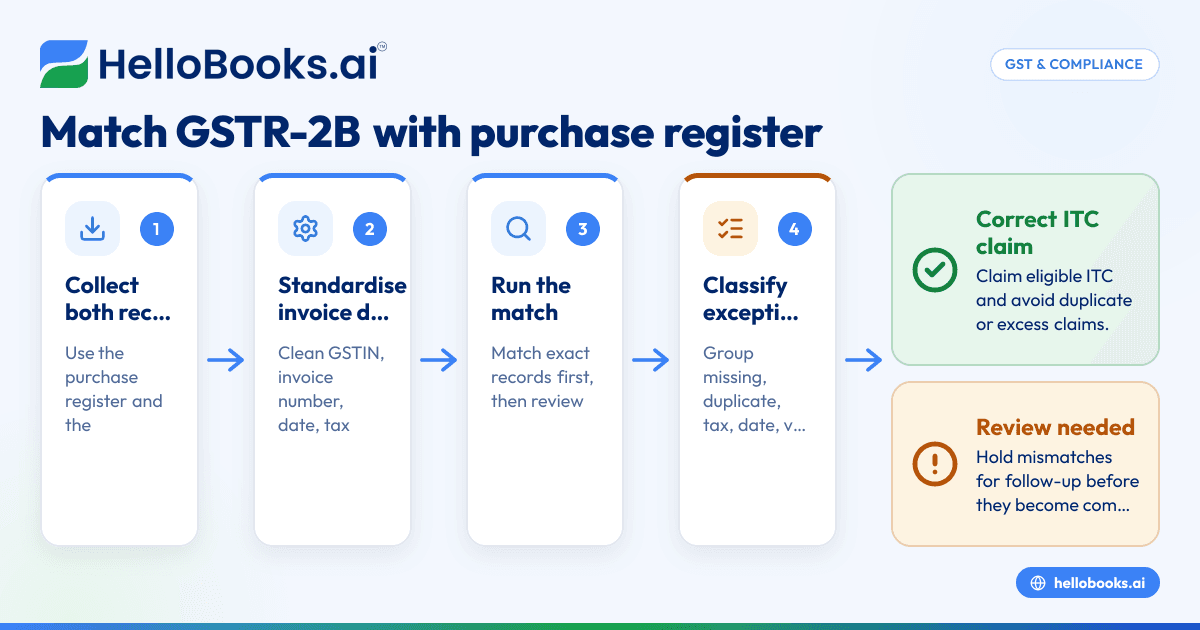
How to do GST reconciliation step by step
A workable GST reconciliation process should be simple enough to repeat every month. The steps below suit most small and growing businesses in India.
Step 1: Download GSTR-2B for the relevant period
Download the correct GSTR-2B for the month you are reviewing. Keep version control clear. Save files with a standard naming format such as GSTR-2B_Aug-2026_MH-GSTIN.
Step 2: Extract the purchase register for the same period
Take your purchase register from your accounting system. Include all purchase invoices, debit notes and credit notes relevant to the GSTIN and period. Remove obvious duplicates before matching.
If your business still relies on manual exports, this is where AI bookkeeping and structured data capture can reduce errors.
Step 3: Standardise the data
Before matching, clean both datasets:
- remove extra spaces from invoice numbers
- apply one date format
- separate GSTIN into one clean field
- split tax values into IGST, CGST and SGST
- classify document types correctly
Without standardisation, many valid invoices will appear as false mismatches.
Step 4: Run the match
Start with exact matching on:
- Supplier GSTIN
- Invoice number
- Invoice date
- Tax amount
Then run a second pass for probable matches using tolerance rules. For example, allow minor formatting differences in invoice numbers if the supplier GSTIN and tax amount match.
If you handle high invoice volume, bank reconciliation software style matching logic is also useful on the GST side because it reduces exception noise.
Step 5: Classify mismatches
Create a clear exception report with categories such as:
- Missing in GSTR-2B
- Missing in books
- Value mismatch
- Tax mismatch
- Duplicate in books
- Duplicate in GSTR-2B
- Wrong GSTIN
- Timing difference
- Credit note or amendment issue
This list becomes your action tracker.
Step 6: Assign owners and timelines
Not every mismatch belongs to the accounts team alone.
- Procurement can follow up with repeat-defaulting vendors.
- Branch admins can correct local invoice coding.
- Tax or finance leads can review disputed ITC treatment.
- Management can hold or release vendor payments based on compliance history.
For many SMEs, a simple weekly review call works better than endless email threads.
Step 7: Pass corrections and track open items
Correct the accounting records where your books are wrong. Follow up with suppliers where portal data is wrong or missing. Keep an ageing report for unresolved mismatches so they do not disappear into next month’s workload.
A simple monthly GST reconciliation checklist
You do not need a very complex system to stay disciplined. Use this monthly checklist:
Before reconciliation
- Close the purchase register for the period
- Ensure all invoices received up to cut-off are recorded
- Mark advances, credit notes and debit notes clearly
- Separate each GST registration
During reconciliation
- Match invoice by invoice
- Flag unmatched records
- Review partial matches carefully
- Identify vendor-wise repeat issues
- Track potential ITC at risk in ₹
After reconciliation
- Correct book errors
- Follow up with vendors
- Review open mismatches from prior months
- Finalise ITC working papers
- Keep supporting documents ready for audit or review
If your current process depends on Excel files sent over WhatsApp, this checklist alone can save hours each month.
Practical example of GST reconciliation in India
Imagine a trading business in Mumbai with one Maharashtra GSTIN. In September, its purchase register shows 240 purchase invoices.
After matching with GSTR-2B:
- 210 invoices match exactly
- 12 are missing in GSTR-2B
- 6 are present in GSTR-2B but missing in books
- 8 have invoice number or date mismatches
- 4 have tax amount differences
Now the business can act with clarity.
What the results mean
12 missing in GSTR-2B:
These may be supplier filing issues or timing differences. The team should ask vendors to confirm filing status and check whether the invoices appear in the next period.
6 missing in books:
These could be invoices received but not posted, wrong branch entries or documents not yet shared by operations. The accounts team should verify goods receipt and booking status.
8 invoice number or date mismatches:
These often come from typing errors or formatting differences. Standardisation may solve some. Others may need correction entries.
4 tax amount differences:
These need immediate review. It could be wrong tax classification, amendment by the supplier or a booking error.
Suppose the total tax amount involved in unresolved items is ₹1.8 lakh. That is not just a compliance issue. It is also a cash-flow issue. For a growing SME, even ₹1.8 lakh locked up every month can hurt working capital.
Best practices to reduce GST mismatches
Good reconciliation is not only about finding errors. It is about preventing them.
Keep vendor master data clean
Store the correct legal name, GSTIN, place of supply and registration mapping for each supplier. Bad master data creates repeat errors.
Make invoice capture faster
The longer invoices sit in email inboxes or branch drawers, the more likely they are to be missed. Use a standard intake process for all locations, including smaller depots and field teams.
Review suppliers with chronic filing issues
If a vendor repeatedly causes ITC problems, escalate it. Procurement and finance should jointly decide whether to continue, delay payment or tighten documentation requirements.
Reconcile every month, not at year-end
Year-end reconciliation is too late. By then, vendors may not respond, internal teams may have moved on and evidence may be harder to trace.
Use software that highlights exceptions
Manual matching works for small volumes, but it does not scale. Businesses moving beyond basic spreadsheets usually need accounting software in India that supports GST workflows, purchase recording and audit trails. If you are evaluating options beyond legacy tools, a Tally alternative may be worth considering if your main goal is less manual reconciliation and better month-end visibility.
For GST-heavy workflows, GST return filing software and e-invoicing software can also help reduce downstream errors by improving source data quality.
When should a business automate GST reconciliation?
You should seriously consider automation when:
- invoice volumes are growing every month
- you operate across multiple GST registrations
- your team spends days in Excel matching files
- unresolved ITC mismatches keep carrying forward
- vendor follow-up is ad hoc and undocumented
- month-end close is delayed because GST numbers are uncertain
Automation is especially useful for companies that receive invoices from many small suppliers across Mumbai, Pune, Surat or tier-2 markets where filing discipline varies. The right AI accounting software can help import purchase data, structure invoice fields, flag mismatches and keep an exception trail for action.
For a business owner, the biggest benefit is not just faster matching. It is confidence. You know what credit is supported, what is pending and where cash may be at risk.
How HelloBooks can help
HelloBooks is built for small businesses and accounting teams that want less manual work and better control over bookkeeping and compliance. If your team is managing purchases, invoicing and GST in disconnected tools, using one system for books and workflows can make reconciliation much easier.
Depending on your process, HelloBooks can help as accounting software for small business, with invoice capture, bookkeeping support and cleaner records that make GST matching less painful month after month.
If you want to reduce time spent on manual entries and GST follow-up, you can book a demo or compare plans on pricing.
Frequently asked questions
Is GSTR-2B enough for claiming ITC in India?
GSTR-2B is a very important document for ITC review, but businesses should also ensure their own purchase records are accurate and complete. In practice, both your books and GST portal data must be reviewed together.
How often should GST reconciliation be done?
For most businesses, monthly reconciliation is best. It helps catch missing invoices and vendor filing issues early, before they affect multiple periods.
What if an invoice is in my purchase register but not in GSTR-2B?
First, check whether it is a timing difference, a supplier filing delay or a data entry issue in your books. Then follow up with the supplier and track the invoice in the next period’s reconciliation.