


Key takeaways
What this article covers, in order:
- Why this comes up / what goes wrong
- Step-by-step
- Example (fictional figures)
- Common mistakes
- Doing this in HelloBooks
- Frequently asked questions
GST billing software is essential for Indian small businesses to generate tax invoices that comply with GST rules, automate tax calculations, and simplify GST return filing. Choosing the right software ensures accurate invoices with proper CGST/SGST/IGST splits, HSN/SAC codes, and smooth filing of GSTR-1 and GSTR-3B returns.
Why this comes up / what goes wrong
Small business owners often start with manual billing methods like spreadsheets, Tally, or bill books. As their business grows, managing GST compliance manually becomes time-consuming and error-prone. Common issues include incorrect tax calculations, missing invoice particulars required by Rule 46, and mismatched data when filing returns. These problems can lead to penalties or delays in GST refunds. Therefore, owners look for GST billing software to streamline invoicing and GST filing tasks.
Step-by-step
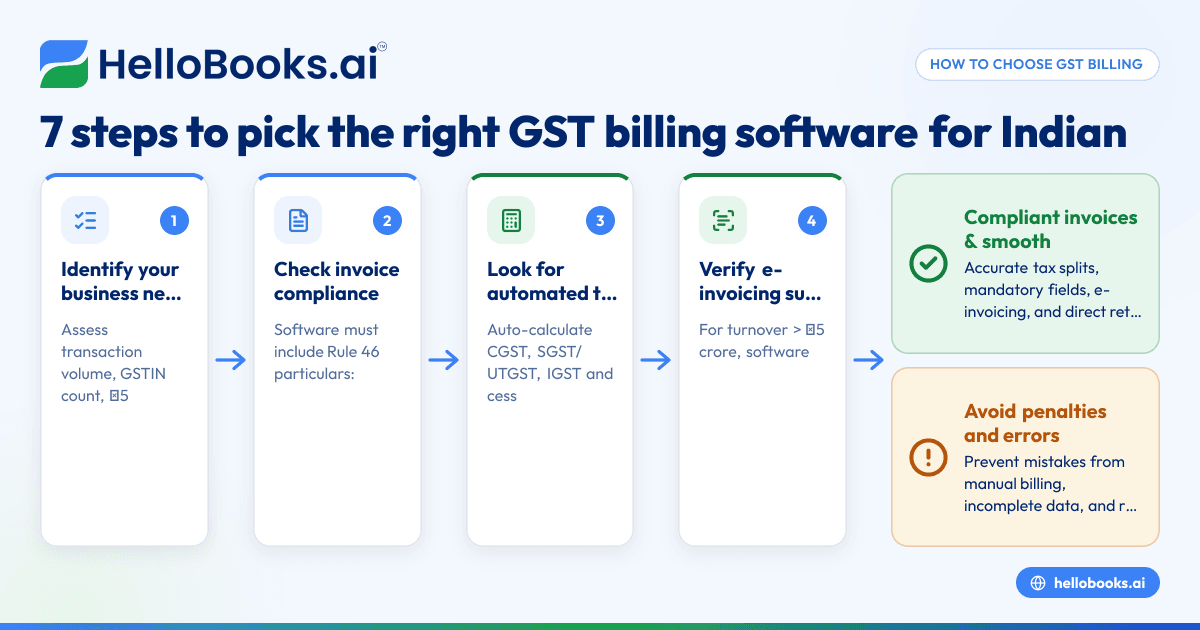
- Identify your business needs: Determine your transaction volume, number of GSTINs, and whether you cross the ₹5 crore turnover threshold requiring e-invoicing.
- Check invoice compliance features: Ensure the software creates invoices with all Rule 46 particulars, such as supplier and recipient GSTIN, HSN/SAC codes, tax splits, and unique serial numbers.[cgst-rule-46/rule46-particulars]
- Look for automated tax calculation: The software should automatically calculate CGST, SGST/UTGST, IGST, and cess based on your supply type and location.
- Verify e-invoicing support: If your turnover exceeds ₹5 crore, confirm the software generates IRN and signed QR codes on saving B2B invoices, reducing manual portal uploads.[einvoice-threshold-5cr/einv-5cr-from-2023-08-01]
- Check GST return filing integration: The software should build GSTR-1 and GSTR-3B returns directly from your recorded invoices and file them electronically, reducing errors and manual effort.[gstr1-due-date/gstr1-monthly-11th][gstr3b-due-date/gstr3b-monthly-20th]
- Evaluate user interface and support: Choose software with easy invoice creation, clear reports, and customer support to help with GST compliance.
- Consider cost and scalability: Compare free and paid plans, transaction limits, and multi-GSTIN support.
Example (fictional figures)
On 15/09/2023, a Mumbai-based supplier issues a GST invoice for goods sold to a Bangalore customer. The taxable value is ₹1,00,000, and the applicable IGST rate is 18% (assumed illustrative rate).
Taxable value = ₹1,00,000
IGST @ 18% = ₹1,00,000 × 18% = ₹18,000
Total invoice value = ₹1,00,000 + ₹18,000 = ₹1,18,000
The invoice must include:
- Supplier details with GSTIN
- Recipient details with GSTIN
- Invoice number and date
- HSN code of goods
- Taxable value
- IGST amount
- Place of supply (Karnataka)
- Signature or digital signature
This invoice can be created using GST billing software that ensures all fields are correctly filled and calculates tax automatically.
Common mistakes
- Incomplete invoice details: Missing GSTIN, HSN/SAC codes, or incorrect serial numbers can cause compliance issues. Use software that enforces mandatory fields as per Rule 46.[cgst-rule-46/rule46-particulars]
- Manual tax calculation errors: Calculating CGST/SGST/IGST manually leads to mistakes. Choose software with automated tax calculations.
- Ignoring e-invoicing requirements: Businesses over ₹5 crore turnover must generate IRN for B2B invoices. Not doing so can attract penalties. Verify e-invoicing support in your software.[einvoice-threshold-5cr/einv-5cr-from-2023-08-01]
- Mismatch between invoices and GST returns: Filing GSTR-1 with figures not matching invoices causes notices. Use software that builds returns directly from invoices recorded.
- Not updating software or ignoring GST rule changes: Stay updated with GST rules and software versions.
Doing this in HelloBooks
HelloBooks GST invoicing creates compliant tax invoices with the correct CGST/SGST or IGST split and HSN/SAC codes from the customer's GSTIN, ensuring all Rule 46 fields are filled consistently. For businesses with turnover over ₹5 crore, HelloBooks generates the IRN and signed QR code on saving B2B invoices, saving time compared to manual JSON uploads. It also builds GSTR-1 and GSTR-3B returns from your recorded invoices and files them directly to the GSTN, ensuring the return figures match your invoices. Learn more about GST invoicing and HelloBooks for India.
Frequently asked questions
What is the best free GST billing software?
Free GST billing software usually offers limited transactions and basic features. HelloBooks provides a free plan for up to 200 transactions a year, including GST invoicing and GSTR-1 and GSTR-3B filing for one GSTIN, suitable for small businesses starting out.
Do I need GST billing software if I use Tally or Excel?
Tally and Excel can be used for billing but may require manual data entry and reconciliation, increasing errors and time spent. GST billing software automates tax calculations, compliance checks, and return filing, reducing effort and mistakes.
How does e-invoicing work with GST billing software?
For businesses with turnover above ₹5 crore, GST billing software generates an Invoice Reference Number (IRN) and a signed QR code at the time of invoice creation, which replaces manual uploading of invoice data to the government portal.
Can GST billing software file GSTR-1 and GSTR-3B returns?
Many GST billing software solutions, including HelloBooks, build GSTR-1 and GSTR-3B returns directly from the invoices recorded and file them electronically, ensuring accuracy and saving time.
Is HSN or SAC code mandatory on GST invoices?
Yes, Rule 46 mandates including the HSN code for goods or SAC code for services on tax invoices to comply with GST regulations.[cgst-rule-46/rule46-particulars]
What are the deadlines for filing GSTR-1 and GSTR-3B?
Monthly GSTR-1 is due on the 11th day of the month following the tax period,[gstr1-due-date/gstr1-monthly-11th] and GSTR-3B by the 20th day.[gstr3b-due-date/gstr3b-monthly-20th] Businesses under QRMP file quarterly with different deadlines.[qrmp-scheme/qrmp-dates]
Key takeaways
- GST billing software automates compliant invoice creation, including CGST/SGST/IGST splits and HSN/SAC codes.
- E-invoicing (IRN and signed QR) is mandatory for businesses with turnover above ₹5 crore from August 2023.
- Software that files GSTR-1 and GSTR-3B directly from invoices reduces errors and manual work.
- Avoid common mistakes like incomplete invoices and manual tax calculations by using suitable software.
- HelloBooks offers GST invoicing, e-invoicing, and direct GST return filing features.
Start simplifying your GST compliance by choosing GST billing software that fits your business needs. You can Start on the Free plan (200 transactions a year, GSTR-1 and 3B filing for one GSTIN) with HelloBooks today.
This article is general information, not tax or legal advice. Rules change; confirm the current position on gst.gov.in or with your chartered accountant before acting.


