

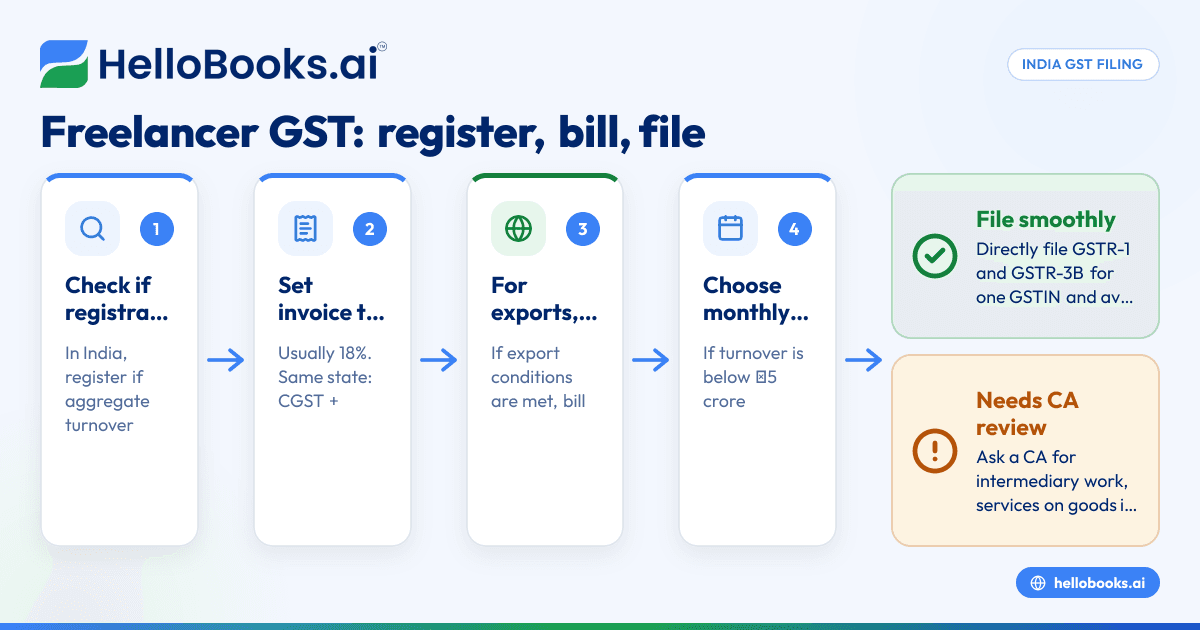

Key takeaways
What this article covers, in order:
- GST for freelancers in India is mostly an invoicing problem first
- When registration becomes a real issue for a solo professional
- Indian clients, out-of-state clients and place of supply confusion
- Foreign clients, export of services and getting paid from abroad
- Purchase bills, ITC and the traps freelancers underestimate
- A realistic invented quarter shows where the work actually is
India freelancers and consultants usually do not need “free GST filing software” first; they need clarity on when GST registration becomes necessary, how to invoice Indian and overseas clients correctly, and how to file GSTR-1 and GSTR-3B without mismatches. For most solo professionals, the practical answer is this: keep every GST invoice, purchase bill, bank receipt and return in one place, verify the current rules on the GST portal, and avoid guessing on place of supply, export treatment, IGST versus CGST/SGST, and ITC eligibility.
GST for freelancers in India is mostly an invoicing problem first
A freelancer or consultant in India can be paid in rupees through UPI, NEFT, RTGS or IMPS, or receive foreign remittances for export of services. In all of those situations, GST problems usually begin before return filing. The first issue is whether you should be registered under the Goods and Services Tax law at all. The second is whether the invoice itself is correct.
The legal framework here is the Central Goods and Services Tax Act, 2017, the Integrated Goods and Services Tax Act, 2017 and the related rules administered by the Central Board of Indirect Taxes and Customs (CBIC) and implemented through GSTN on the GST portal. Any current registration threshold, return frequency option, e-invoicing turnover trigger or filing calendar should be checked on the GST portal and CBIC notifications because these can change, and state-specific context can matter.
For freelancers, that means the safest workflow is not “make a bill at month-end and figure GST out later.” It is to create the invoice correctly on day one, with the customer GSTIN where relevant, the right place of supply, the right tax head split between CGST and SGST or IGST, and the right service classification. That reduces most of the cleanup that otherwise appears while filing GSTR-1 and GSTR-3B.
If you want that process to stay simple, software that creates GST invoices and carries the same data into GST return filing is far more useful than a tool that only helps on the last filing screen.
When registration becomes a real issue for a solo professional
Many freelancers delay this question because they are not running a shop, holding stock, or calling themselves a “business.” GST does not care much about that label. If you are supplying services for consideration in India, the registration question is determined by the GST law, the nature of supply, your aggregate turnover and some special cases published by CBIC and on the GST portal.
Do not rely on a social-media post for the current turnover threshold. The latest number should be verified from the CGST Act read with CBIC notifications and the GST portal. NEEDS EXPERT REVIEW
Two practical points matter more than generic threshold talk:
- Some freelancers register even before they are strictly compelled to, because a client’s accounts-payable team insists on a GSTIN.
- Once registered, return filing becomes a continuing obligation, including periods with no business activity, as reflected in the return system on the GST portal.
That second point is where “free” software can help or hurt. A tool is useful only if it reduces routine compliance work: generating invoice data in the format needed for returns, letting you file GSTR-1 and GSTR-3B directly, and helping you track purchase-side ITC without maintaining side spreadsheets.
HelloBooks is relevant here because it can create GST invoices and file GSTR-1 and GSTR-3B from the same records, which is exactly what a solo consultant needs if the goal is fewer mismatches rather than one more disconnected app.
Indian clients, out-of-state clients and place of supply confusion
Freelancers often think GST is just “add tax if the client is in India.” In practice, one of the most expensive recurring errors is using the wrong tax head. A designer in Kochi, a developer in Bengaluru, and a marketing consultant in Mumbai can all make the same mistake: charging CGST and SGST when IGST should apply, or the other way around.
That is governed by the GST law, especially the place-of-supply rules under the IGST Act, 2017. The applicable rule depends on the nature of the service, where the supplier is located, where the recipient is located, and in some cases where the service is actually performed or consumed. The current legal position must be checked from the Act, CBIC guidance and the GST portal.
For many ordinary B2B consulting and freelancing services, the practical billing question is whether the supply is intra-state or inter-state. But “many” is not “all.” Event-linked services, intermediary services, services tied to immovable property, and certain performance-based services need closer review.
This is why invoice software matters. If the system can derive the tax head split from the customer location and place of supply logic, it reduces a common human error. In smart invoicing, that means the invoice is not merely pretty; it is structurally more likely to survive scrutiny by a client’s finance team, a CA, or your own return reconciliation later.
You should also validate the client GSTIN before invoicing. A simple GSTIN validator helps avoid obvious data-entry mistakes that later flow into GSTR-1.
Foreign clients, export of services and getting paid from abroad
For Indian freelancers, this is the area where bad advice spreads fastest. Receiving money from outside India does not automatically settle the GST treatment. The correct analysis depends on whether the transaction qualifies as export of services under the IGST Act, 2017, as administered through the GST framework under CBIC and reflected in GST portal processes.
The current statutory conditions for export of services should be read from section 2(6) of the Integrated Goods and Services Tax Act, 2017 and related guidance. Do not assume that every overseas client arrangement qualifies automatically. Where the work resembles intermediary services, involves an Indian establishment of the same entity, or has delivery/use complications, professional review is sensible.
For freelancers who genuinely supply export of services, the commercial issue is simple: your invoice wording, documentary trail and banking records must line up. In practice that means keeping:
- the contract or email trail,
- the invoice,
- remittance evidence from the bank,
- and any relevant declaration or undertaking required under the GST process for zero-rated supplies.
Because remittances may arrive in INR where permitted by RBI arrangements, or in foreign currency routed into your Indian bank account, your records should reflect what actually happened rather than what a generic template assumes. RBI rules and bank documentation practice matter here alongside GST law.
A useful accounting setup is one where you can upload a bank statement and match receipts to invoices instead of manually tracing each inward remittance line by line. That is especially valuable when one client pays multiple invoices together or deducts bank charges. HelloBooks supports bank statement upload with AI reconciliation for India, so a freelancer can tie receipts back to invoices without retyping every bank narration.
Purchase bills, ITC and the traps freelancers underestimate
Freelancers tend to focus on output invoices and ignore the purchase side until the return is due. Then they discover a pile of laptop bills, SaaS subscriptions, coworking invoices, contractor charges or professional fees, and they are unsure what can be claimed as input tax credit.
Eligibility for ITC is governed by the CGST Act, 2017, the CGST Rules, 2017 and the matching logic visible through GSTN data on the GST portal. The current conditions, restrictions and blocked-credit rules must be checked from the statute, CBIC circulars and your own fact pattern. You should not claim a credit just because tax appears on a vendor invoice.
For freelancers, the real operational problems are usually these:
- the supplier invoice is missing or unreadable,
- the supplier has not correctly reported the invoice,
- the expense is partly personal and partly business,
- reverse charge implications were missed,
- or TDS and GST were tracked in separate sheets that do not agree.
This is where OCR for purchase bills and reconciliation matter more than one-click filing. If you can capture bills from a photo or PDF, compare them with GSTR-2A or 2B, and track ITC before filing GSTR-3B, you are less likely to overclaim or miss legitimate credit.
HelloBooks is useful in this narrow but important way: purchase bills can be captured with OCR, ITC can be reviewed against GSTR-2A/2B, and TDS or reverse charge entries can be handled in the books rather than on a side note. For a consultant working alone, that is often the difference between books that reconcile and books that merely look complete.
If you want a quick cross-check, a GST reconciliation checker can help surface obvious mismatches before filing.
A realistic invented quarter shows where the work actually is
Take an illustrative and invented case, not a legal opinion: a consultant in Kerala bills three Indian clients and one overseas client in a quarter. Assume the consultant receives INR credits through bank transfer for domestic invoices, one foreign remittance converted into rupees by the bank, pays for software subscriptions, a laptop repair, and coworking space, and has one purchase invoice where the supplier’s GST reporting is delayed. The figures below are invented only to show the workflow, and they leave out income-tax treatment under the Income-tax Act, 1961, surcharge, cess, foreign-exchange accounting nuances, and any sector-specific GST issues.
Suppose the quarter has these invented entries:
- Domestic client in Kerala: ₹48,000 billed
- Domestic client in Karnataka: ₹72,000 billed
- Startup client in Maharashtra: ₹35,000 billed
- Overseas client remittance: ₹90,000 equivalent credited by bank after charges
- Software subscriptions and local expenses with GST shown on bills: ₹22,000 total invoice value across vendors
What happens in practice is not “calculate one net tax number.” First, each sales invoice must carry the correct GST treatment under the CGST Act and IGST Act based on place of supply and the status of the customer. Second, the overseas invoice must be reviewed under the export-of-services conditions in the IGST Act, not merely because the payer is outside India. Third, the purchase invoices must be checked in GSTR-2B before relying on them for ITC in GSTR-3B. Fourth, the bank receipt of ₹90,000 equivalent may not match the face value of the invoice because of charges and conversion; your books must capture that difference properly.
In other words, even in a tiny quarter, the hard part is document discipline. The return is simply the final expression of the documents. That is why software that combines invoicing, OCR for bills, bank statement upload and direct GSTR-1/GSTR-3B filing tends to be more useful for freelancers than a returns-only utility.
What “free GST filing software” should really do for an Indian freelancer
A free or low-friction tool is good only if it removes repetitive compliance work in India. For a consultant, the useful benchmark is not how many buttons it has; it is whether it keeps the same data flowing from invoice to return to books.
The essentials are straightforward:
- GST invoice creation with the correct fields
- customer GSTIN capture and validation
- place-of-supply handling with proper CGST/SGST or IGST split
- purchase-bill capture for expenses and ITC review
- bank statement upload to match receipts and expenses
- direct filing of GSTR-1 and GSTR-3B
- reports that show turnover, receivables and tax position together
That is the practical attraction of accounting software for small business built for India rather than a generic invoice maker. If you already keep old data in Tally, migration matters too; many freelancers start with a CA-maintained Tally file and later want a simpler operating system without losing continuity. HelloBooks supports Tally migration and a connector, which makes the shift less disruptive.
For people who work mostly from a phone, the mobile app on iOS and Android matters because bills and expenses are often captured on the move. For a freelancer juggling client calls and travel, that is more relevant than advanced enterprise features.
Choosing software without buying another compliance headache
The wrong tool creates duplicate work: invoice in one app, track receipts in Excel, review expenses in email, and then manually type totals into the GST portal. The right tool reduces duplication and keeps your books closer to your returns.
If you are evaluating options in India, ask these questions:
- Can I create GST invoices that correctly reflect place of supply and tax head split?
- Can I file GSTR-1 and GSTR-3B from the same invoice data?
- Can I upload a bank statement and reconcile receipts without manual entry?
- Can I capture purchase invoices from PDFs or photos and compare them with GSTR-2B?
- If I have more than one GSTIN in future, will the setup still work?
- If my CA still uses Tally, can my records stay aligned?
If the answer to most of those is no, the software may be “free” but not cheap in time or risk.
HelloBooks is worth considering in that context because it focuses on the India-specific parts freelancers actually struggle with: GST invoicing, e-invoicing where legally applicable under the current CBIC framework, GSTR-1 and GSTR-3B filing, ITC tracking through GSTR-2A/2B reconciliation, bank statement upload for India, and books that stay tied to the same entries. If you want details or a walkthrough, see the India pages at HelloBooks India, pricing, or request a demo.
Before you file, check the official source for the current rule
GST for freelancers in India is manageable when you separate three questions:
- Do I need registration under the current law?
- Is each invoice legally correct?
- Do my books support what I am filing in GSTR-1 and GSTR-3B?
For the live numbers and dates, do not trust an old blog post, including this one. Check the current position on the GST portal, GSTN utilities, CBIC notifications and the text of the CGST Act, IGST Act and relevant rules. For income-tax overlap such as TDS credit, business income treatment and deductions, verify the current law under the Income-tax Act, 1961 and the Income Tax Department’s official materials.
If you want a lightweight starting point, use a GST calculator for rough invoice math, validate a client with the GSTIN validator, and then keep invoicing, purchase bills and return filing inside one India-ready workflow instead of stitching together four different tools.


