
Key takeaways
What this article covers, in order:
- What “free GST filing software” should mean for an Indian freelancer
- The first question is not software: do you need GST registration at all?
- For freelancers, invoice accuracy matters more than invoice design
- Indian clients, foreign clients and export invoices are not the same job
- Input tax credit is often small for freelancers, but errors are costly
- A realistic invented quarter shows where freelancers lose time
India freelancers and consultants usually need software that does three things well: creates GST-ready invoices, keeps books matched to bank receipts and purchase bills, and files GSTR-1 and GSTR-3B without retyping. Whether you bill in ₹ to an Indian client, receive export payments under RBI rules, or juggle one GSTIN across projects, the practical question is not just “free or paid?” but whether the tool helps you stay consistent with the GST law, the GST Portal and CBIC guidance.
What “free GST filing software” should mean for an Indian freelancer
For a solo consultant, designer, developer, marketer, trainer or agency-of-one, GST work is rarely just “submit a return.” It starts much earlier:
- you raise an invoice with the right GSTIN details,
- you choose the correct place of supply,
- the tax has to split correctly between CGST and SGST or go to IGST,
- export invoices need the right wording and supporting trail,
- purchase bills affect input tax credit,
- receipts hit the bank through UPI, NEFT, RTGS or IMPS and need matching,
- then GSTR-1 and GSTR-3B should reflect the same books.
That is why a genuinely useful free option in India is not a PDF invoice maker with a “GST” label pasted on top. It should reduce the most frequent mismatches seen on the GSTN system and the GST Portal: wrong tax head, missing supplier invoices in GSTR-2B, invoice values that do not agree with books, and return figures typed manually from spreadsheets.
If you want to see what the platform offers in India, the country page is here: HelloBooks India. If you are comparing options before deciding, it also helps to check the full pricing and book a demo.
The first question is not software: do you need GST registration at all?
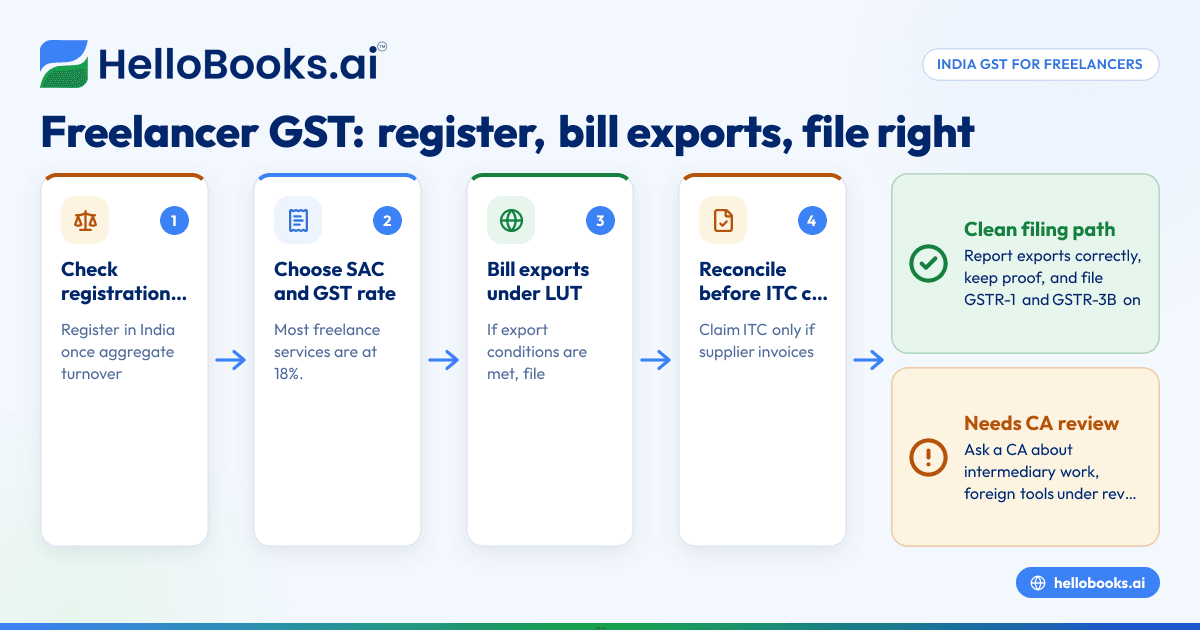
A freelancer’s GST decision in India depends on the Central Goods and Services Tax Act, 2017, the Integrated Goods and Services Tax Act, 2017, and notifications issued under those laws by the Central Board of Indirect Taxes and Customs (CBIC). The live registration thresholds, category-based rules and notifications are published through CBIC and reflected on the GST Portal. Because those figures can change by notification, you should confirm the current position there or with a chartered accountant before acting on them.
What matters in practice is this:
- many freelancers register because the law requires it under current CBIC notifications and the GST Acts;
- some register voluntarily because Indian clients ask for a GSTIN before vendor onboarding;
- some need a GST invoice so their client can account for ITC where eligible;
- once registered, you are inside the GST compliance cycle even in slow months.
This is where software helps. A tool that stores your customer GSTIN, applies place-of-supply logic and builds your GSTR-1 and GSTR-3B from the invoices already issued is far more useful than one that leaves you to type figures again on the GST Portal. HelloBooks does that directly through its GST return filing software workflow, which matters most when you are filing regularly and want your books and returns to agree.
For freelancers, invoice accuracy matters more than invoice design
Under the CGST Act and the CGST Rules, especially the invoicing requirements under the Rules, a tax invoice needs specific fields. The exact requirements and updates are published through CBIC notifications, circulars and the GST Portal. The problem for freelancers is not usually missing a logo or using the wrong template. It is more basic:
- charging CGST and SGST when IGST should apply,
- missing SAC or HSN-related classification details where required,
- leaving out the client GSTIN when needed,
- using the wrong place of supply,
- failing to keep invoice numbering consistent,
- treating exports as ordinary domestic supply.
For service businesses, the place of supply point is a repeat offender. A consultant in Karnataka billing a company in Maharashtra does not want to discover months later that local tax was charged where IGST should have appeared, or vice versa. HelloBooks is useful here because the invoice flow can use customer GSTIN and place-of-supply rules to split the tax head correctly and keep GST invoicing aligned with the transaction, rather than leaving the choice to memory on each invoice. If you want to see that side first, start with smart invoicing.
A small but practical point: many freelancers still move between Excel, Word, and Tally-style habits. If you already have data in Tally, migration matters more than fancy automation claims. HelloBooks has a Tally migration and connector path, which is relevant when you do not want to rebuild your books from zero just to improve GST filing.
Indian clients, foreign clients and export invoices are not the same job
Freelancers often collapse three separate issues into one: who the client is, where the place of supply falls, and whether the transaction qualifies as export of services under the IGST Act. Those are legal questions under the Integrated Goods and Services Tax Act, 2017, with guidance and notifications available through CBIC and the GST Portal; foreign exchange realisation conditions also connect to RBI rules and banking documentation.
For Indian clients, the recurring operational issue is tax-head accuracy and clean filing.
For foreign clients, the operational issue is documentation. If your service qualifies as an export of services under the IGST Act, the treatment is governed by that law and current CBIC guidance published on official channels. The exact wording, declarations and current procedural details should be checked on the GST Portal and with your advisor, especially where LUT, zero-rated supply treatment, or proof of payment in foreign exchange is involved. Payments may arrive through banking channels under RBI-permitted modes, and your records should preserve the invoice, remittance proof and underlying contract.
Software cannot decide every export classification issue for you. Intermediary services, group entities, and edge cases involving Indian establishments or mixed performance can need expert analysis. But software can make the record trail stronger. Keeping the invoice, customer details, bank receipt and books together is much better than hunting across Gmail, PDFs and passbooks at return time.
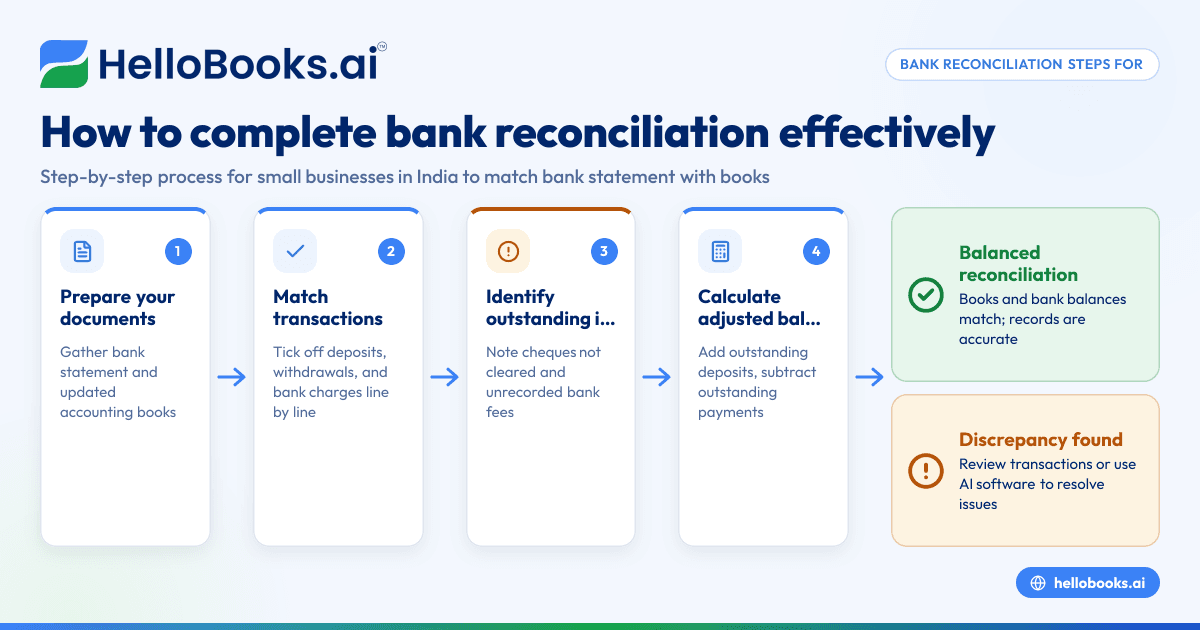
This is where uploading a bank statement in INR or foreign inward remittance-linked entries becomes practical. HelloBooks lets you upload bank statements and reconcile receipts with invoices using AI assistance for India, which is useful when payments come in batches or clients pay after TDS deductions. You can explore that at bank reconciliation software.
Input tax credit is often small for freelancers, but errors are costly
A solo professional may not have warehouse-scale purchases, yet ITC still appears on laptops, software subscriptions billed in India, coworking, contractors, internet services, business travel in some cases, and other recurring expenses depending on facts and eligibility. The rules come from the CGST Act, 2017 and related Rules, while the availability reflected in GSTR-2A and GSTR-2B is surfaced through GSTN on the GST Portal.
The practical problem is not just “what did I spend?” It is “what can I support, what did the supplier upload, and what did I already claim?”
For freelancers, four things repeatedly go wrong:
- purchase bills stay in email and never enter the books;
- the supplier invoice details do not match what appears in GSTR-2B;
- ineligible items get mixed with eligible business expenses;
- TDS deductions and reverse charge situations are tracked in side sheets rather than the accounting system.
HelloBooks is relevant here because it can pull data from purchase bill PDFs or photos using OCR, track reconciliation against GSTR-2A/2B, and keep ITC visibility close to the books you will later use for GSTR-3B. It also handles TDS/TCS and reverse charge entries in the accounting flow, which matters for consultants who work with larger clients that deduct TDS under the Income-tax Act, 1961. Tax deducted at source is not the same thing as GST liability, but in real life both affect cash flow and reconciliation, so keeping them in one system reduces confusion.
If you want a quick check before filing, HelloBooks also offers free India utilities like a GST reconciliation checker, a GSTIN validator and an HSN code search.
A realistic invented quarter shows where freelancers lose time
Consider an illustrative and invented consultant in Bengaluru with one GSTIN. None of the figures below are legal guidance; they are only a simple working picture and they leave out edge cases like credit notes, foreign currency conversion differences, blocked credits, reverse-charge-specific analysis, and any law-specific threshold or due-date consequences.
Suppose she issues three domestic invoices and two export invoices in one quarter. The domestic invoices are for an invented ₹48,000, ₹75,000 and ₹1,10,000. One customer is in Karnataka and two are outside the state. She also records invented business purchases of ₹12,000 for software, ₹18,000 for a laptop accessory order, and ₹9,500 for internet and workspace costs, subject to eligibility under the CGST Act and whatever actually appears in GSTR-2B.
If she works from spreadsheets, she may have to:
- prepare each invoice manually,
- decide tax-head split each time,
- download and compare supplier data,
- total B2B and other invoice classes for GSTR-1,
- summarize tax payable and ITC for GSTR-3B,
- check whether the receipts in the bank statement really match those invoices.
If she works in HelloBooks, the same quarter is cleaner because the invoices themselves feed the return data, bank statement upload helps match the receipts, and purchase OCR reduces manual bill entry. The value is not “free filing” in isolation. The value is that the books used for financial reports and the books used for GST are the same books.
That becomes important at year-end too. A freelancer applying for a loan, preparing Companies Act or MCA-linked vendor documents for a client, or simply reviewing annual profit in rupees does not want a P&L that disagrees with filed GST returns.
If you also sell goods, dispatches change the workflow
Some consultants and freelancers are hybrid businesses. A creator sells merch, a designer resells printed materials, a tech professional sends hardware kits, or a trainer ships course packs. Then GST compliance is no longer only about service invoices. You may need inventory records, dispatch documentation and, depending on the movement and current legal position under the GST law and e-way bill rules, an e-way bill generated through the official system.
The current applicability conditions and limits for e-way bill generation are published under the GST law through CBIC notifications and the e-way bill system, so those figures should be checked on the official portal before relying on them.
Operationally, what changes is simple: once physical movement starts, data entry duplication becomes expensive. If your invoice already contains the consignee, goods details and taxable value, generating the e-way bill from the same transaction saves time and lowers mismatch risk. HelloBooks supports that flow, which is why it can work for a freelancer who is part service business and part product business, not just a pure consultant. Related details are on e-way bill software and inventory.
What to look for before you trust any “free” option
In India, the word “free” can hide the real burden: manual work moved onto you. Before choosing a GST filing tool, check whether it actually helps with your compliance pattern.
A freelancer or consultant should look for:
- direct GSTR-1 and GSTR-3B filing, not only export to Excel;
- GST invoice creation with GSTIN, place-of-supply and tax-head logic;
- e-invoicing support if your business falls under the current CBIC-notified requirement, with IRN and signed QR handled from the software after you confirm applicability on official sources;
- purchase bill capture and GSTR-2A/2B reconciliation for ITC tracking;
- bank statement upload, not just ledger entry, so receipts through UPI, NEFT, RTGS and IMPS can be matched sensibly;
- financial reports that use the same entries as GST;
- multi-GSTIN support if you operate registrations in more than one state.
Those are the areas where HelloBooks is strongest for this article’s use case. If your practice grows from solo freelancing to a small firm with staff, unlimited users and multiple GSTINs become more relevant than they seem on day one.
Also remember the non-GST layer. Your accounting records still sit in a broader Indian legal environment: the Income-tax Act, 1961 for income tax and TDS, the Companies Act, 2013 and MCA processes if you later move into a company structure, RBI rules where foreign receipts are involved, and the DPDP Act for data handling expectations in India. Software is not your legal advisor, but it should help you keep a cleaner trail across these realities.
So, is HelloBooks a good fit for freelancers and consultants in India?
If your real need is only to generate a one-off invoice PDF, almost any template may feel enough. But if you are registered under GST in India and want one place to issue invoices, reconcile purchase bills and bank receipts, track ITC, and file GSTR-1 and GSTR-3B directly, HelloBooks is a strong fit.
It is especially relevant when:
- you invoice both Indian and overseas clients,
- you want place-of-supply and CGST/SGST/IGST logic built into invoicing,
- you do not want to re-enter figures on the GST Portal,
- you need GSTR-2A/2B visibility before claiming ITC,
- you receive payments that need careful reconciliation against invoices and TDS deductions,
- you may grow from a solo consultant into a small multi-user practice.
For a closer look, you can explore accounting software India, compare it as a Tally alternative, or go straight to the pricing page. If you want to test the workflow with your own GSTIN, invoice pattern and bank statement format, the most useful next step is to book a demo.