
Key takeaways
What this article covers, in order:
- The GST issues agencies face most often in India
- Free filing matters less than whether your invoices are right
- Advances from clients are where service firms often slip
- Reimbursements are not all the same under GST
- Place of supply decides whether you charge IGST or CGST plus SGST
- Purchase bills, reverse charge, and GSTR-2B matter even for service firms
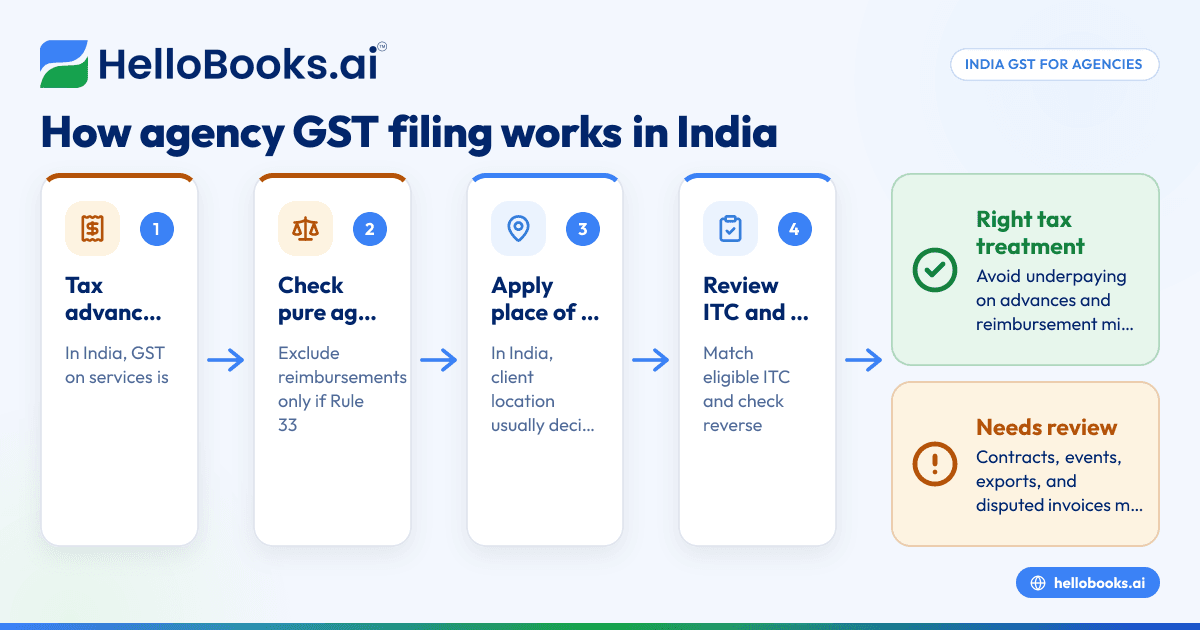
India agencies and service businesses usually do not struggle with GST because filing is mysterious; they struggle because everyday work creates edge cases: an advance hits the bank before work starts, a client in another state changes the tax head from CGST/SGST to IGST, a reimbursement may or may not qualify under the pure agent rule, and supplier credits in GSTR-2B do not always match your books. If you want “free GST filing,” the real question is whether your setup keeps invoices, bank receipts, purchase bills, and GST returns aligned on the GST portal.
The GST issues agencies face most often in India
A digital agency, design studio, recruitment firm, consultancy, software service company, and event-led service business can all look similar in accounting terms: low inventory, high people cost, milestone billing, retainers, vendor pass-throughs, and frequent interstate work. That is exactly why GST errors often start small and then repeat every month.
The trouble spots are usually these:
- money received in advance by UPI, NEFT, RTGS, or IMPS before the final invoice is raised
- deciding whether a client bill should carry CGST and SGST or IGST
- separating your own fee from third-party costs you recovered
- tracking reverse charge in specific service purchases
- checking whether purchase invoices actually appear in GSTR-2A or GSTR-2B before input tax credit is used
- keeping one set of books that agrees with GSTR-1 and GSTR-3B
Under the Central Goods and Services Tax Act, 2017 and the Integrated Goods and Services Tax Act, 2017, administered through CBIC and implemented operationally on GSTN via the GST portal, the answer to these issues depends on the nature of the supply, place of supply, time of supply, and documentation. Current rates, thresholds, and filing dates are published on official CBIC notifications, the GST portal, and GSTN advisories; if you need the current figure for your case, verify there rather than relying on a blog.
Free filing matters less than whether your invoices are right
Many businesses search for free GST filing when what they really need is fewer corrections. If an agency raises invoices manually, tracks collections in a spreadsheet, stores purchase bills in email, and then tries to compile returns at month-end, “free” can become expensive in staff time.
For Indian service firms, the useful part is not only that returns can be filed; it is that the sales invoices already carry the right GSTIN, place-of-supply logic, and tax head split so GSTR-1 and GSTR-3B are built from the same records. In HelloBooks, that matters because GST invoicing and direct filing to GSTR-1 and GSTR-3B are tied to the entries you already made instead of being retyped later.
That is especially relevant if you bill clients in more than one state or operate multiple registrations. A firm with one GSTIN in Karnataka and another in Maharashtra needs separate compliance without separate chaos. If that is your structure, using one login across multiple GSTINs with unlimited users is more relevant than whether the filing screen itself is free. You can review GST return filing software, accounting software India, or the India page at /in, and if you need commercial details, check /in/pricing.
Advances from clients are where service firms often slip
Agencies frequently receive retainers, project kickoffs, campaign advances, production deposits, or annual support fees before all work is delivered. Under GST, the treatment of advances for services is governed by the CGST Act and rules under it, with current guidance and notifications published by CBIC and surfaced through the GST portal. Because positions can change through notifications and sector-specific interpretation, confirm the live rule from the official source before acting on any article.
In practice, what matters is this: do not wait until project completion to think about GST just because your internal commercial milestone is later. If money is received first, your documentation and return treatment may need to reflect that earlier event under the law.
An illustrative and invented case makes the risk clearer. Suppose a Delhi branding agency receives ₹2,40,000 as an advance from a client in Gurugram for a campaign that will begin next month. These figures are illustrative and invented, and they leave out any special facts such as credit notes, export treatment, or contractual clauses that may change the result. The agency should not simply book the rupee amount as “advance from customer” and forget it until final billing. It needs to check the time-of-supply position under the CGST Act, issue the appropriate tax document where required, and ensure the amount is reflected properly in the period’s GST reporting on the GST portal.
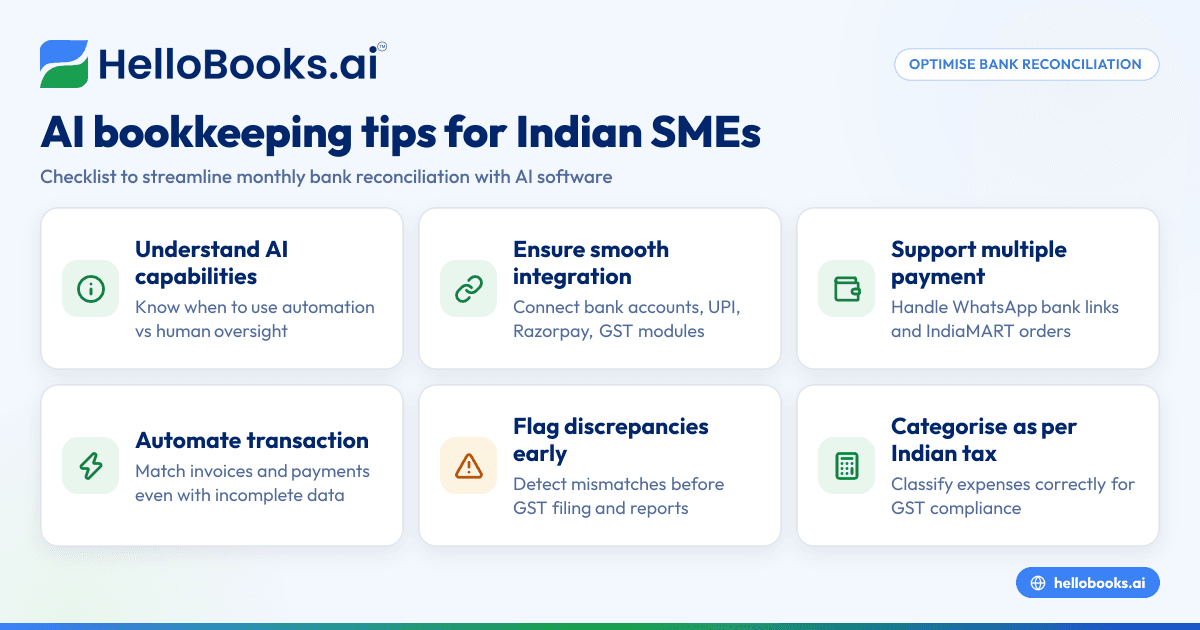
This is where accounting discipline matters more than memory. If you upload the month’s bank statement and reconcile receipts against invoices and advances, the chance of missing a taxable receipt goes down sharply. HelloBooks supports bank statement upload with AI reconciliation for India, which is useful for agencies receiving many small UPI or bank transfers from clients.
Reimbursements are not all the same under GST
Service firms love to call things “reimbursable,” but GST does not care what the email subject line says. It cares whether the amount forms part of the value of your supply, and whether the conditions around pure-agent treatment are actually met.
The relevant legal framework sits under the CGST Act, 2017 and the CGST Rules, 2017, particularly the valuation rules administered by CBIC. The official wording of the rule, circulars, and any updates should be checked on CBIC and the GST portal.
For agencies, the distinction usually looks like this:
- if you incur a cost in your own name and use it to perform your service, recovery from the client is often part of your taxable value
- if you merely pay a third party on the client’s behalf and satisfy the pure-agent conditions in the contract, invoice, and actual conduct, the treatment may differ under the rules
That sounds abstract until you apply it to common India workflows:
- ad platform spend paid using the agency card
- travel booked by the agency for a client meeting
- printing, venue, or freelancer costs marked up and rebilled
- statutory fees paid on behalf of a client
An illustrative and invented scenario: a Mumbai event agency pays ₹85,000 to a printer, ₹40,000 for local logistics, and charges a separate management fee of ₹1,20,000 to the client. These numbers are illustrative and invented, and they leave out contract language, vendor invoice names, markups, and other facts that determine GST treatment. If the printer and logistics services were procured in the agency’s own name and formed part of the service bundle delivered by the agency, treating the rupee amounts as outside taxable value simply because they were “recovered” could be wrong. If, however, one item was genuinely paid as a pure agent under Rule 33, documented separately, and recovered at exact cost, the analysis may be different. This is a contract-and-facts question, not a labelling question.
Your software should therefore let you separate service fees, pass-through costs, and tax treatment cleanly on the invoice rather than collapsing everything into one line called “professional charges.”
Place of supply decides whether you charge IGST or CGST plus SGST
This is one of the most frequent agency mistakes in India because clients are mobile, teams work remotely, and the person approving the invoice is often not the person checking tax.
For services, whether you charge IGST or split the amount into CGST and SGST depends on the place-of-supply provisions in the IGST Act, 2017 together with the location of supplier and recipient. These provisions are administered through CBIC and reflected in GSTN filing flows on the GST portal. The current statutory rules and any explanatory circulars must be read from official publications.
In ordinary B2B situations, the recipient’s location often drives the answer, but many service categories have special place-of-supply rules. Events, training, performance-related services, and services linked to immovable property can diverge from the standard pattern.
An illustrative and invented comparison:
- a Bengaluru software services firm invoices a registered client whose GSTIN belongs to Tamil Nadu
- the same firm invoices a registered client whose GSTIN belongs to Karnataka
These facts are illustrative and invented, and they leave out exceptions such as exports, special categories of services, or disputed recipient location. The point is not the amount; the point is that the same team, same contract style, and same rupee value can still require a different tax head split depending on place of supply and registration details.
If your invoicing tool picks up the customer GSTIN, applies place-of-supply logic, and shows the correct tax head split before the invoice is saved, you remove a large class of avoidable errors. HelloBooks does that in the normal invoicing flow, which is more useful than trying to fix misclassified interstate and intrastate invoices inside returns later. If you want to see how this works in practice, smart invoicing and accounting software for small business are the relevant pages.
Purchase bills, reverse charge, and GSTR-2B matter even for service firms
Service businesses sometimes think GST compliance is mainly about sales. In reality, purchase-side discipline matters because your input tax credit position depends on supplier behaviour too.
The legal framework comes from the CGST Act and associated rules, with ITC conditions, blocked credits, and reverse charge positions published through CBIC notifications, circulars, and the GST portal. Because these areas change through interpretation and updates, the current position should be confirmed from the official source and, where material, with your CA.
For agencies and similar firms, purchase-side trouble usually appears in these forms:
- a freelancer or vendor bill is sitting in email but never entered in books
- the supplier has given a GSTIN invoice, but the invoice is missing from GSTR-2B
- tax under reverse charge on a specific inward supply is forgotten
- TDS is deducted or collected somewhere in the chain, but the posting in books is incomplete
If your purchase process starts with photos and PDFs, OCR on purchase bills reduces the chance that bills remain outside your books. Then reconciliation against GSTR-2A and GSTR-2B helps you see which credits are actually reflected before you use them in GSTR-3B. HelloBooks supports OCR for purchase bills and GST reconciliation with ITC tracking, which is particularly relevant for agencies working with many vendors each month.
Where TDS or reverse charge enters the picture, the accounting also needs to land in the right ledgers, not in side spreadsheets. That is why TDS/TCS and reverse charge handling is relevant here, even though this article is about GST filing rather than income-tax return preparation under the Income-tax Act, 1961.
If you want a quick self-check before touching returns, the free GST reconciliation checker, GSTIN validator, and GST calculator are the right supporting tools.
E-invoice, e-way bill, and service firms: relevant only in specific cases
Not every agency needs e-invoicing or an e-way bill every day, but some do need them at the wrong moment and scramble because nobody planned the workflow.
Under the GST framework, e-invoicing requirements, including IRN generation and the signed QR, are notified by CBIC and implemented through the GST system infrastructure. Eligibility thresholds and current applicability are published in official notifications and on the GST portal; do not rely on any unverified number in a generic article. Likewise, e-way bill rules are governed by the GST law and e-way bill system notifications, with current operational requirements published on the official portal.
For a pure consulting firm, e-way bill may be irrelevant most months. For an event agency moving printed material, stage items, promotional kits, or equipment between states, it can become very relevant. For a larger service firm crossing the notified e-invoicing applicability criteria, manually creating invoices and then separately generating IRN is exactly the kind of duplicate effort that creates errors.
That is why the useful question is not “Do agencies need these?” but “Which part of our service business triggers them?” If they do apply, generating the IRN and signed QR in the same invoicing flow, or creating the e-way bill from invoice data rather than typing consignment details again, saves time and lowers mismatch risk. The relevant product pages are e-invoicing software and e-way bill software.
Filing GSTR-1 and GSTR-3B is easier when books and returns are one system
The biggest practical difference between clean GST filing and recurring confusion is whether your books, invoices, collections, and purchase records live together.
If they do not, month-end usually looks like this: export invoices from one app, copy them to Excel, compare against the GST portal, ask the team for missing bills on WhatsApp, pull a Tally dump, and then explain why receivables in reports do not match filed turnover. This is common in firms that grew from founder-led operations and kept patching systems together.
If they do, GSTR-1 and GSTR-3B become outputs of day-to-day bookkeeping rather than a separate exercise. HelloBooks files GSTR-1 and GSTR-3B directly, which matters most when the same system also stores invoices, purchase bills, reconciled bank entries, and financial reports. Then your receivables ageing, P&L, and GST positions are less likely to drift apart.
That is also where migration matters. Many Indian firms still keep history in Tally because the accountant knows it well. If you are not ready for a hard switch, a Tally migration path or connector can make the transition less disruptive. For firms comparing modern workflows with old desktop habits, tally alternative and compare HelloBooks vs Tally are the most relevant reads.
What “free GST filing” should mean for an Indian agency owner
A useful definition of free GST filing is not “someone gave me a return screen at zero cost.” It is: I can raise a compliant invoice in rupees, the customer GSTIN is captured correctly, the system understands place of supply, purchase bills are recorded, bank receipts are reconciled from uploaded statements, GSTR-2B mismatches are visible before ITC is used, and GSTR-1 and GSTR-3B go out from the same books.
For India, that workflow is more valuable than generic bookkeeping because GST sits inside everyday operations: client contracts, reimbursement clauses, vendor onboarding, interstate billing, e-invoice applicability, and even whether your team records a payment as an advance or as settlement of an invoice.
If you run a service business with founders, finance staff, and an outside CA all touching the same data, unlimited users and mobile access also matter in real life. And if the owner prefers to ask a quick question in Hindi, English, or Hinglish on WhatsApp rather than opening a help center, that can improve follow-through more than another long SOP.
The final caution is simple: GST positions come from law and facts, not from templates. For current rates, thresholds, due dates, and notifications, always verify with CBIC, GSTN, and the GST portal. For contract-sensitive issues such as pure agent treatment, exports, reverse charge, and special place-of-supply cases, get professional advice under the CGST Act, IGST Act, and where relevant the Companies Act, 2013 or the Income-tax Act, 1961. If you want to see whether HelloBooks fits your setup, the practical next stop is /demo.