
Key takeaways
What this article covers, in order:
- Key takeaways
- Why is expense management important for startups in St Louis?
- What is AI expense management and how can it help startups?
- How can startups in St Louis streamline expense tracking effectively?
- Can AI bookkeeping handle compliance and reporting requirements?
- How do I choose the right accounting tools for expense management in St Louis?
Expense management is vital for startups in St Louis to keep costs under control and ensure steady cash flow. Using AI expense management tools automates tracking and categorization, reducing errors and freeing founders to focus on growth.
Key takeaways
- Efficient expense management optimizes cash flow and prepares startups for investor scrutiny.
- AI expense management automates data entry, categorization, and bank reconciliation.
- Real-time expense tracking prevents overspending and improves forecasting.
- Streamlined workflows reduce errors and save bookkeeping time.
- Organized records ease IRS compliance and 1099 reporting.
- Integrating AI expense management with accounting software creates accurate financial data.
Why is expense management important for startups in St Louis?
Expense management is critical for startups, especially in St Louis, where managing costs effectively can determine success or failure. Startups face unpredictable income and tight budgets. Careful expense oversight helps maintain liquidity and avoid surprises that stunt growth.
Organized expense tracking also simplifies compliance with IRS rules that require detailed documentation for deducting business expenses. Local licensing and state tax requirements add another layer where transparent records pay off. Unlike large firms with accounting departments, startups benefit from tools automating mundane tasks like receipt tracking and bank matching. This saves time while reducing human error, enabling founders to focus on expanding their ventures.
What is AI expense management and how can it help startups?
AI expense management uses artificial intelligence to automate the capture, categorization, and approval of business expenses. It replaces manual entry with automatic recognition of receipts, invoices, and bank transactions.
Such software dramatically reduces bookkeeping errors and speeds up reporting. Integrated bank reconciliation matches expenses to statements continuously, so no transaction slips through unnoticed. This real-time visibility helps startups keep closer tabs on spending against budgets.
AI expense management also supports compliance by maintaining digital, auditable records that ease tax preparation and financial audits. For startups with limited financial staff, these tools shift focus from data collection to financial analysis and decision-making, improving overall efficiency.
How can startups in St Louis streamline expense tracking effectively?
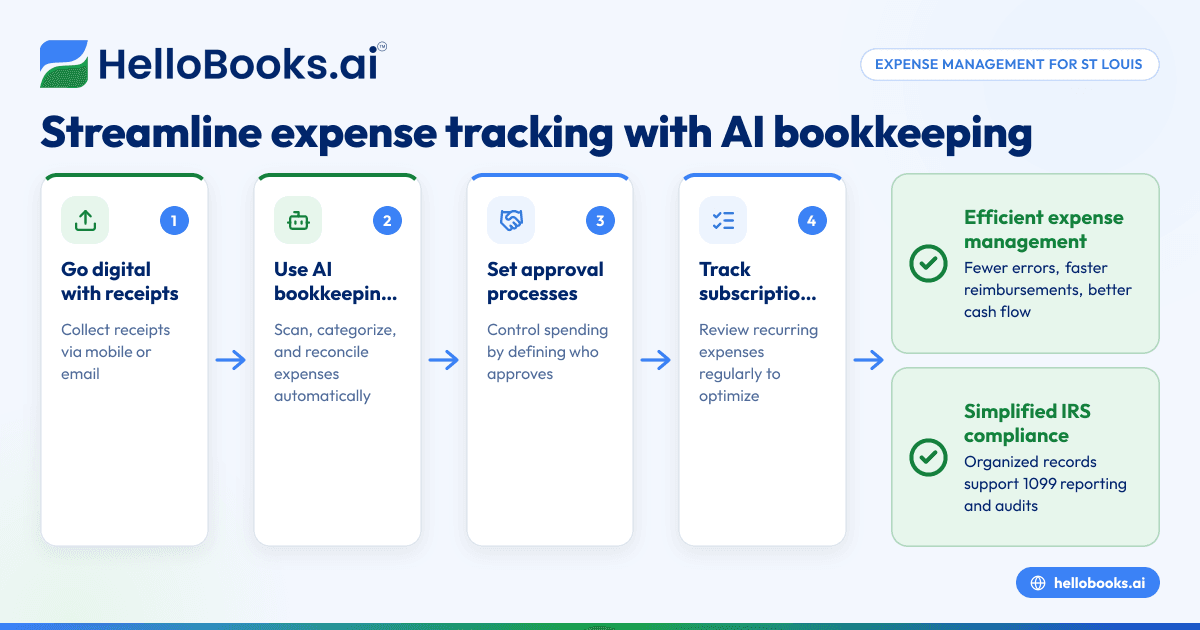
Startups can improve expense tracking by implementing these key steps:
- Go digital with receipts: Encourage employees to submit receipts through mobile or email to avoid lost paperwork.
- Use AI bookkeeping software: Solutions like HelloBooks scan, categorize, and reconcile expenses automatically.
- Set expense approval processes: Define who must approve spending to control unauthorized costs.
- Track subscriptions and contracts: Regularly review ongoing expenses to renegotiate or cut costs.
- Perform weekly reconciliations: Match bank statements with records to catch discrepancies promptly.
- Communicate clear policies: Train teams to follow expense rules, ensuring consistency.
This approach cuts manual effort, minimizes errors, and speeds up reimbursements, making expense management efficient and transparent.
Can AI bookkeeping handle compliance and reporting requirements?
Yes, AI bookkeeping software helps startups stay compliant by organizing expenses as per IRS guidelines. It generates reports aligned to tax forms like Schedule C and Form 1099. Detailed digital records reduce risks of audits and penalties. Automated reports prepare accountants with accurate data, simplifying tax season and regulatory filings.
How do I choose the right accounting tools for expense management in St Louis?
Select software that fits your startup’s needs. Consider:
- Integration with existing tools like QuickBooks and Stripe.
- Features for automated bank reconciliation.
- Mobile access for on-the-go expense capture.
- Customizable expense categories aligned with your business.
- Robust data security meeting industry standards.
HelloBooks.ai offers a unified solution designed for small businesses, combining accounting software in the USA with AI expense management and compliance features.
What are common expense categories startups in St Louis should track?
Essential categories include:
- Office rent, utilities, and remote work costs.
- Payroll, contractor fees, and related taxes.
- Marketing and advertising.
- Office supplies and technology subscriptions.
- Travel, meals, and entertainment.
- Professional services like legal and consulting.
- Insurance and banking fees.
Proper categorization aids precise reporting and tax deductions.
How do startups handle expense reimbursements efficiently?
Expense reimbursements slow down when done manually. AI expense management simplifies by:
- Employees upload digital receipts.
- AI auto-categorizes and submits expenses for approval.
- Managers approve quickly via mobile or desktop.
- Paid expenses reconcile with bank statements.
This accelerates reimbursements and prevents backlog, aiding positive cash flow.
What role does regular financial reporting play in expense management?
Regular expense reports help startups monitor spending patterns and spot overspending early. Monthly or quarterly financial summaries generated by AI provide clear insights, supporting budget adjustments and investor communications. Automation reduces errors and ensures timely, accurate financial information.
How to start with AI expense management?
To begin using AI expense management:
- Assess current tracking pain points like lost receipts or slow data entry.
- Explore AI bookkeeping platforms suited for your startup’s size.
- Attend demos to evaluate key features and integrations.
- Train staff on digital receipt submission and expense policies.
- Use reports regularly to refine categories and expenses.
Start with core processes and expand automation gradually to build confidence and efficiency.
Expense management becomes smarter and faster with AI bookkeeping. Streamlining cost tracking, compliance, and reporting frees startups in St Louis to focus on growth confidently.
Discover how AI bookkeeping can transform your expense processes by booking a demo at /book-a-demo or compare plans at /pricing to choose what fits best.
Frequently asked questions
What expenses are deductible for small businesses in the US?
Deductible expenses must be ordinary and necessary for your business. Common examples include office rent, utilities, payroll, marketing, travel, and software subscriptions. Keep detailed receipts and records to support deductions in case of IRS review.
How often should startups reconcile their bank accounts?
Weekly reconciliation is ideal to catch errors and prevent fraud. Monthly reconciliation is the minimum to ensure books match actual cash flow and avoid surprises during tax filing.
Can AI bookkeeping software integrate with QuickBooks?
Yes, AI bookkeeping tools like HelloBooks integrate seamlessly with QuickBooks and finance apps like Stripe, helping maintain unified data without double entry.
How does automated expense categorization work?
AI reads details from receipts and transactions, such as vendor, amount, and date, then classifies expenses using preset rules and machine learning. This reduces manual sorting and improves accuracy.
Is it necessary to have an expense policy in place?
A clear expense policy outlines reimbursable costs, required documents, and approval workflows. It ensures employee compliance and streamlines bookkeeping processes.
What is the benefit of real-time expense tracking?
Real-time tracking shows up-to-date spending against budgets, preventing overspending and enabling proactive financial decisions to maintain healthy cash flow.
Read next
This article covers one part of a bigger topic. For the complete picture, read our guide to st louis.