
Key takeaways
What this article covers, in order:
- Key takeaways
- Why expense management for startups matters
- What should be in a startup expense policy
- How to design approval workflows that do not slow the business
- Reimbursement tracking: what a clean process looks like
- Common startup expense categories to track separately
Expense management for startups in United States means setting clear rules for what employees can spend, who approves it, and how reimbursements are tracked and recorded. Good expense management helps startups control cash, close books faster, and avoid tax and audit problems as the team grows.
Key takeaways
- Expense management for startups starts with a written policy, even if your team is still small.
- Approval rules should match spending risk, not just job titles or company hierarchy.
- Reimbursement tracking works best when every expense has a receipt, a business purpose, and a clear owner.
- Corporate cards reduce out-of-pocket claims, but they still need review and coding controls.
- A monthly close process that includes expenses helps founders see true burn and cash runway.
- Simple tools such as expense management software and AI bookkeeping can reduce manual follow-up and bookkeeping errors.
Why expense management for startups matters
Many startups begin with a loose spending process. A founder pays for software on a personal card. A sales rep books travel and sends a screenshot later. A contractor submits a spreadsheet at month-end. That may work for a few weeks, but it breaks quickly once spending increases.
Expense management for startups is not just about reimbursement. It is a system for controlling cash and creating clean financial records. In the United States, that matters because startups often need accurate books for investors, lenders, tax filings, and due diligence. Buyers and enterprise customers may also expect stronger financial controls as part of vendor reviews.
Poor expense control creates three common problems.
First, you lose visibility. If expenses are submitted late, your profit and loss statement is wrong. Your monthly burn rate looks lower than reality. That can lead to bad hiring or marketing decisions.
Second, reimbursements become slow and frustrating. Employees do not want to wait weeks to get paid back for travel, software, or client meals. Slow repayment hurts trust.
Third, bookkeeping becomes messy. Missing receipts, duplicate claims, and unclear categories increase accounting work. Teams using spreadsheets, email approvals, and personal cards usually feel this pain first.
A practical expense process fixes these issues. It gives employees a clear path to spend. It gives managers a clear path to approve. It gives finance a clear path to record, review, and report.
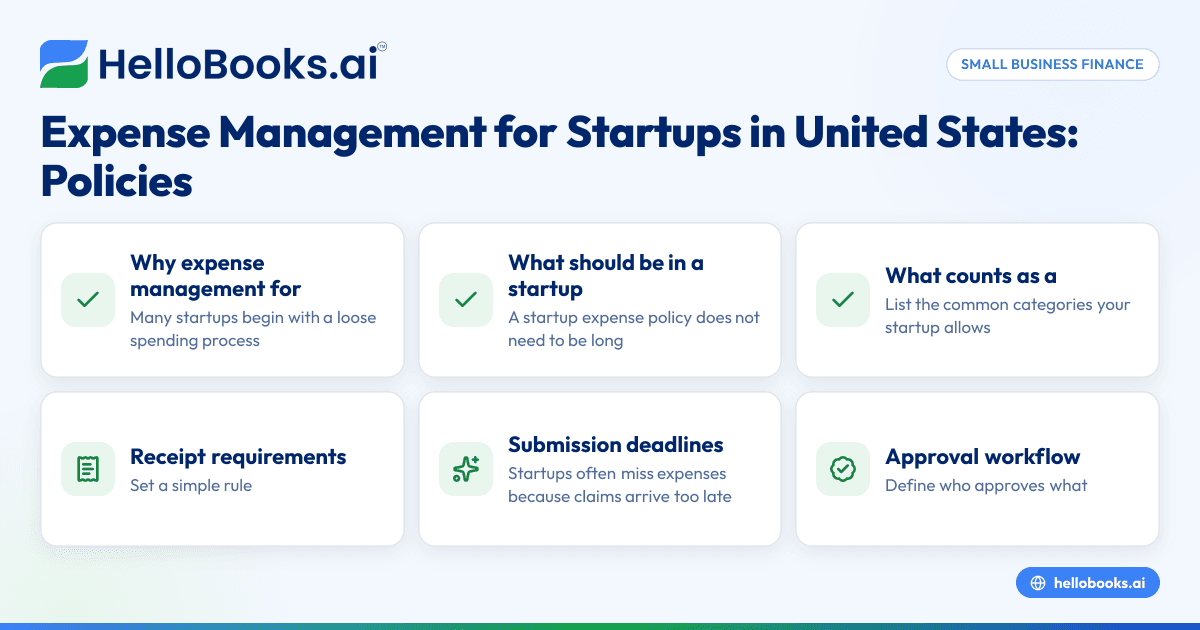
What should be in a startup expense policy
A startup expense policy does not need to be long. It does need to be clear. If employees cannot understand it in one sitting, they will not follow it.
Include these core sections.
1. What counts as a reimbursable business expense
List the common categories your startup allows. Examples include:
- Local travel, flights, hotels, and rideshares
- Meals during business travel
- Client meals with a documented business purpose
- Software subscriptions approved for business use
- Home office items if your company allows them
- Conference fees and professional memberships
- Office supplies and shipping costs
Also list expenses that are not reimbursable. Examples might include personal entertainment, family travel costs, traffic fines, or upgrades beyond policy limits.
2. Receipt requirements
Set a simple rule. For example, require a receipt for every expense where one is available. Ask employees to submit the receipt image, date, amount, vendor name, and business purpose. If your company sets a minimum dollar threshold for receipts, document it clearly and apply it consistently.
3. Submission deadlines
Startups often miss expenses because claims arrive too late. Set a standard deadline, such as within a few business days after the expense or by a fixed date after month-end. The exact number is your choice, but the rule should be easy to remember.
4. Approval workflow
Define who approves what. Small claims may go to a team lead. Larger claims may need department head or founder approval. Travel can require pre-approval before booking. Without this rule, finance becomes the default decision-maker, which slows everything down.
5. Reimbursement timing
Tell employees when they will be reimbursed. Many startups process reimbursements weekly or twice a month. A written reimbursement cycle reduces repeated status questions.
6. Corporate card rules
If you issue company cards, spell out permitted use, receipt submission rules, and who reviews statements. A company card is not a substitute for expense control.
7. Tax and accounting treatment
Employees do not need a tax manual, but finance should define categories that map cleanly into the chart of accounts. This supports better reporting and cleaner tax records. This article is general information, not tax or legal advice.
How to design approval workflows that do not slow the business
Many founders swing between two extremes. Either every expense needs founder approval, or no one reviews anything. Neither works well.
The best startup approval workflow uses spending thresholds and risk level.
Use a three-tier model
A simple model often works well:
- Low-risk recurring spend: Auto-approved if it is within policy and budget. Example: approved software renewals under a set limit.
- Manager-approved spend: Requires the direct manager or budget owner. Example: team meals, local travel, small equipment.
- Escalated spend: Requires department head or finance leadership. Example: international travel, large software contracts, or unusual purchases.
This approach prevents founders from approving every $35 meal while still keeping control over larger spend.
Separate pre-approval from reimbursement approval
These are different decisions.
- Pre-approval answers whether the employee may spend.
- Reimbursement approval confirms what was actually spent and whether documents match policy.
For example, a founder may pre-approve a trip to Chicago for a customer meeting. After travel, the employee still submits receipts for hotel, flight, rideshare, and meals. The reviewer checks the final claim against the original approval.
Build approval rules around budgets
A department budget owner should see expense data early, not just after the month ends. This makes approvals smarter. A marketing lead can judge whether a conference expense still fits the quarter plan. A sales manager can review whether travel in Houston or Detroit produced pipeline value.
Keep exceptions visible
Not every valid expense fits the policy perfectly. Founders sometimes approve exceptions for speed. That is fine if exceptions are documented. Add a field for exception reason and approver name. This creates an audit trail and helps you update the policy later.
Reimbursement tracking: what a clean process looks like
Reimbursement tracking is where many startup systems fail. Employees submit incomplete information. Finance follows up by email. The same expense appears twice. Then month-end arrives.
A clean reimbursement process has five steps.
1. Capture the expense at the time of spend
The closer the record is to the purchase date, the better. Employees should upload the receipt right away and add a short business purpose. This reduces missing details later.
2. Code the expense correctly
Each expense should be assigned to the right category, team, and if relevant, customer or project. This matters for reporting. For example, software, travel, meals, and office supplies should not all sit in one catch-all account.
If your current books are hard to classify, moving to accounting software in the USA can make categorization and month-end reporting easier.
3. Route for approval
The expense should go to the correct approver automatically based on amount, department, or type. Manual forwarding through email is where delays start.
4. Reimburse on a fixed schedule
Once approved, reimburse employees on a known cycle. Consistency matters more than speed alone. A startup that pays every Friday is easier to trust than one that pays “when we get to it.”
5. Record the payment and close the loop
Finance should mark the claim as paid and link it to the accounting entry. This avoids duplicate payment and supports account reconciliation later.
Common startup expense categories to track separately
Many startups use broad categories at first. That weakens reporting. Track the categories that help you understand burn and operating leverage.
Travel and lodging
Separate flights, hotels, rideshares, mileage, and meals if travel is meaningful for your business. This helps you see where customer acquisition costs are rising.
Software and SaaS
Do not bury all software under general admin. Startups often underestimate tool sprawl. Tracking software spend separately can uncover duplicate subscriptions and unused seats.
Marketing and events
Conference booths, sponsorships, ad creative, and event travel should be visible. This helps founders compare spend against pipeline or lead generation.
Office and remote work
Coworking costs, supplies, shipping, and approved home office purchases should be coded consistently.
Professional services
Legal, accounting, recruiting, and consultants can grow quickly. Keeping these separate helps with planning and due diligence.
Meals and entertainment
Use clear business purpose notes. This category often draws the most policy questions and the most inconsistent employee behavior.
Corporate cards versus reimbursements
Startups often ask whether they should use corporate cards or reimbursements. The answer is usually both.
Corporate cards are best for recurring business spending and frequent travel. Reimbursements are best for occasional employee spending or edge cases.
Benefits of corporate cards
- Less employee out-of-pocket burden
- Better real-time visibility into spend
- Fewer reimbursement claims
- Cleaner merchant data for bookkeeping
Risks of corporate cards
- Employees may treat the card as open permission
- Receipts still go missing
- Personal and business spend can get mixed
- Card statements still need review and reconciliation
If you use cards, connect card activity to your bookkeeping process. Good bank reconciliation software helps finance confirm that card transactions, bank feeds, and expense records match.
How expense management affects bookkeeping and monthly close
Expense management is not a side process. It directly affects your books.
If expenses are missing, your financial statements are incomplete. If expense categories are wrong, your reporting is misleading. If reimbursements are delayed, liabilities may sit unrecorded. These issues distort burn rate, runway, and departmental budgets.
Build expenses into your monthly close checklist
A practical startup close process should include:
- Remind employees to submit expenses before month-end cutoff.
- Review open and unapproved claims.
- Accrue material missing expenses when appropriate.
- Reconcile corporate card and bank transactions.
- Review unusual vendors, duplicate charges, and large one-time items.
- Post reimbursements and confirm payment status.
This is especially important if you are fundraising or reporting to a board. Investors want clean numbers. They may not ask about receipts directly, but weak expense control often shows up in unreliable reporting.
Using AI accounting software or accounting software for small business can reduce the manual work involved in coding, matching, and reviewing transactions.
Warning signs your startup expense process is breaking
You do not need a full audit to see if the process is failing. Look for these signs:
- Employees ask repeatedly when they will be reimbursed
- Month-end includes many late expense claims
- Founders approve small expenses one by one in email or Slack
- Card transactions appear in the bank but have no receipt attached
- The same vendor is coded to different accounts each month
- Finance spends days chasing business purpose notes
- Personal expenses show up on company cards
- Department heads say actual spending was “higher than expected”
Any two or three of these usually mean the process needs redesign, not just more reminders.
A simple expense management framework for early-stage startups
If your startup has fewer than 50 employees, start simple. You do not need a complex enterprise policy. You need consistency.
Step 1: Write a one-page policy
Cover allowed expenses, approval limits, receipt rules, submission deadlines, and reimbursement timing.
Step 2: Set approval thresholds
Create tiers based on amount and type. Keep normal approvals with managers. Escalate only higher-risk spending.
Step 3: Standardize categories
Use the same expense categories every month. Match them to your chart of accounts.
Step 4: Pick one system of record
Do not split the process across email, spreadsheets, and chat. Use a single workflow for submissions, approvals, and payment status.
Step 5: Review monthly trends
Look at spend by department, category, and employee. Policy problems usually show up in patterns, not isolated claims.
Step 6: Update the policy as you grow
The policy that worked at 10 employees will not work at 75. Review it at least twice a year.
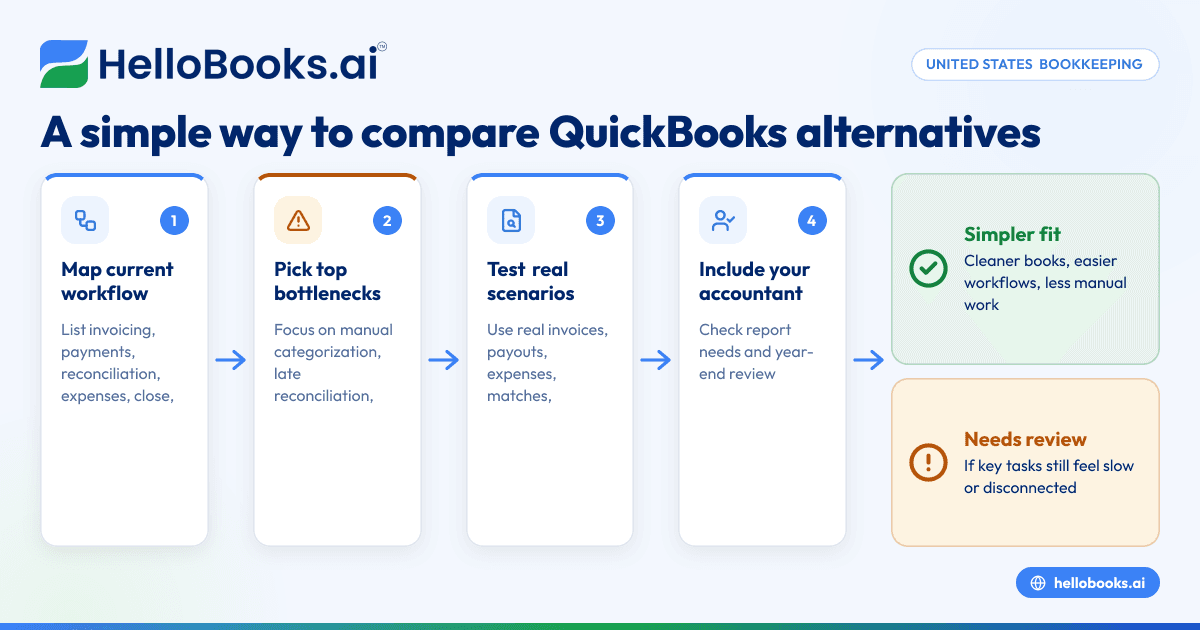
For startups moving away from spreadsheets or messy QuickBooks workflows, a QuickBooks alternative may help simplify expense tracking, approvals, and bookkeeping in one place.
How HelloBooks can help
If your startup is trying to tighten controls without adding more manual finance work, HelloBooks can help with expense workflows, bookkeeping, and reporting. It is designed for growing businesses that need cleaner records, faster close cycles, and better visibility into spending without living in spreadsheets.
If you want to see whether it fits your process, you can book a demo or compare options on the pricing page.
Frequently asked questions
What is expense management for startups?
Expense management for startups is the process of controlling, approving, recording, and reimbursing business spending. It usually includes policy rules, approval workflows, receipt collection, accounting categorization, and reimbursement tracking.
How often should a startup reimburse employee expenses?
Many startups choose a weekly or twice-monthly reimbursement cycle. The best schedule is one you can follow consistently while keeping employee wait times reasonable.
Should founders approve every startup expense?
Usually no. Founders should approve higher-risk or high-value spending, not every routine claim. Manager-based approvals with clear thresholds are faster and easier to scale.
Do startups need receipts for all expenses?
A startup should define clear receipt rules in its policy and apply them consistently. In practice, asking for receipts whenever available and requiring a business purpose note is a strong baseline.
Is it better to use corporate cards or reimbursements?
Most startups use both. Corporate cards work well for recurring or frequent business spend, while reimbursements cover occasional employee purchases and exceptions.
When should a startup upgrade from spreadsheets to software?
Upgrade when claims are getting lost, approvals are delayed, or month-end expense cleanup takes too long. That usually happens well before the finance team says it out loud.
If your startup wants a simpler way to manage expenses, approvals, and bookkeeping, book a demo at /book-a-demo or compare plans at /pricing.