
Key takeaways
What this article covers, in order:
- Key takeaways
- Why expense management matters for Indian startups
- What counts as a startup expense
- What to include in an expense policy for startups in India
- How to set up a practical reimbursement process
- GST recordkeeping for startup expenses in India
Expense management for startups in India means setting clear rules for spending, collecting bills on time, reimbursing employees correctly, and keeping records ready for accounting and GST. If your team still manages expenses on WhatsApp, email threads and spreadsheets, a simple policy and process can save hours every month and reduce filing mistakes.
Key takeaways
- A startup expense policy should define who can spend, what needs approval, spending limits, and document requirements.
- Reimbursements move faster when employees submit claims in one format with bills, dates, business purpose and payment details.
- GST recordkeeping matters because missing or poor-quality invoices can make bookkeeping harder and weaken your tax documentation.
- Founder spending, mixed personal-business payments and cash purchases are common startup problems that need clear rules early.
- Monthly reviews, card controls and better receipt capture reduce leakage and help finance close books faster.
- Software such as expense management software can automate capture, approvals and accounting entries as the business grows.
Why expense management matters for Indian startups
In the early stage, most Indian startups are focused on sales, hiring and product. Expense control usually comes later. By then, the business may already have many small leaks. These include duplicate reimbursements, missing bills, delayed approvals, personal spends booked as business costs, and messy GST records.
This becomes a bigger problem when the company starts closing monthly books properly. Investors, auditors and finance teams expect cleaner numbers. Founders also want to know burn, department-wise spending, and vendor outflows without chasing ten people across Slack, WhatsApp and Excel.
For Indian startups, expense management is not just an internal control issue. It also affects GST documentation, vendor payments, employee trust and year-end readiness. A startup in Bengaluru with 20 staff may process travel claims, software subscriptions, internet reimbursements and customer meeting costs every week. If every expense comes in a different format, the finance lead loses time on follow-ups instead of analysis.
Good expense management creates three practical benefits:
- Faster reimbursements for employees.
- Better visibility into where money is going.
- Cleaner books and support for GST and audit records.
If you are still doing this manually, moving to structured workflows or AI bookkeeping can reduce repeated data entry and help finance teams keep records consistent.
What counts as a startup expense
A startup expense is any cost incurred wholly and exclusively for business purposes. In practice, startups usually see a mix of recurring operating costs and one-off spends.
Common startup expenses in India
Typical categories include:
- Office rent and maintenance
- Internet and mobile bills used for work
- Local travel and outstation travel
- Client meetings and business meals
- Software subscriptions
- Digital ads and marketing tools
- Recruitment costs
- Courier and logistics charges
- Training and workshops
- Laptop accessories and small equipment
- Professional fees
- Event sponsorships and stall costs
The trouble starts when categories are not defined clearly. One employee may book Uber rides under travel. Another may book the same under admin expenses. A founder may pay for a SaaS tool on a personal card and send a screenshot later. This makes reporting inconsistent.
Create a small but practical chart of expense categories from day one. Keep it simple enough that non-finance employees can use it.
Expenses that need extra attention
Some spends need tighter review because they often create confusion:
- Founder-paid expenses
- Cash expenses without proper bills
- Team meals and entertainment
- Mixed-use internet or phone bills
- Home office reimbursements
- Foreign currency SaaS subscriptions
- Vendor advances
- Employee travel with partial personal use
These are not always wrong. They just need better documentation and approval.
What to include in an expense policy for startups in India
A written expense policy avoids arguments and reduces ad hoc decisions. It does not need to be a 30-page document. For most startups, a clear 3 to 5 page policy is enough.
1. Purpose and scope
Start with who the policy covers. Include founders, employees, interns and consultants if they claim expenses. State that only genuine business expenses with adequate support will be reimbursed or booked.
2. Approved expense categories
List allowed categories with examples. For instance:
- Travel: flights, cabs, metro, hotel
- Client meetings: tea, coffee, working lunch
- Remote work: approved internet reimbursement
- Software: approved tools for work
- Admin: courier, stationery, office supplies
If a category needs manager approval before spending, say that clearly.
3. Approval rules
Define who can approve which expense. Keep the chain short.
Example:
- Up to ₹2,000: reporting manager
- ₹2,001 to ₹10,000: department head
- Above ₹10,000: founder or finance head
- New vendors or annual subscriptions: finance plus founder approval
You can also define pre-approval for travel, events and recurring subscriptions.
4. Spending limits
Set reasonable caps where needed. Limits reduce disputes and help teams make better choices.
Examples:
- Hotel cap per city band
- Meal cap per person
- Cab use rules for late-night travel
- Economy fare by default
- Internet reimbursement limit for remote roles
Avoid unrealistic limits. If your cap does not match actual market rates in Mumbai or Bengaluru, employees will ignore it.
5. Document requirements
This is one of the most important sections. Specify what employees must submit:
- Date of expense
- Vendor name
- Amount
- Business purpose
- Team or client name if relevant
- Original bill, invoice or receipt
- Payment proof if needed
- GST invoice where available and relevant
If scanned or photographed bills are accepted, state the quality standard. Blurry images and cropped receipts create problems later.
6. Submission timeline
Set a clear deadline. For example, all expenses for a month should be submitted within a few days after month-end. The exact timeline can vary by company. What matters is consistency.
Late claims should need an exception approval. Otherwise, finance teams end up reopening closed months.
7. Non-reimbursable expenses
Include examples. This helps avoid awkward back-and-forth later.
Common examples:
- Personal shopping
- Alcohol unless specifically approved for a business event
- Traffic fines
- Room service without business purpose
- Family travel costs
- Upgrades beyond approved travel class
- Expenses without minimum supporting details
8. Consequences and exceptions
State what happens if policy is not followed. Usually this means delayed approval, partial reimbursement, or rejection. Also include who can approve exceptions.
How to set up a practical reimbursement process
A policy only works if the process is easy. Startups often fail here. Employees are asked to submit claims, but there is no standard form, no approval path, and no reimbursement cycle.
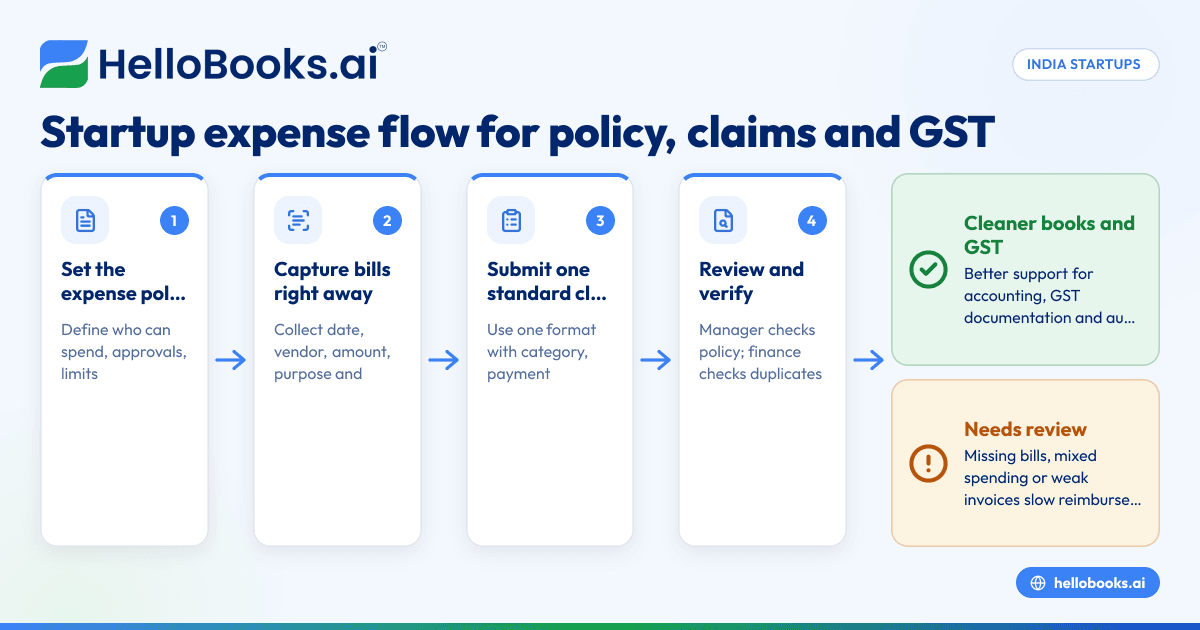
A simple 7-step workflow
- Employee incurs expense The employee pays for an approved business expense.
- Bill is captured immediately The employee uploads the bill on the same day if possible. This reduces missing documents.
- Claim is submitted in one format Each claim should include category, amount, date, business reason and attached bill.
- Manager reviews the claim The manager checks purpose, amount and policy compliance.
- Finance verifies documents Finance checks arithmetic, duplicates, vendor details and tax documentation.
- Reimbursement is paid on a schedule For example, weekly or twice a month. Predictable cycles improve employee trust.
- Expense is booked in accounts The finance team posts the entry under the correct ledger and period.
Tips to make reimbursements faster
- Use one channel for submissions, not email plus WhatsApp plus paper.
- Ask employees to submit expenses within a fixed time.
- Reject incomplete claims quickly instead of letting them sit.
- Publish reimbursement dates internally.
- Standardise expense heads and approval rules.
As you scale, using accounting software for small business or dedicated expense workflows can reduce manual checking and help connect claims with bookkeeping.
GST recordkeeping for startup expenses in India
GST treatment depends on the nature of the expense and the document available. Because rules can vary by transaction type, this section is general information and not tax or legal advice. Your accountant should confirm how a specific expense should be treated in your business.
From an expense management point of view, the main job is simple: keep proper records and collect valid documents.
Why GST records break in startups
In many startups, employees pay first and submit later. Bills are often missing, torn, or sent as poor screenshots. Vendor names may not match. Sometimes only a payment screenshot is shared. That may prove payment happened, but it is not the same as a proper tax invoice.
This creates three issues:
- Finance cannot classify the expense correctly.
- GST support documents may be weak or missing.
- Reconciliations take longer at month-end.
What records you should keep
For each expense, maintain:
- Invoice or receipt copy
- Date of expense
- Vendor name
- Amount paid
- Nature of expense
- Employee who incurred it
- Approval trail
- Payment mode
- Ledger mapping in books
Where a GST invoice is available and relevant, store it clearly and in a retrievable format. Keep records organised month-wise and vendor-wise where possible.
Common GST-related problem areas
Small local purchases
A team member buys office supplies from a nearby shop in Pune and gets only a simple bill. This may still support bookkeeping, but the quality of tax documentation may be limited. The policy should tell employees to ask for proper invoices whenever possible.
Travel and hotel bills
Travel claims can include many line items. Flights, hotels, cabs and meals may come from different vendors. Without item-level bills, the claim becomes hard to review.
SaaS and online subscriptions
Startups often buy software tools quickly. Keep the subscription invoice, payment confirmation and business purpose together. This helps with accounting and audit trail.
Founder-paid expenses
If founders use personal cards for business purchases, documentation often gets delayed. Ask founders to follow the same process as employees. Exceptions at the top become habits across the company.
If GST workflows are a major pain point, teams often benefit from software built for GST return filing software and structured recordkeeping, especially when expense data feeds into monthly books.
Common mistakes startups make with expenses
Mixing business and personal spending
This is the biggest issue in very early-stage companies. It is common when founders move fast. But it creates confusion in books and weakens spend visibility. Open separate business payment channels as early as possible.
No pre-approval for larger spends
An employee books a costly hotel or pays for an annual software plan without approval. Finance then has to decide after the fact. That creates friction and weak control.
Too many cash expenses
Cash makes documentation harder. Encourage digital payments through UPI, bank transfer or company cards where possible. Clear digital trails make bookkeeping easier.
Submission delays
Claims that come in two months late distort period reporting. If your July expenses are submitted in September, the monthly P&L becomes less useful.
No category discipline
When every expense goes into “miscellaneous”, reporting loses value. Department heads cannot understand actual spend drivers.
Poor receipt storage
Expenses should not live only in personal phones or chat threads. They need a central system and naming standard.
How to design expense controls without slowing the team down
Good controls should feel light for small spends and tighter for risky ones. Startups need speed, but speed without controls leads to messy books.
Use risk-based controls
Apply stronger checks to:
- Large-value expenses
- New vendors
- Travel bookings
- Recurring subscriptions
- Cash claims
- Founder-related claims
Use lighter checks for routine low-value items within policy.
Separate approval from payment where possible
The person approving a claim should not be the only person paying and recording it. Even in a small startup, basic separation reduces error and misuse.
Review reports monthly
At month-end, review:
- Top expense categories
- Department-wise spend
- Rejected claims
- Repeat policy exceptions
- Claims without proper bills
- Vendor concentration
This helps you improve the policy based on actual usage.
When to move from spreadsheets to software
Spreadsheets work in the beginning. But they start failing when the team grows, claims increase, and finance needs cleaner monthly closes.
Signs you have outgrown manual expense management
- Employees keep asking if they will be reimbursed
- Finance spends days matching bills to entries
- Duplicate claims are hard to spot
- Founder spends are scattered across statements
- GST records are incomplete or hard to retrieve
- Monthly close takes too long
- You cannot see spend by team or category quickly
At this point, using AI accounting software or a proper accounting software in India setup can help centralise records and reduce manual posting. If your current process depends heavily on legacy workflows, you may also evaluate a Tally alternative that handles expenses, approvals and reporting in a simpler way.
A simple monthly checklist for startup finance teams
Use this checklist at the end of each month:
- Confirm all employee claims for the month are submitted.
- Follow up on missing bills and incomplete claims.
- Check for duplicate submissions.
- Verify large or unusual expenses.
- Ensure founder-paid expenses are recorded separately and clearly.
- Review vendor invoices and supporting documents.
- Post all approved claims to the right ledger.
- Reconcile reimbursements paid with books and bank entries.
- Organise records month-wise for audit and GST support.
- Share a short spend summary with founders or department heads.
If bank matching is taking too much time, bank reconciliation software can reduce manual effort and help tie reimbursements back to actual payments.
Best practices for startup founders and finance leads
Start with policy, not perfection
Do not wait for a 100-person team. A basic policy at 10 employees is far better than no policy at 40 employees.
Make founders follow the same rules
This is one of the strongest culture signals in finance operations. If founders submit complete claims with bills and reasons, everyone else will too.
Keep employee experience in mind
Expense policy should protect the company, but also make reimbursement fair and predictable. Long delays damage trust.
Centralise documents
Receipts, invoices and approvals should be searchable in one place. This matters during due diligence, audits and tax review.
Link expense data with accounting
Expenses should not stop at approval. They should flow into bookkeeping, vendor records and reports. That is where software helps most.
HelloBooks can help startups automate expense capture, approvals, bookkeeping and reports in one workflow. If you want to simplify reimbursements and recordkeeping, you can book a demo or compare options on the pricing page.
Frequently asked questions
What is expense management for startups in India?
Expense management for startups in India is the process of controlling company spending, collecting proof of expenses, approving claims, reimbursing employees, and recording costs correctly in the books. It also includes keeping proper records for GST and audit support.
What should a startup expense policy include?
A startup expense policy should include allowed categories, approval levels, spending limits, claim timelines, bill requirements, and non-reimbursable items. It should also explain who can approve exceptions and how reimbursements are processed.