


Key takeaways
What this article covers, in order:
- Key takeaways
- What are digital invoicing requirements in Delaware, United States?
- What should a Delaware invoice include?
- Do Delaware small businesses need to charge sales tax on invoices?
- What does a digital invoice need to look like in Delaware?
- How can Delaware small-business owners stay organized with digital invoicing?
Electronic invoicing requirements in Delaware, United States are mostly about getting the basics right. For most small-business owners, that means sending clear invoices, keeping accurate records, matching what you billed to what you were paid, and handling Delaware and local tax details correctly where they apply.
If you sell to business customers in Wilmington, Dover, or Newark, digital invoicing can make billing faster and easier to track. But the legal side still comes down to ordinary business records, contract terms, tax treatment, and organized books.
Key takeaways
- Delaware does not have a statewide retail sales tax, but your invoice still needs clear business and payment details.
- A good digital invoice should show who billed whom, what was sold, when, how much, and when payment is due.
- Small-business owners in Delaware should keep invoice records that match payments, refunds, credits, and bank deposits.
- If your city or industry has a local fee, gross receipts issue, or special rule, your invoice and books should reflect it accurately.
- Digital invoicing works best when it connects invoicing, payment tracking, expenses, and reconciliation in one workflow.
- This article is general information, not tax or legal advice.
What are digital invoicing requirements in Delaware, United States?
For most Delaware small businesses, digital invoicing requirements are practical, not overly formal. You usually do not need a special Delaware-only invoice format for ordinary business billing. What matters is that your invoice is complete, accurate, easy to understand, and saved in a way you can retrieve later.
A digital invoice is simply an invoice created, sent, and stored digitally. That can include a PDF invoice emailed to a customer, an invoice sent through an invoicing platform, or a bill generated through your accounting system. The format matters less than the record quality.
If you own a Delaware service business, online store, contractor business, consulting firm, repair shop, or wholesale operation, your invoice should help you answer basic questions fast:
- Who did you bill?
- What did you provide?
- When did you provide it?
- How much did you charge?
- When is payment due?
- Did the customer pay?
- If they paid partially, what remains open?
Those details are what protect your cash flow and help when a customer disputes a charge or asks for backup months later.
What does Delaware expect small businesses to keep?
Delaware businesses generally need reliable books and records to support income, expenses, and tax filings. That means your invoices should line up with your accounting records, your bank deposits, and any related contracts or purchase orders.
If you are ever reviewing your books before tax time, applying for financing, or answering customer questions, messy invoicing creates avoidable risk. A clean digital trail makes the job easier.
Why Delaware owners should care about invoice structure
Delaware is often seen as business-friendly, but that does not remove the need for strong documentation. If you run a small business in Delaware, poor invoicing can still lead to:
- Late payments
- Duplicate billing
- Missed follow-up
- Wrong revenue totals
- Harder bank reconciliation
- Confusion around fees, deposits, and credits
That is why digital invoicing is not just about sending bills faster. It is about building a process you can trust every week.
What should a Delaware invoice include?
A Delaware digital invoice should include the same core business details you would expect on any strong U.S. invoice. If you send invoices electronically, include these fields every time unless a field truly does not apply.
Basic business details
Start with the billing identity of your business:
- Legal business name
- Trade name, if used in customer-facing documents
- Business address in Delaware or your operating address
- Email address
- Phone number
- Website, if relevant
This helps your customer confirm who sent the invoice. It also reduces payment delays caused by uncertainty.
Customer details
Include enough information to identify the customer clearly:
- Customer business name or individual name
- Billing address
- Contact name or department
- Customer email
- Purchase order number, if the customer uses one
If you invoice larger companies, this matters even more. Their accounts payable team may reject invoices that do not match internal references.
Invoice identification
Each invoice should have a unique invoice number. It should also include:
- Invoice date
- Due date
- Payment terms, such as Net 15 or Net 30
Do not reuse invoice numbers. A clean numbering system helps with collections, reporting, and audits.
Description of goods or services
This is one of the most important parts of the invoice. State what you sold in plain English:
- Product or service description
- Quantity
- Unit price
- Hours, if billing time
- Service date or delivery date
- Line item totals
For example, a Delaware HVAC contractor should not write “services rendered” if the work was a furnace repair and maintenance visit. A better line item is easier to approve and defend.
Amounts and payment terms
Every invoice should clearly show:
- Subtotal
- Discounts, if any
- Shipping or service fees, if any
- Taxes or other charges, if applicable
- Total amount due
- Amount already paid, if there was a deposit
- Remaining balance due
- Accepted payment methods
Use USD ($) consistently. Avoid hiding fees in vague line items.
Do Delaware small businesses need to charge sales tax on invoices?
Delaware does not impose a statewide retail sales tax. That is one reason many business owners assume invoicing is simple. In many cases, it is simpler. But “no sales tax” does not mean “no tax thinking.”
You still need to be accurate about what you charge and how you record it. Delaware businesses may face other tax and licensing issues, including Delaware gross receipts tax at the business level, depending on the nature of the business. That tax is not the same as a retail sales tax charged to the customer at checkout.
What to do on the invoice in Delaware
If you are not charging a customer tax on the transaction, do not add a made-up tax line just because templates often include one. Keep the invoice clean and truthful.
If a separate fee, surcharge, deposit, or reimbursable expense applies, label it correctly. That way the customer sees what they are paying for, and your books stay accurate.
Local and industry details matter
Some Delaware businesses also operate in ways that create special billing needs. For example:
- Contractors may need progress billing
- Professional service firms may bill retainers and drawdowns
- Product businesses may include freight charges
- Landlords and property service businesses may handle recurring billing
- Manufacturers may need PO-based invoicing
If your invoice format reflects how your business really works, collections get easier.
What does a digital invoice need to look like in Delaware?
It needs to clearly show the seller, buyer, invoice number, date, item details, total due, and payment terms. In Delaware, there is usually no special state-only invoice layout for ordinary small-business billing, but your records should still be accurate, readable, and easy to retrieve.
A simple invoice can be legally and operationally strong if it answers the basic payment questions. The problem for many small businesses is not missing one field. The problem is inconsistency.
One invoice has a due date. Another does not. One includes a deposit. Another hides it in the total. One uses a customer name. Another uses a project nickname. That inconsistency creates friction for both your customer and your own team.
A simple Delaware invoice example
Here is what a clean structure might look like for a small business in Newark, Delaware:
- Invoice number: 2026-1048
- Invoice date: 10/06/2026
- Due date: 10/21/2026
- Seller: First State Facility Services LLC
- Buyer: Brandywine Office Interiors
- Service date: 10/03/2026
- Line item: Office HVAC repair, 3 hours at $145
- Parts: Replacement thermostat
- Subtotal: $485
- Deposit received: $150
- Balance due: $335
- Payment methods: ACH, card, check
That invoice is easy to read, easy to verify, and easy to post into your books.
How can Delaware small-business owners stay organized with digital invoicing?
Use one system for invoice creation, numbering, payment status, and record storage. In Delaware, the biggest win is not the file format. It is making sure every invoice matches your work, your bank deposits, and your books without manual cleanup at month-end.
Once you move from scattered PDFs and spreadsheets to a defined workflow, you spend less time chasing details. You also reduce the chance of billing the wrong amount or missing unpaid invoices.
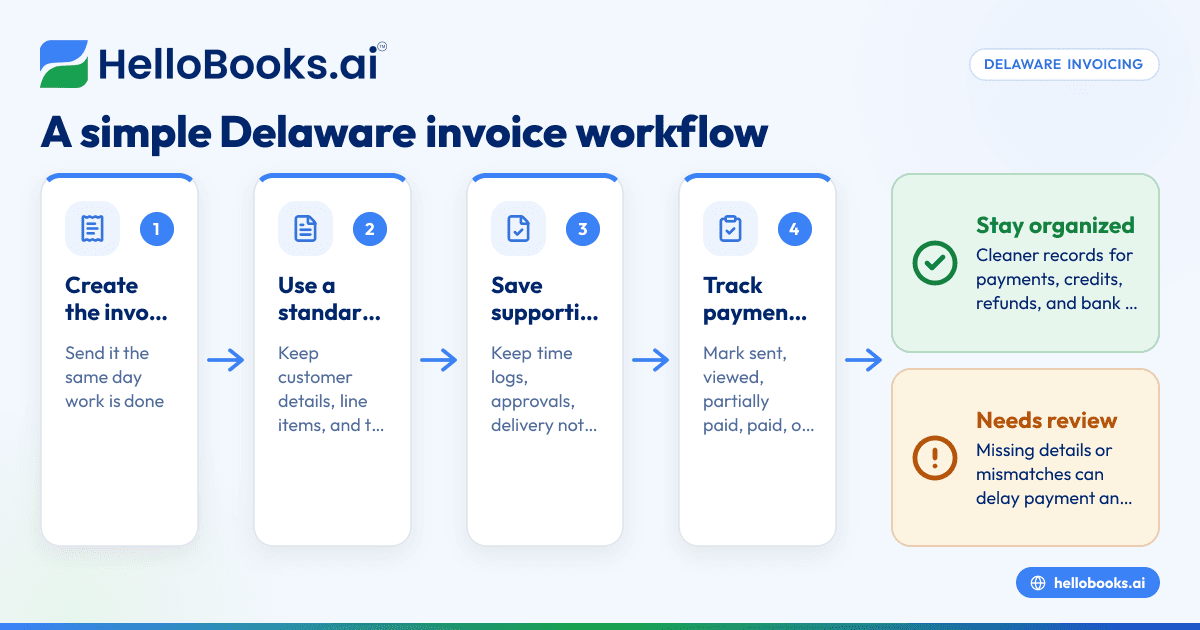
Build a simple invoice workflow
Use this process:
- Create the invoice the same day work is done Waiting until Friday or month-end leads to missing details and delayed cash flow.
- Use a standard template Keep customer details, numbering, line items, and payment terms consistent.
- Save supporting documents Attach time logs, signed approvals, delivery notes, or purchase orders where relevant.
- Track payment status Mark each invoice as sent, viewed, partially paid, paid, overdue, or disputed.
- Match invoices to deposits Reconcile every payment against the right invoice instead of posting lump-sum revenue later.
- Handle credits clearly If you issue a refund, discount, or credit memo, record it against the original invoice trail.
Why this matters in real life
Suppose you run a maintenance business in Wilmington and send 40 invoices each month. If five customers pay without using the invoice number, and three short-pay because they dispute one line item, your books get messy fast. Without a good system, you waste hours searching email threads and bank activity.
This is where invoice software and bank reconciliation software can help. The goal is not more technology for its own sake. The goal is fewer loose ends.
Can ai electronic invoicing help a Delaware business owner?
Yes. ai electronic invoicing can help you create invoices faster, keep customer details consistent, flag missing fields, and connect billing with payment tracking. For a Delaware small business, that often means fewer errors, faster follow-up, and cleaner month-end books.
The best use of AI is not replacing your judgment. It is reducing repetitive work. If you invoice similar jobs every week, AI can help standardize descriptions, customer data, and recurring line items.
Where AI helps most
For small businesses in Delaware, AI is useful in these situations:
- Reusing past invoice formats for repeat customers
- Pulling line item details from approved work records
- Spotting duplicate invoices
- Flagging missing due dates or payment terms
- Summarizing overdue balances
- Matching customer payments to invoices faster
If your current process lives across email, spreadsheets, and downloaded bank files, AI can save time by organizing those records into one workflow.
That is part of the value of AI bookkeeping and AI accounting software. Good systems reduce manual data entry and help you keep billing and bookkeeping connected.
How do I avoid common invoicing mistakes in Delaware?
Use clear line items, unique invoice numbers, correct customer names, and consistent payment terms. In Delaware, many invoice problems are not legal issues. They are process issues that delay payment, confuse customers, and make bookkeeping harder than it needs to be.
Here are the mistakes that show up often with small-business owners:
1. Sending invoices late
Late invoices slow cash flow. They also increase the chance you forget billable work.
2. Using vague descriptions
A customer is more likely to question “monthly support” than “October onsite IT support, 4 hours.”
3. Forgetting deposits and partial payments
If you collect a deposit, show it clearly. Otherwise the customer may think you billed them twice.
4. Not setting due dates
“Due on receipt” is different from Net 15. Be specific.
5. Losing invoice records
If an invoice sits only in someone’s email inbox, it is easy to lose. Store it in a searchable accounting system.
6. Failing to reconcile payments
An invoice is not truly complete until payment is matched and recorded correctly.
What should Delaware owners check before sending an invoice?
Check the customer name, invoice number, dates, line items, totals, deposits, and payment instructions. In Delaware, most invoice problems come from missed details, not complex rules. A 30-second review before sending can prevent payment delays and cleanup later.
A practical Delaware invoicing checklist for small-business owners
Use this checklist before you send any invoice:
- Is the customer name correct?
- Is the invoice number unique?
- Did you include the invoice date and due date?
- Did you describe the product or service clearly?
- Are quantity, rate, and total correct?
- Did you show discounts, deposits, or credits separately?
- Did you include payment instructions?
- Did you save the invoice in your records?
- Can you match this invoice to a job, order, or contract?
- Will the amount tie back to your books and bank activity later?
If you can answer yes to all 10, your invoice process is probably in good shape.
How do you choose a better invoicing system in Delaware?
Pick a system that helps you create invoices quickly, track payments, store records, and keep bookkeeping connected. For a Delaware small business, the right tool should reduce manual entry and month-end cleanup, not add another app to manage.
Choosing a better invoicing system for your Delaware business
Many small-business owners start with Word, Excel, or a basic PDF template. That works for a while. Then volume grows, customers want faster answers, and month-end cleanup becomes painful.
A better invoicing system should help you:
- Create and send invoices quickly
- Track paid and unpaid balances
- Store customer history
- Reduce manual entry
- Connect invoicing with bookkeeping
- Make reporting easier
If you are comparing tools, look for accounting software for small business or accounting software in the USA that supports invoicing as part of the full accounting workflow, not as a separate task.
For owners moving away from old habits or disconnected tools, it can also help to review a QuickBooks alternative if your current setup feels too manual or hard to maintain.
How long should Delaware businesses keep invoice records?
Keep them long enough to support your tax filings, financial statements, customer disputes, and business records needs. Delaware small-business owners should keep invoice records in an organized, retrievable format, along with related payment and contract documents.
The exact retention period can depend on your tax, accounting, legal, and industry needs. Because those needs vary, many owners choose to keep digital invoice records for several years with backups and searchability. The key is consistency.
What to retain with the invoice
Try to keep these together:
- The final invoice
- Any revised invoice
- Payment confirmation
- Credit memo or refund record
- Contract or quote
- Purchase order
- Delivery proof or completion note
- Relevant customer communication
That creates a clean trail if questions come up later.


