
Key takeaways
What this article covers, in order:
- Key takeaways
- What e-invoicing means in India
- The e invoicing threshold in India
- Who must generate e-invoices in India
- Which invoices do not work the same way
- How to check if your business crosses the threshold
If you are trying to understand the e invoicing threshold in India, the short answer is this: e-invoicing applies to businesses whose turnover crosses the notified limit under GST, based on aggregate annual turnover in any financial year from 2017-18 onwards, as notified by the Government of India. If your business crosses the threshold, you must generate e-invoices for applicable B2B transactions through the Invoice Registration Portal (IRP), not just issue a normal GST invoice from your billing system.
For small businesses, the real task is not only checking whether the threshold applies. You also need to confirm which invoices are covered, update your invoicing process, train your team, and make sure your GST records match what is reported.
Key takeaways
- The e invoicing threshold in India is based on aggregate annual turnover, not just current-year sales.
- Eligibility is checked with reference to turnover in any financial year from 2017-18 onwards, as per notified rules.
- If covered, you generally need to generate e-invoices for applicable B2B, export and certain other notified transactions through the IRP.
- E-invoicing does not mean creating an invoice in PDF or Excel. It means getting an Invoice Reference Number (IRN) after reporting invoice data to the portal.
- Small businesses should review turnover, entity structure, invoice types, GST workflow and reconciliation process before going live.
- This article is general information, not tax or legal advice. Rules can change, so verify the latest notification or speak to your GST adviser.
What e-invoicing means in India
In India, e-invoicing under GST is a standardised system for reporting invoice data electronically to the government-designated Invoice Registration Portal. Once the invoice data is validated, the system generates an Invoice Reference Number (IRN) and a signed QR code.
This is different from simply emailing a digital invoice to a customer. A PDF made in Word, Tally or Excel is not an e-invoice unless it has been reported through the prescribed system where required.
For a business in Mumbai, Pune or Bengaluru, this changes the daily billing process in practical ways. Your sales team may still create the invoice in your accounting or billing software. But if e-invoicing applies to you, that invoice must be pushed to the IRP and registered before it is treated as a valid e-invoice for covered transactions.
The aim is to standardise invoice reporting and reduce mismatches between invoices, GST returns and input tax credit records.
The e invoicing threshold in India
The e invoicing threshold in India has been reduced in phases over time. The government notifies which class of registered persons must comply, usually based on aggregate annual turnover.
The important principle is this:
The threshold is linked to aggregate annual turnover
You do not check only this year’s revenue. The test is whether your aggregate annual turnover exceeded the notified limit in any financial year from 2017-18 onwards, where that wording is part of the applicable notification framework.
Aggregate turnover under GST is a defined concept. It generally includes taxable supplies, exempt supplies, exports and inter-state supplies of persons having the same PAN, computed on an all-India basis, but excludes certain tax components. Because this is a legal definition, businesses should be careful not to use only “sales in one GSTIN” or “invoiced revenue in one state” as the test.
The threshold has changed over time
The government has gradually brought more businesses into the e-invoicing system by lowering the threshold in stages. Because of this, many businesses that were not covered earlier may now be covered.
That is why a business cannot rely on an old assumption such as, “We were never asked to do this before.” If your turnover crossed the relevant notified limit, you may now be required to comply.
Why small businesses get confused
Many businesses in India still use manual billing, Tally exports or spreadsheet-based invoice preparation. Confusion usually comes from four issues:
- They look at current monthly turnover, not the notified turnover test.
- They check one GST registration, not PAN-level aggregate turnover.
- They think e-invoicing applies to all invoices in the same way.
- They assume a normal GST invoice is enough.
A trading business in Surat with operations in Gujarat and Maharashtra may cross the threshold on a PAN basis even if one branch looks small on its own.
Who must generate e-invoices in India
If your business falls within the notified class based on turnover, you must generate e-invoices for applicable transactions. In general, this applies to many registered persons making B2B supplies, exports and supplies to SEZs, subject to the current rules and exclusions.
Businesses generally covered
A registered business may need to comply if:
- Its aggregate annual turnover crossed the notified threshold in any relevant financial year
- It is not part of an excluded category
- It is issuing invoices for transactions covered by the e-invoicing rules
This often affects manufacturers, wholesalers, distributors, B2B service providers, multi-state sellers and growing D2C brands that also sell to other registered businesses.
Common transaction types covered
Where e-invoicing applies, it commonly covers:
- B2B tax invoices
- Export invoices
- Supplies to SEZ units or developers, where applicable under GST invoicing rules
- Credit notes and debit notes for covered transactions
If your finance team raises these documents regularly, the process should be built into your invoicing workflow rather than handled as an afterthought.
Businesses or entities that may be excluded
Some categories of registered persons have been excluded from e-invoicing under notified rules. Exclusions have included specific sectors or entity types in certain cases.
Because these exclusions are rule-based and may change, do not assume you are exempt just because your industry is unusual. Check the current notification carefully, especially if you are in transport, financial services or another regulated sector.
Which invoices do not work the same way
Even if your business is covered by e-invoicing, not every bill you issue is treated identically.
B2C invoices are different
For many businesses, e-invoicing is primarily relevant for B2B transactions. B2C invoices are not handled in the same way under the e-invoicing framework. However, separate QR code or invoicing requirements may apply in some contexts, so review your exact case.
This matters for retailers and omnichannel sellers. A business may have both GST-registered wholesale customers and walk-in or online retail buyers. The wholesale invoices may need IRN generation, while retail billing may follow a different process.
Delivery challans and other documents
Not every commercial document is an e-invoice. Delivery challans, proforma invoices and internal commercial documents do not automatically become e-invoices just because your business is under the threshold.
Your team should clearly define:
- Which documents need IRN generation
- Which documents are only internal or logistical
- Who is responsible for each step
- When cancellation or amendment needs to be handled
That prevents errors during dispatch, GST reconciliation and customer communication.
How to check if your business crosses the threshold
If you are unsure whether the e invoicing threshold in India applies to you, use a structured review.
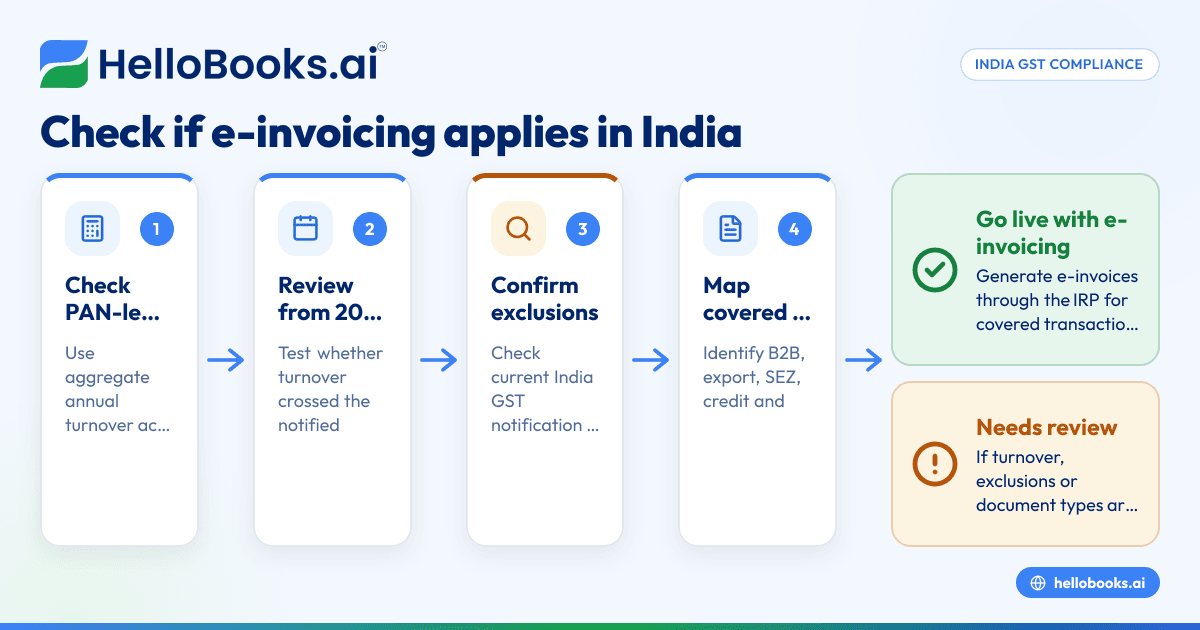
Step 1: Calculate aggregate annual turnover on a PAN basis
Start with turnover across all GST registrations under the same PAN in India. Do not limit the review to one branch or one state. Include the components relevant under the GST definition of aggregate turnover.
If your business has entities in Karnataka, Maharashtra and Delhi under the same PAN, combine them for the test.
Step 2: Review turnover from 2017-18 onwards
Check each financial year from 2017-18 onward. The question is whether you crossed the notified threshold in any of those years, not whether you are below it today.
This is where many businesses miss compliance. A company may have done ₹12 crore turnover two years ago and ₹4 crore today. If the notified rule captures businesses that crossed the threshold in any relevant year, current slowdown does not automatically remove the requirement.
Step 3: Identify excluded categories, if any
Next, check whether your entity falls into any notified exclusion. Do not guess. Use the exact wording of the applicable GST notification or ask your consultant to confirm it in writing.
Step 4: Map the invoice types you issue
List out your transaction types:
- B2B domestic sales
- Export sales
- SEZ supplies
- Credit notes
- Debit notes
- B2C retail invoices
This helps you see where e-invoicing is mandatory and where normal invoicing continues.
Step 5: Test your invoicing system
If you use spreadsheets or a legacy billing setup, do a dry run before going live. You need to check whether your system can:
- Capture mandatory invoice fields
- Generate JSON in the required format
- Push data to the IRP
- Store IRN and QR details
- Reflect cancellations correctly
- Reconcile invoice data with GST returns
If it cannot, you may need e-invoicing software or broader accounting software in India that supports the process properly.
What small businesses should do next
Once you confirm that e-invoicing applies, the next step is operational readiness. This is where most practical issues happen.
1. Fix your invoice master data
Incorrect GSTINs, place of supply, HSN/SAC details, tax rates or customer names can cause failures or mismatches. Before rollout, clean up your master data.
Focus on:
- Customer GSTIN validation
- Product and service tax classification
- State codes
- Unit and quantity formats
- Credit note linkage
- Export customer details where relevant
A small manufacturer in Rajkot or Coimbatore may raise hundreds of invoices a month. Even a small error rate creates customer disputes and delayed dispatches.
2. Standardise your invoice workflow
Define who does what. For example:
- Sales enters order details.
- Accounts verifies GST fields.
- System generates invoice data.
- Invoice is reported to IRP.
- IRN and QR code return to the invoice.
- Final invoice is shared with the customer.
- Dispatch happens only after validation, where required by your process.
Without a clear workflow, teams often print invoices too early and then discover that IRN generation failed.
3. Train your team on exceptions
Most businesses train staff for the normal case but not for edge cases.
Teach your team what to do when:
- IRP is unavailable
- Customer GSTIN is wrong
- Invoice needs cancellation
- A credit note must be raised
- The shipment is urgent
- The invoice date and dispatch date differ
This is especially important for businesses using WhatsApp for customer communication and fast dispatch coordination.
4. Match e-invoicing with GST return preparation
E-invoicing is not just a billing change. It affects GST reporting and reconciliation. Your sales register, e-invoice data and return data should line up.
If your current process still depends on spreadsheet uploads and manual matching, this is a good time to tighten it. Many businesses adopt GST return filing software and bank reconciliation software together with invoicing upgrades so finance gets one clean workflow.
5. Keep records and controls
Maintain a clear audit trail of:
- Invoice generation time
- IRN generation
- Cancellations
- Revised documents
- Credit and debit notes
- Customer communication on invoice corrections
This reduces confusion during internal review and year-end closing.
Practical mistakes to avoid
Small businesses usually do not fail because the law is impossible. They fail because the process is patchy.
Assuming your CA or accountant will handle everything
Your accountant can guide you, but e-invoicing sits inside your day-to-day sales operations. If the billing team, warehouse and finance team are not aligned, problems continue.
Treating e-invoicing as a one-time setup
Rules, thresholds and operational needs change. New GST registrations, product lines or export sales can alter your invoicing needs.
Continuing with disconnected tools
If you create invoices in one system, track payments in another and prepare GST workings in Excel, errors multiply. Businesses often move to AI accounting software or accounting software for small business when manual processes become too slow.
Ignoring data privacy and access control
Invoices contain customer details and sometimes personal information. If your teams share files loosely over email and messaging apps, review access and storage practices. The DPDP Act 2023 has made data handling more important for Indian businesses, especially when customer information moves across teams and vendors.
How software can make e-invoicing easier
A good setup reduces manual work in four places: data capture, IRN generation, reconciliation and reporting.
You should look for software that helps you:
- Create compliant invoices
- Generate and store IRN details
- Track cancellations and credit notes
- Reconcile sales with GST records
- Manage expenses and cash flow in the same system
- Reduce duplicate data entry
For businesses outgrowing Tally-heavy manual workflows, a modern Tally alternative can make billing and compliance easier to manage. If your pain point is mainly invoice creation and follow-up, invoice software may also help simplify the process.
If your books are still spread across spreadsheets, bank statements and GST workings, moving towards AI bookkeeping can save time beyond e-invoicing alone.
A simple readiness checklist for Indian SMEs
Before you go live, ask these questions:
- Have we checked PAN-level turnover from 2017-18 onward?
- Are we sure we are not in an excluded category?
- Have we identified all covered invoice types?
- Can our system generate and store IRN details?
- Is our sales team trained on failed or cancelled invoices?
- Do our GST and accounting records reconcile properly?
- Are invoice data and customer records stored securely?
If the answer to two or more is “no”, pause and fix the process first. Compliance is much easier when the workflow is stable.
If you want to simplify invoicing, bookkeeping and GST operations in one place, you can book a demo or review the available options on pricing.
Frequently asked questions
What is the e invoicing threshold in India?
The threshold is the notified aggregate annual turnover limit under GST for the class of registered persons covered by e-invoicing. The government has reduced this limit in phases over time, so you should check the latest notification that applies to your business.
Is the threshold checked on current-year turnover only?
No. The test has generally been linked to whether your aggregate annual turnover exceeded the notified limit in any financial year from 2017-18 onwards. That is why even a business with lower sales today may still need to comply.
Does e-invoicing apply to B2C invoices in India?
In general, the e-invoicing framework is mainly relevant for covered B2B and certain related transactions such as exports. B2C invoices are not treated the same way, though other invoice or QR-related requirements may apply in specific situations.