
Key takeaways
What this article covers, in order:
- Key takeaways
- What are e-invoicing rules in India for a UK business?
- Do e-invoicing rules india apply to your UK business?
- Which invoices are usually covered under India’s e-invoicing framework?
- When does a UK business need to think about Indian GST registration?
- What should your invoice process look like if you are in scope?
If your UK business sells to customers in India, India’s e-invoicing rules matter only in specific cases. In most cross-border sales, the key question is whether you must register for GST in India and issue tax invoices under Indian rules; India’s IRP-based e-invoicing applies only to certain GST-registered businesses that meet the turnover threshold set by the Indian government.
Key takeaways
- India’s e-invoicing system is a GST compliance requirement for eligible businesses registered in India.
- A UK business selling to India does not automatically fall under Indian e-invoicing rules.
- The main trigger is usually Indian GST registration and whether the notified aggregate turnover threshold applies.
- B2B, export and some other invoices can fall within India’s e-invoicing framework when the supplier is covered.
- You should separate commercial invoicing, VAT treatment in the UK, and Indian GST invoicing requirements.
- This article is general information, not tax or legal advice, and cross-border GST positions should be checked with a qualified adviser.
What are e-invoicing rules in India for a UK business?
India’s e-invoicing rules are not the same as simply emailing a PDF invoice. Under India’s GST system, e-invoicing means reporting invoice data to the Invoice Registration Portal, or IRP, and receiving an Invoice Reference Number, known as an IRN, for applicable invoices.
For a business in London, Manchester or Birmingham selling into India, this matters only if your business has an Indian GST presence that brings you inside the rule. A UK company issuing invoices from the UK to Indian customers is not automatically required to use India’s IRP system just because the customer is in India.
This is where many businesses get confused. There are really three separate layers:
- Your commercial invoice for the customer.
- Your UK accounting and VAT treatment.
- Your Indian GST obligations, if any.
If your business has no GST registration in India and no fixed place or taxable presence there, India’s e-invoicing rules may not apply directly to you. But if you have set up an Indian entity, branch, or taxable registration, the position changes quickly.
Do e-invoicing rules india apply to your UK business?
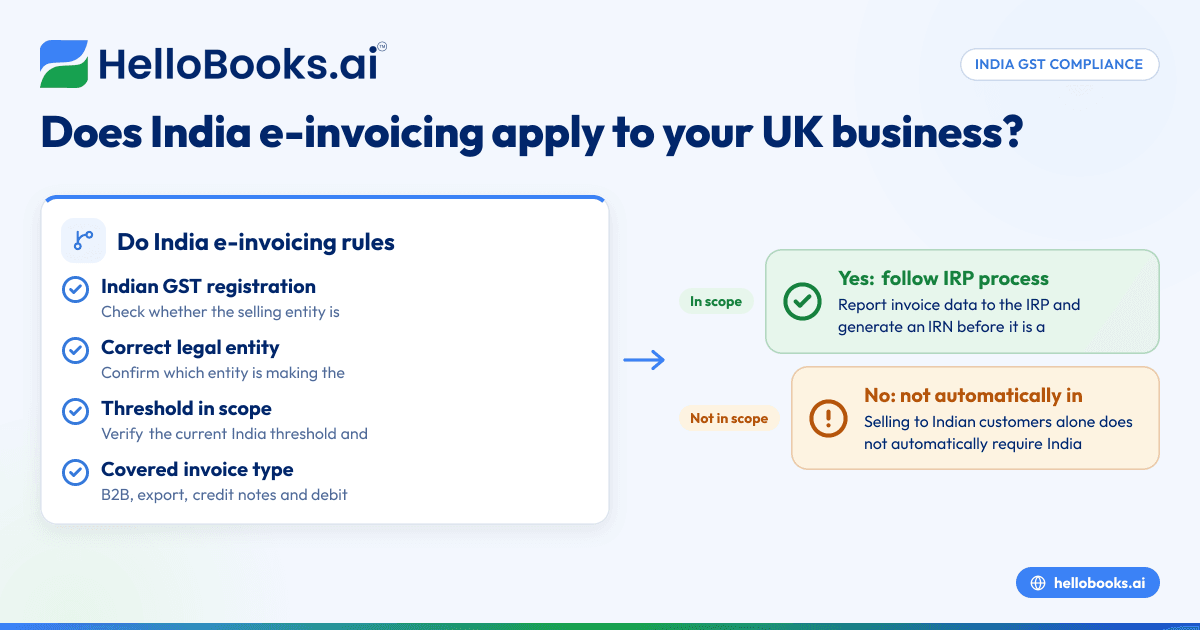
Usually, India’s e-invoicing rules apply only if your business is registered for GST in India and crosses the notified turnover threshold. Selling to Indian customers alone does not, by itself, mean your UK business must generate IRNs through India’s e-invoicing system.
Start with your Indian tax footprint. If you invoice through an Indian subsidiary, warehouse, branch, local GST registration, or another taxable setup, you may be inside scope. If you sell remotely from the UK with no Indian GST registration, the answer is often different.
You should check:
- Whether you have an Indian GST registration
- Which legal entity is making the sale
- Whether that entity meets India’s current e-invoicing turnover threshold
- Whether the invoice type is covered under the rule
- Whether the transaction is B2B, B2G, export, or another category
India has changed e-invoicing thresholds over time. Because of that, never rely on an old article or an accountant’s memory. Confirm the current threshold and effective date before changing your process.
What counts as e-invoicing in India?
In India, an invoice is treated as an e-invoice only when the required invoice details are reported to the IRP and an IRN is generated. A normal PDF, Word file or invoice created in your ERP is not an Indian e-invoice unless it goes through that process where required.
After IRN generation, the invoice data is validated and a QR code is produced. Businesses then use that registered invoice for GST reporting and downstream compliance.
This is important for UK finance teams using Xero, Sage, spreadsheets, or custom billing tools. Your internal system may create the invoice, but Indian compliance depends on whether the invoice is reported correctly to the government system.
Which invoices are usually covered under India’s e-invoicing framework?
For businesses that are in scope in India, e-invoicing generally covers B2B invoices. It can also apply to exports and certain credit notes and debit notes. The exact application depends on the GST rules in force and the nature of the transaction.
If your UK group has an Indian entity, that entity may need to generate e-invoices for:
- Sales to other businesses registered under GST in India
- Export invoices issued from India
- Credit notes linked to covered invoices
- Debit notes linked to covered invoices
By contrast, consumer-facing invoices are treated differently. In many cases, B2C supplies are outside the core IRN generation process, though other QR code or invoicing rules may still apply depending on the transaction and current law.
This is why finance teams should map invoice types, not just entity turnover. One Indian registration may issue several kinds of invoices, and only some may need IRN generation.
How do ai e-invoicing rules affect compliance?
AI tools can help classify invoices, flag missing GST fields and catch format errors before submission. But ai e-invoicing rules do not replace the legal rules. Your business still needs the right GST registration, threshold check and IRP process where India requires it.
Underneath that simple point, there is a practical opportunity. Finance teams often lose time because invoice data sits in emails, spreadsheets, order systems and accounting tools. AI can reduce manual review by checking customer GSTIN details, invoice fields, document type and duplicate risks before the invoice is pushed forward.
That matters for cross-border businesses because the same team may be managing UK VAT, overseas sales, and local compliance in India. A structured workflow reduces avoidable errors, especially where one legal entity is in the UK and another is in India.
If you want to reduce manual work, tools such as e-invoicing software or AI accounting software can help standardise invoice creation and controls, though the legal setup still needs to be correct first.
When does a UK business need to think about Indian GST registration?
This is the real starting point. E-invoicing in India is generally a consequence of being a qualifying GST-registered supplier there, not a standalone requirement for every overseas seller.
A UK business should pause and review Indian GST registration when it:
- Sets up an Indian company or subsidiary
- Stores goods in India
- Makes taxable supplies from India
- Has an establishment or operational presence in India
- Uses an Indian entity to contract and invoice customers
The answer can differ for goods and services. It can also differ based on who contracts with the customer and where the supply is treated as taking place. Cross-border tax treatment is fact-specific, so broad assumptions are risky.
For example, a software company in London selling remotely to a customer in Bengaluru may not have the same Indian compliance obligations as a UK manufacturer with stock held in Mumbai and invoiced through an Indian registration.
What should your invoice process look like if you are in scope?
If your Indian entity or registration is covered by the rule, your invoice process should be designed around compliance before the invoice is sent to the customer. This is much safer than trying to fix invoices after issue.
A practical workflow looks like this:
- Confirm entity and registration details Make sure the invoice is being raised by the correct legal entity and GST registration.
- Classify the transaction correctly Identify whether it is B2B, export, or another invoice type.
- Validate invoice data Check customer tax details, place of supply, item values, tax amounts and document type.
- Generate invoice data in the required schema Your system should prepare the invoice fields needed for IRP submission.
- Submit to the IRP where required The invoice needs IRN generation before it is treated as a valid e-invoice under Indian rules.
- Store the registered invoice and QR code Keep the final invoice and audit trail for accounts, GST returns and customer queries.
- Reconcile books and filings Match invoice records with GST reporting and ledger entries.
For growing teams, this is where AI bookkeeping and bank reconciliation software become useful. E-invoicing data still needs to match receipts, ledger postings and month-end reporting.
What mistakes do UK businesses make with Indian e-invoicing?
The most common mistake is assuming that sending a PDF by email means you are compliant. In India, that is not enough where IRP-based e-invoicing applies.
Other common mistakes include:
Treating all India sales the same
A sale from the UK is not always treated the same as a sale from an Indian registered entity. The contracting party matters.
Ignoring threshold changes
India’s e-invoicing thresholds have changed over time. A business that was outside scope before may now be inside scope.
Using the wrong entity on the invoice
If your UK parent issues the invoice but the Indian subsidiary performs the supply, or vice versa, your tax and accounting position may become messy.
Missing credit and debit note controls
Businesses often focus on sales invoices and forget that related notes can also need correct treatment.
Keeping tax logic outside the system
When invoice decisions live in email chains and finance team memory, errors are much more likely. A repeatable workflow is safer.
This is also why some businesses move from spreadsheets or older manual setups to accounting software for small business with stronger controls around invoicing and records.
How can you check if your Indian entity crosses the threshold?
Check the current turnover threshold notified by the Indian government for e-invoicing, then compare it with the aggregate turnover of the relevant entity under Indian GST rules. Use current guidance only, because thresholds have changed and old references are often wrong.
In practice, your finance team should not do this as a one-off exercise. Build a simple review into your monthly close. If your Indian business is growing, crossing the threshold can happen faster than expected.
A sensible review process is:
- Identify the exact Indian GST-registered entity.
- Confirm the current notified threshold and effective date.
- Calculate aggregate turnover using the Indian rules that apply.
- Check whether any exclusions apply.
- Set a go-live date for compliant invoicing if you enter scope.
- Test invoice generation before the live date.
If your UK headquarters oversees multiple entities, central visibility matters. One dashboard for entity-level sales, invoice types and compliance status can reduce surprises.
How does this fit with UK accounting and VAT?
India’s e-invoicing rules do not replace your UK bookkeeping duties. Your UK business still needs proper accounting records, correct revenue recognition, and correct VAT treatment under UK law where relevant.
That means your finance stack should be able to answer both questions at once:
- What happened commercially?
- What was required for tax and compliance in each country?
For example, a Manchester-based services business may record revenue in pounds for management reporting, but an Indian subsidiary may need local invoicing and GST compliance in rupees for statutory purposes. Those are connected, but not identical, workflows.
This is where clean systems matter more than manual effort. If your team is exporting CSV files from one tool, editing invoices in another, and reconciling in spreadsheets, cross-border compliance becomes fragile.
Using invoice software together with expense management software can help standardise records, even if your tax adviser still reviews the legal treatment.
What should you ask your accountant or adviser?
If you are unsure whether India’s e-invoicing rules apply, ask direct operational questions. Do not stop at a high-level tax memo.
Useful questions include:
- Which legal entity is making the supply?
- Does that entity need or already hold GST registration in India?
- Is that entity above India’s current e-invoicing threshold?
- Which invoice types need IRN generation?
- What is the effective date for compliance?
- How should credit notes and exports be handled?
- What records must be retained?
If you do not have the right adviser, it may help to find an accountant who understands cross-border bookkeeping and indirect tax.
Should you automate Indian invoicing if you sell into India regularly?
Yes, if you have ongoing Indian GST obligations or expect them soon. Manual invoicing may work for low volume, but it becomes risky once you have multiple entities, frequent B2B invoices, or threshold monitoring to manage.
Automation helps in four ways:
- Data consistency Customer and tax fields stay standard.
- Validation before issue Errors are caught earlier.
- Audit trail You can trace who created, changed and submitted each invoice.
- Faster month-end close Registered invoices flow more cleanly into books and reconciliations.
For businesses comparing systems, the right setup depends on whether you need only invoicing or a broader platform covering bookkeeping, expenses and reporting. If you are assessing options, a QuickBooks alternative may be useful if your current process feels too manual for multi-country operations.
Frequently asked questions
Does every UK business selling to India need Indian e-invoicing?
No. Selling to Indian customers does not automatically mean your UK business must use India’s e-invoicing system. The usual trigger is having an Indian GST-registered entity that falls within the notified scope.
Is a PDF invoice the same as an e-invoice in India?
No. In India, a PDF invoice is not an e-invoice for GST purposes where IRP-based e-invoicing applies. The invoice must be reported to the IRP and receive an IRN.
Do export invoices from India fall under e-invoicing?
They can, if the supplier is a covered GST-registered business in India and the invoice type is within scope. The exact treatment should be checked against current Indian GST rules and thresholds.
Do India’s e-invoicing rules affect UK VAT?
Not directly. UK VAT treatment follows UK law, while Indian e-invoicing is part of India’s GST framework. A cross-border transaction can involve both accounting considerations, but they are separate legal systems.
What if my UK company has an Indian subsidiary?
Then you should review the subsidiary separately. If that Indian entity is GST-registered and above the current threshold, it may need to follow India’s e-invoicing rules for covered invoices.
If your business sells into India regularly and you want a cleaner invoicing and bookkeeping workflow, explore HelloBooks’ pricing or book a demo to see how automation can reduce manual work.