Key takeaways
What this article covers, in order:
- How are the two different?
- E-invoicing: who's in?
- E-way bills: when do you need one?
- Five businesses, quick answers
- Self-test
- How HelloBooks helps
A truck is loaded, the driver's waiting, and someone asks, "Do we need an e-way bill for this, or was that the e-invoice thing?" They get mixed up all the time, but they answer different questions. E-invoicing depends on your turnover: you need it if your aggregate turnover crossed ₹5 crore in any year since FY 2017-18, and only for B2B-type invoices. An e-way bill depends on the goods: you need one when a consignment worth more than ₹50,000 moves, whatever your turnover. A small trader can need e-way bills and never e-invoices. A services firm can be the other way round.
How are the two different?
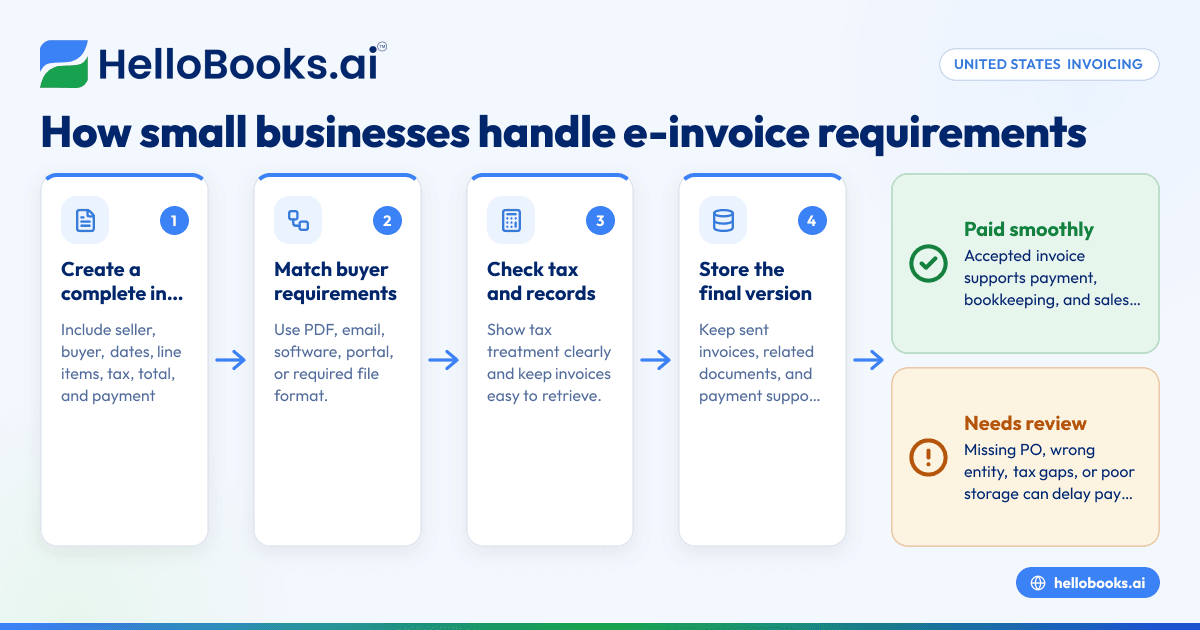
An e-invoice is about registering a B2B invoice with the government. You send the invoice to the Invoice Registration Portal (IRP). It gives you back an Invoice Reference Number (IRN) and a signed QR code, and the details flow into your GSTR-1 on their own.
An e-way bill is about goods on the road. It's a movement document generated before goods leave, carrying the consignment and vehicle details.
| E-invoice | E-way bill | |
|---|---|---|
| What triggers it | Your aggregate turnover | Value of goods being moved |
| Threshold | Above ₹5 crore in any FY since FY 2017-18 | Consignment above ₹50,000 (some states use different intra-state limits) |
| Covers | B2B invoices, credit/debit notes, exports, SEZ supplies, deemed exports | Sales, stock transfers, job work, returns and other movement |
| B2C sales | Not covered | Covered if goods above the limit move |
| Services | Covered (B2B) | Not applicable |
| What you get | IRN and QR code on the invoice | E-way bill number travelling with the goods |
E-invoicing: who's in?
Any business whose aggregate turnover went above ₹5 crore in any financial year from FY 2017-18 onwards. Notice the word "any". Lakshmi's garment unit in Tiruppur crossed ₹5.4 crore in FY 2022-23, and has done about ₹4.6 crore a year since. She's still in. Once you cross, e-invoicing applies from the start of the next financial year and stays.
A few sectors are exempt regardless of turnover: banks and certain financial institutions, insurers, goods transport agencies, passenger transport, multiplex admissions and SEZ units among them. If you're in a borderline sector, check the current list on the e-invoice portal.
What gets an IRN? Tax invoices to registered buyers, credit and debit notes to them, exports with or without tax, SEZ supplies and deemed exports. Plain B2C bills don't. (Very large businesses have a separate dynamic QR requirement for B2C, but that's a different threshold altogether.)
The 30-day rule you'll hear about
Since 1 Apr 2025, businesses with aggregate annual turnover of ₹10 crore or more can't report an invoice, credit note or debit note to the IRP if it's more than 30 days old. An invoice dated 3 Nov 2026 has to be reported by 3 Dec 2026. Try on 5 Dec 2026, and the IRP simply rejects it.
Between ₹5 crore and ₹10 crore, the 30-day limit doesn't apply under the advisories issued so far. But GSTN has already lowered this threshold once, from ₹100 crore. Report within a few days as a habit and you'll never have to care.
What if you skip it?
For a business inside the mandate, a B2B invoice without an IRN isn't a valid tax invoice. Your buyer's credit is at risk, and penalties can follow. In real life, the buyer's accounts team usually notices before the department does, and your payment gets stuck.
E-way bills: when do you need one?
Whenever goods worth more than ₹50,000 move in a consignment. And "move" is broader than "sell". It includes stock transfers to your own branch, goods sent for job work and back, sales returns, goods on approval and stuff sent to an exhibition.
Inter-state, the ₹50,000 limit applies everywhere. Within a state, some governments set higher thresholds, so check yours. Certain goods are exempt, and there are exceptions for non-motorised transport and some short-distance movements. When you're unsure, generate one. It takes two minutes and avoids a long afternoon at a checkpost.
The e-way bill has two parts. Part A carries invoice details, GSTINs, delivery location, HSN and value. Part B is the vehicle. Validity starts when Part B is first filled, at roughly one day for every 200 km for normal cargo, and you can extend it in a window around expiry if the truck's delayed.
What changed recently
Since 1 Jan 2025, you can generate an e-way bill only for documents up to 180 days old, and extensions are capped. Multi-factor authentication also became mandatory for e-way bill generation in 2025. If your dispatch team still shares one login and one phone, sort that out.
The cost of getting it wrong
Goods moving without a valid e-way bill can be detained, with a penalty under Section 129 of the CGST Act. The amount depends on the tax involved, but it's routinely far more than the GST on the consignment itself.
Five businesses, quick answers
Rohit runs a bakery in Pune doing ₹45 lakh, all walk-in. No e-invoice. No e-way bill unless he ships a large catering order by road.
Kiran trades textiles in Surat, ₹3 crore turnover, sending ₹1.2 lakh bales to Delhi by road. No e-invoice. E-way bill on every one of those.
A Bengaluru IT services firm at ₹8 crore, all B2B. E-invoice every B2B bill. No e-way bills. The 30-day rule doesn't bite at ₹8 crore today, but report promptly anyway.
A Chennai auto-parts distributor at ₹14 crore. E-invoices within 30 days, plus e-way bills for consignments over the limit, generated from the same invoice data.
And Lakshmi in Tiruppur, now at ₹4.6 crore. Still e-invoicing, because she crossed ₹5 crore once.
Self-test
- [ ] Has my aggregate turnover crossed ₹5 crore in any year since FY 2017-18? Then I e-invoice B2B bills.
- [ ] Is my aggregate annual turnover ₹10 crore or more? Then I report within 30 days.
- [ ] Do I move goods worth over ₹50,000 in one consignment? Then I need e-way bills.
- [ ] Do I transfer stock between my own branches? E-way bills apply, sale or no sale.
- [ ] Do I send goods for job work? Check e-way bills and ITC-04.
- [ ] Is multi-factor authentication set up for everyone generating e-way bills?
Imports, SEZ supplies or odd movement patterns? Run them past your CA.
How HelloBooks helps
E-invoice (IRN and QR code) and e-way bill generation are on Pro (₹499/month) and above. You generate them from the same screen where you raise the invoice, so the IRN and QR land on the invoice and the data flows into GSTR-1. HelloBooks Free doesn't generate e-invoices or e-way bills. It's built for smaller businesses, filing GSTR-1 and GSTR-3B for one GSTIN directly to the GST portal at ₹0. If you're below ₹5 crore and rarely move goods over the e-way bill limit, Free may be all you need; when you cross the line, upgrading keeps your invoices and history where they are. More on e-invoicing, e-way bills and pricing.
FAQs
Is e-invoicing mandatory below ₹5 crore?
Not unless your aggregate turnover went above ₹5 crore in some earlier year since FY 2017-18. Once you cross, you stay in.
Do B2C invoices need an IRN?
No. E-invoicing covers B2B supplies, exports, SEZ supplies and deemed exports.
What exactly is the 30-day e-invoice rule?
If your aggregate annual turnover is ₹10 crore or more, you can't report an invoice, credit note or debit note to the IRP more than 30 days after its date. It's applied since 1 Apr 2025.
I'm a small business. Do I still need e-way bills?
Possibly. The e-way bill depends on what you're moving, not your turnover. A ₹60,000 consignment needs one even if you do ₹20 lakh a year.
Does an e-invoice replace the e-way bill?
No. You can generate an e-way bill from e-invoice data, but you still need it for goods above the limit.
Can HelloBooks Free generate e-invoices or e-way bills?
No. That's on Pro (₹499/month) and above. Free includes GSTR-1 and GSTR-3B filing for one GSTIN.
Work out which of the two applies to you once, write it on the wall above the dispatch desk, and the truck never has to wait again.
Start free — GST filing included, no card. Try HelloBooks Free