


Key takeaways
What this article covers, in order:
- Why this comes up / what goes wrong
- Step-by-step
- Example (fictional figures)
- Common mistakes
- Doing this in HelloBooks
- Frequently asked questions
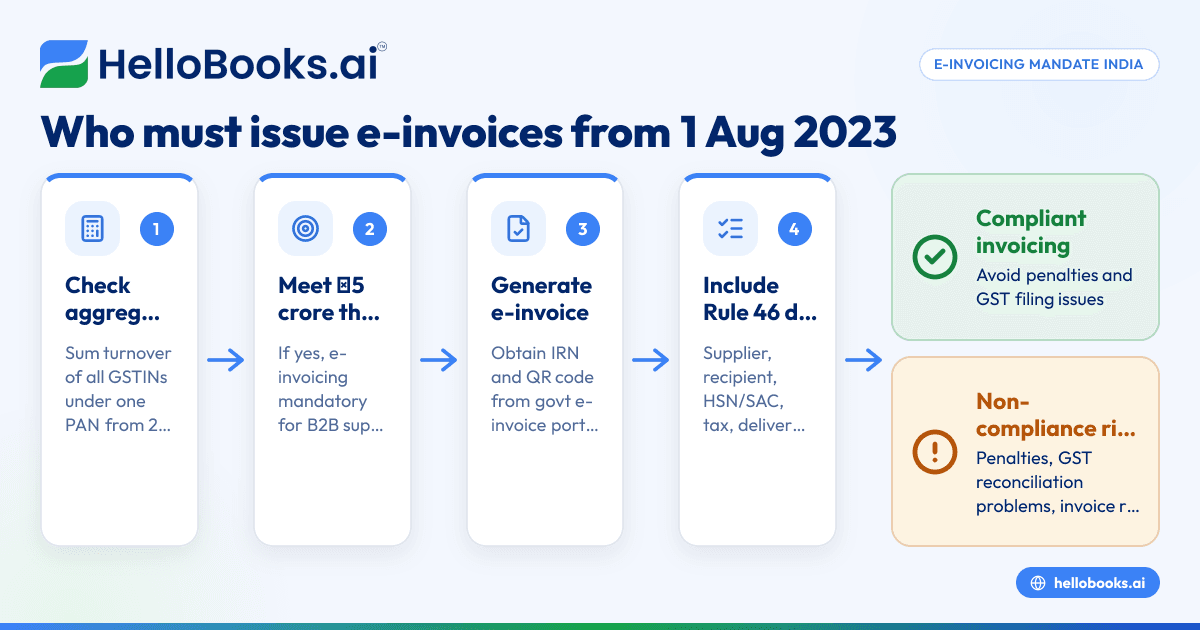
The government of India has mandated that registered persons whose aggregate turnover (at the PAN level, combining all GSTINs) exceeded ₹5 crore in any financial year from 2017-18 onwards must issue e-invoices for B2B supplies starting 1 August 2023. This means businesses crossing this threshold must obtain an Invoice Reference Number (IRN) from the government e-invoice portal for each eligible invoice. The e-invoice must also carry a QR code embedding the IRN.
Why this comes up / what goes wrong
Many small and growing businesses keep their books in Excel, Tally, or bill books and may not track aggregate turnover at the PAN level. They often check turnover only for individual GSTINs and miss the combined turnover across multiple GSTINs. Without knowing the latest notification, these businesses risk non-compliance by not issuing e-invoices when required. This can lead to penalties, difficulties in GST filing, and reconciliation issues. Additionally, missing required invoice details as per Rule 46 or failing to generate the IRN and QR code correctly can cause rejections or delays.
Step-by-step
- Who it applies to: Registered persons whose aggregate turnover (combined turnover of all GSTINs under one PAN) exceeded ₹5 crore in any financial year from 2017-18 onwards. This is a PAN-level threshold, not per GSTIN.
- Threshold: ₹5 crore aggregate turnover at the PAN level.
- What must be done:
- Issue e-invoices for all B2B supplies by obtaining an Invoice Reference Number (IRN) from the government e-invoice portal.
- The invoice must contain all particulars as per Rule 46 of the CGST Rules, including:
- Supplier's name, address, GSTIN
- Consecutive serial number unique for the financial year
- Date of issue
- Recipient's name, address, GSTIN or UIN (if registered)
- HSN code of goods or SAC of services
- Description, quantity, unit
- Total value, taxable value after discount
- Tax rates and amounts (CGST, SGST/UTGST, IGST, cess)
- Place of supply with State name for inter-State supplies
- Delivery address if different from place of supply
- Reverse charge applicability
- Signature or digital signature of supplier or authorised representative
- The e-invoice must carry a QR code embedding the IRN.
- By when: From 1 August 2023 onwards.
- Exemptions: Entities exempt from e-invoicing despite crossing the threshold must declare the exemption on the portal and print a declaration on their invoices.
- Additional details:
- If the recipient is unregistered and the taxable value is ₹50,000 or more, the invoice must include the recipient's name, address, delivery address, and State name and code.
For detailed invoice validation, use the GST invoice validator.
Example (fictional figures)
Consider a business with aggregate turnover as follows:
- Financial Year 2021-22: ₹4,50,00,000
- Financial Year 2022-23: ₹5,20,00,000
Since the turnover exceeded ₹5 crore in 2022-23, the business must issue e-invoices from 1 August 2023.
Suppose the business issues a B2B invoice dated 15/08/2023 with a taxable value of ₹1,00,000 and an assumed GST rate of 18%.
Tax calculation:
₹1,00,000 × 18% = ₹18,000 (GST)
Total invoice value:
₹1,00,000 + ₹18,000 = ₹1,18,000
The invoice must be uploaded to the e-invoice portal to obtain the IRN and QR code before sharing with the buyer.
Common mistakes
- Not aggregating turnover at the PAN level: Businesses often check turnover for one GSTIN only. Prevent this by aggregating turnover across all GSTINs under your PAN.
- Delaying e-invoice generation: Waiting until filing deadlines can cause errors and portal rejections. Generate the e-invoice immediately when creating the invoice.
- Missing mandatory invoice details: Rule 46 requires specific fields like HSN/SAC codes and recipient GSTIN. Use the GST invoice validator to ensure completeness.
- Ignoring exemption declarations: Some entities crossing the threshold are exempt. Check official notifications and declare exemptions on the portal.
- Omitting recipient details for unregistered buyers: For taxable value ₹50,000 or more, include recipient name, address, delivery address, and state code.
- Manual data entry errors: Manual invoice preparation can cause mistakes in GSTIN, tax rates, or serial numbers. Use software or templates to reduce errors.
See our guide on GST invoicing for compliant invoice formats.
Doing this in HelloBooks
HelloBooks helps businesses comply with e-invoicing rules by creating GST-ready invoices that include the correct CGST/SGST or IGST split and HSN/SAC codes from the customer's GSTIN, ensuring all Rule 46 fields are filled consistently. For businesses exceeding the ₹5 crore threshold, HelloBooks automatically obtains the IRN and signed QR code from the government portal when saving a B2B invoice, saving time compared to manual JSON uploads. Additionally, e-way bills can be created directly from the invoice, eliminating duplicate data entry.
Learn more about e-invoicing (IRN and QR).
Frequently asked questions
Who must issue e-invoices from August 2023?
Registered persons with aggregate turnover over ₹5 crore in any financial year from 2017-18 onwards must issue e-invoices for B2B supplies starting 1 August 2023.
What is aggregate turnover for e-invoicing?
Aggregate turnover is the combined turnover of all GSTINs under a single PAN, not just one GSTIN.
Are there exemptions from e-invoicing despite crossing the threshold?
Yes, certain entities can declare exemption on the portal and print a declaration on their invoices.
What details must be on an e-invoice?
As per Rule 46, the invoice must include supplier and recipient details, GSTINs, HSN/SAC codes, tax amounts, IRN, QR code, and other required particulars.
What if the recipient is unregistered?
If taxable value is ₹50,000 or more, the invoice must include the recipient's name, address, delivery address, and state code.
Can small businesses with turnover below ₹5 crore opt for quarterly filing?
Yes, taxpayers with turnover up to ₹5 crore may opt for the QRMP scheme with quarterly GSTR-1 and GSTR-3B filing and monthly tax payments. See official QRMP advisory for details.
Key takeaways
- E-invoicing is mandatory from 1 August 2023 for businesses with aggregate turnover over ₹5 crore.
- Aggregate turnover is calculated at the PAN level, including all GSTINs.
- E-invoices require an IRN and QR code generated from the government portal.
- Rule 46 specifies detailed invoice particulars that must be included.
- Entities exempt from e-invoicing despite crossing the threshold must declare their status on the portal.
- Invoices to unregistered recipients with taxable value ₹50,000 or more require additional recipient details.
Start complying easily with HelloBooks. Start on the Free plan (200 transactions a year, GSTR-1 and 3B filing for one GSTIN).


