


Key takeaways
What this article covers, in order:
- Why this comes up / what goes wrong
- Step-by-step
- Example (fictional figures)
- Common mistakes
- Doing this in HelloBooks
- Frequently asked questions
To register for GST, Indian business owners must submit specific documents that verify their identity, business existence, and banking details. These documents ensure your GST registration application is complete and accepted without delays.
Why this comes up / what goes wrong
Small business owners often search for "documents required for GST registration" because they want to start their GST compliance but get stuck due to unclear documentation requirements. Missing or incorrect documents can cause application rejection or delays, affecting business operations and legal compliance. Many keep physical books or spreadsheets and are unfamiliar with digital filing requirements, making clarity on documents essential.
Step-by-step
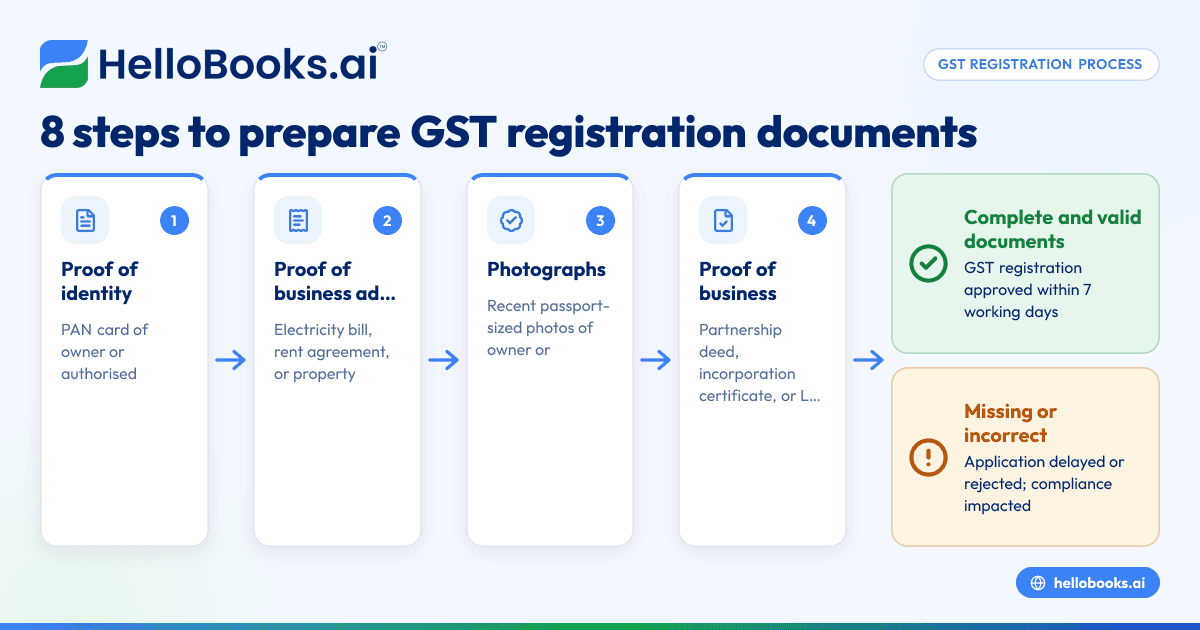
- Gather Proof of Identity: Submit PAN card of the business owner or authorised signatory as a mandatory identity proof.
- Collect Proof of Business Address: Provide documents such as electricity bill, rent agreement, or property tax receipt showing the business premises address.
- Photographs: Recent passport-sized photographs of the business owner or authorised signatory are required.
- Proof of Constitution of Business: Submit the registration certificate of the business entity, such as partnership deed, incorporation certificate, or LLP agreement.
- Bank Account Details: Provide a cancelled cheque, bank statement, or passbook copy showing the bank account linked to the business.
- Authorization Letter or Board Resolution: If a representative is applying for GST registration, submit an authorisation letter or board resolution.
- Digital Signature: For companies and LLPs, a DSC (Digital Signature Certificate) of the authorised signatory is necessary.
- Other Specific Documents: Depending on the business type, additional documents like import/export code, proof of business place ownership or tenancy may be needed.
Check all documents for clarity, validity, and consistency before uploading to the GST portal to avoid rejection.
Example (fictional figures)
Rajesh runs a small garment shop in Bengaluru and wants to register for GST on 01/07/2023. He prepares these documents:
- PAN card of Rajesh
- Rent agreement of shop premises
- Passport-sized photo of Rajesh
- Partnership deed of the shop
- Cancelled cheque of the shop's bank account
Rajesh fills the GST application and uploads these documents. The application fee is ₹500 (assumed illustrative).
GST registration fee = ₹500 (assumed)
Rajesh submits the application on 01/07/2023 and receives GSTIN within 7 working days.
Common mistakes
- Submitting expired or unclear documents: Always submit valid and clear scanned copies to avoid delays.
- Mismatch in details across documents: Ensure the name, address, and PAN are consistent in all documents.
- Not uploading all mandatory documents: Check the GST portal checklist carefully before submission.
- Uploading incorrect file formats or sizes: Follow the portal guidelines for document format (usually PDF or JPEG) and size limits.
- Ignoring digital signature requirement for companies: Companies and LLPs must upload DSC of authorised signatories.
- Not verifying bank details correctly: Upload a cancelled cheque or bank statement that clearly shows the account number and IFSC.
For more on GST invoicing and filing, see GST invoicing and GSTR-1 and GSTR-3B direct filing. Using digital tools can reduce errors and speed up compliance.
Doing this in HelloBooks
HelloBooks helps you create GST-compliant invoices with the correct CGST/SGST or IGST split and HSN/SAC codes directly from your customer's GSTIN, ensuring your tax invoice meets Rule 46 requirements. You can also file your GSTR-1 and GSTR-3B returns directly from the invoices recorded in HelloBooks, reducing manual errors. Supplier bills can be captured using OCR from photos or PDFs, cutting down data entry time. Learn more about HelloBooks for India at HelloBooks for India.
Frequently asked questions
What documents are mandatory for GST registration?
You must provide proof of identity (PAN card), proof of business address, photographs, proof of business constitution, and bank account details. Additional documents like authorization letters or digital signatures may be required based on business type.
Can I register for GST without a physical business address?
No, you need a valid proof of business address such as a rent agreement or electricity bill to complete GST registration.
How long does GST registration take after submitting documents?
Typically, GST registration is processed within 7 working days if all documents are correct and complete.
What if my documents have minor mismatches?
Minor mismatches can cause rejection or delays. Always cross-check that names, addresses, and PAN details are consistent across all documents.
Is a digital signature mandatory for GST registration?
A digital signature certificate is mandatory for companies and LLPs but not for sole proprietors or partnerships.
Where can I file GSTR-1 and GSTR-3B returns easily?
You can file these returns directly from HelloBooks, which builds the returns from your recorded invoices, ensuring accuracy. See GSTR-1 and GSTR-3B direct filing.
Key takeaways
- Gather PAN, proof of business address, photographs, proof of business constitution, and bank details for GST registration.
- Check all documents for clarity, validity, and consistency before submission.
- Companies and LLPs require a digital signature certificate for registration.
- Avoid common mistakes like document mismatches and incorrect file formats.
- HelloBooks simplifies GST invoicing, filing GSTR-1 and GSTR-3B, and purchase bill capture.
- Proper documentation speeds up GST registration and compliance.
Start your GST registration with the right documents and reduce errors by using HelloBooks. Start on the Free plan (200 transactions a year, GSTR-1 and 3B filing for one GSTIN).
This article is general information, not tax or legal advice. Rules change; confirm the current position on gst.gov.in or with your chartered accountant before acting.


