Key takeaways
What this article covers, in order:
- What are the key steps in my month end close checklist?
- How does AI month end close simplify the process?
- How do I ensure GST compliance during month end close?
- Common gaps in month end close for Indian SMEs
- What should I do after completing my month end close?
- Related reading
Complete Month End Close Checklist for Small Businesses in India Using AI Bookkeeping
=======================================================================================
Closing the books at month end is a crucial task for every business. It ensures financial accuracy, compliance with GST, and readiness for tax filing. For small businesses in India, this process can be time-consuming and error-prone when done manually. Using AI bookkeeping software can streamline your month end close, reduce data entry, and give you faster insights. Here’s a comprehensive month end close checklist tailored for Indian small businesses leveraging AI tools.
What is a month end close checklist and why use it?
A month end close checklist is a step-by-step guide to wrap up your accounting for the month. It helps you verify all transactions, reconcile accounts, and prepare financial statements. Using a checklist ensures nothing is missed, which is critical for GST compliance and audit readiness. When combined with AI bookkeeping, many repetitive tasks like invoice matching or bank reconciliation can be automated, saving hours and improving accuracy.
What are the key steps in my month end close checklist?
- [ ] Verify all sales invoices are recorded and dispatched Accurate sales data is essential for GST returns and revenue tracking. AI invoicing software can auto-generate and send invoices, ensuring no sales are missed.
- [ ] Record all purchase bills and expenses Expenses must be entered correctly to claim input tax credit under GST. AI expense management software can extract data from bills and match them with payments.
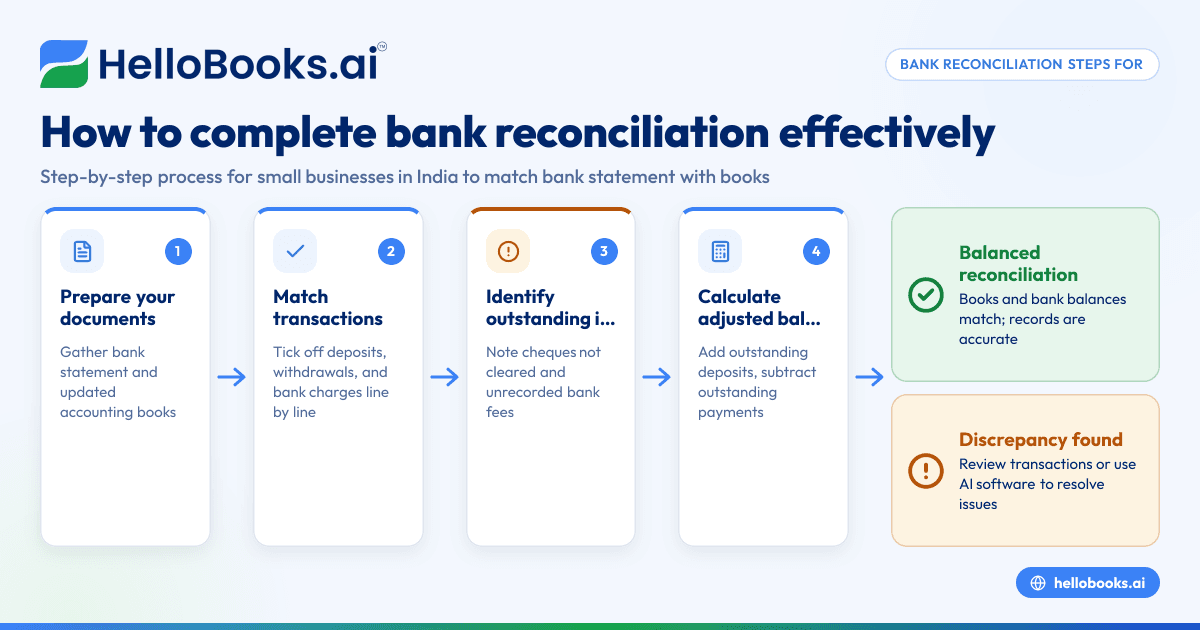
- [ ] Reconcile bank and payment accounts Bank statements must match your books to catch missing or duplicate entries. AI bank reconciliation software can compare transactions and flag discrepancies quickly.
- [ ] Review GST input and output tax ledgers Check that GST collected and paid is correctly posted in your accounting system. This simplifies preparing your monthly or quarterly GST returns.
- [ ] Complete stock and inventory adjustments Any stock received, sold, or written off should be updated to reflect true asset values and cost of goods sold.
- [ ] Verify payroll entries and statutory deductions Ensure salary payments, TDS, and PF contributions are posted accurately for correct expense reporting and compliance.
- [ ] Generate and review financial reports Profit & Loss, Balance Sheet, and Cash Flow statements provide insights into business health and guide decisions.
- [ ] Backup accounting data and documents Keeping secure digital copies helps protect against data loss and supports audits or filings.
How does AI month end close simplify the process?
AI month end close automates transaction matching, bank reconciliation, and report generation, reducing manual work and errors. It speeds up closing by linking invoices, payments, and GST data instantly, letting you focus on analysis rather than data entry.
AI month end close tools automate data entry, categorize transactions, and reconcile accounts faster than manual methods. They reduce human errors and save time by linking invoices, payments, and bank data instantly. For example, HelloBooks.ai can auto-match your bank transactions with invoices and bills, highlight GST mismatches, and prepare reports with a few clicks. This means less time chasing paperwork and more time focusing on business growth.
How do I ensure GST compliance during month end close?
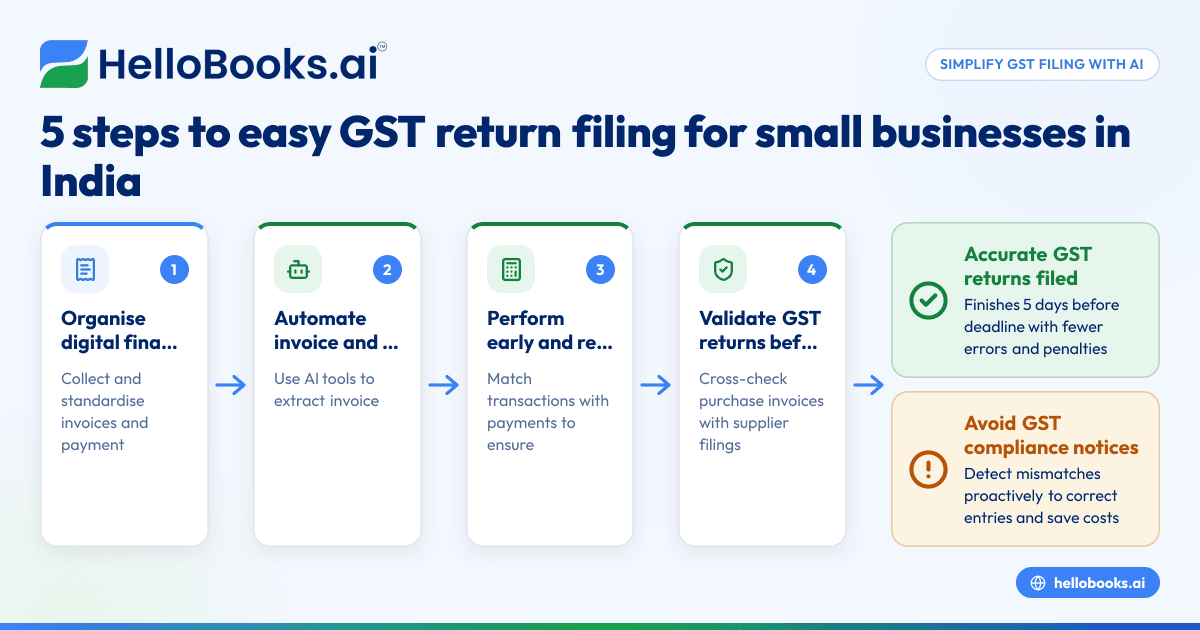
Use GST return filing software synced with your bookkeeping to accurately report sales, purchases, and tax payments. Check that input tax credits are claimed only against valid GST invoices and that all required e-invoices are generated on time.
Maintaining GST compliance requires accurate reporting of sales, purchases, and tax payments every month or quarter. Use GST return filing software integrated with your bookkeeping to pull data directly from your recorded transactions. Confirm that your input tax credit claims have valid invoices with GSTINs and that e-invoices (where applicable) have been generated using e-invoicing software. Timely reconciliation of GST ledgers avoids penalties.
- [ ] Confirm all e-invoices are generated for B2B sales above ₹50 lakh (if applicable)
- [ ] Match input tax credit with supplier invoices and payments
- [ ] File GSTR-1 and GSTR-3B returns by due dates
- [ ] Check for any GST notices or alerts in your accounting software
Common gaps in month end close for Indian SMEs
- Unreconciled bank transactions: Many businesses miss reconciling all bank entries, leading to errors in cash flow reporting. AI bank reconciliation software helps automate this.
- Missing or incorrect GST details on invoices: Incomplete GSTINs or wrong tax rates cause input tax credit denials. Using AI invoicing tools ensures compliance from the start.
- Delayed expense recording: Expenses entered late distort monthly P&L and tax filings. Expense management software with receipt capture on WhatsApp or email helps avoid delays.
What should I do after completing my month end close?
Review your financial statements carefully for any unusual trends or errors. Use insights to plan cash flow, tax payments, and investments. Share reports with your accountant if needed to ensure compliance and financial health.
After closing the month, review your financial reports carefully. Look for unusual expenses, revenue dips, or GST irregularities. Use insights to plan cash flow, tax payments, and business investments. Share reports with your accountant or tax consultant if needed. Regular month end closes build a reliable financial history, making loans, audits, or investor meetings smoother.
If you want to see how AI-powered tools can make your month end close faster and error-free, consider booking a demo at hellobooks.ai/book-a-demo or compare plans at hellobooks.ai/pricing. Automating your bookkeeping will free up your time to focus on growing your business in Bengaluru, Mumbai, Pune, or beyond.
This month end close checklist is designed to help small businesses in India maintain accurate books, comply with GST, and leverage AI bookkeeping for efficiency. Following these steps every month will reduce stress and improve financial control. Remember, this is general information and not a substitute for professional tax or legal advice. For specific concerns, always consult your accountant or GST practitioner.
Related reading
- AI bookkeeping
- How to Streamline Month-End Close for Small Businesses in the United States Using AI Bookkeeping
- How AI Bookkeeping Software Helps US Small Businesses Automate Month-End Close Processes
Read next
This article covers one part of a bigger topic. For the complete picture, read our guide to supported with caveat.