

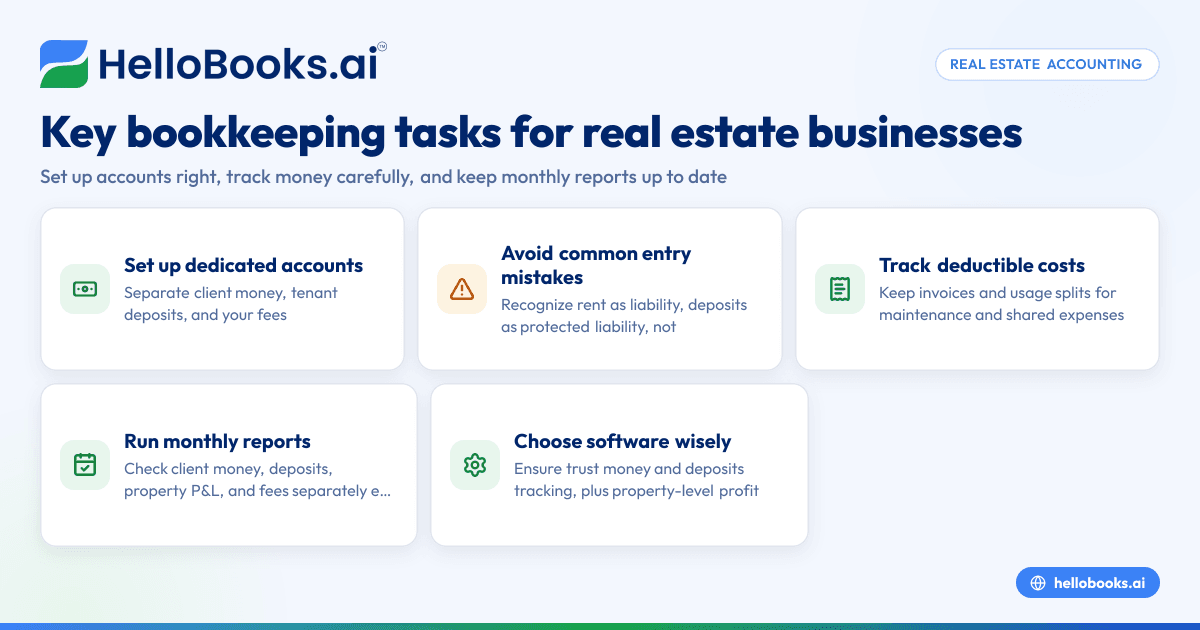

Key takeaways
What this article covers, in order:
- The chart of accounts for a real estate business
- The 3 entries a real estate business gets wrong
- What a real estate business can claim
- The reports to run every month
- Frequently asked questions
- Where to go next
Rent you collect belongs to the landlord, deposits belong to the tenant, and your fee is the small slice in the middle. Keep all three in one bank account and the problem is not your margin — it is your licence.
This is the bookkeeping side of that problem: the accounts to set up, the entries that go wrong, and what you can claim. If you are still choosing software, the round-up linked at the end compares the options.
The chart of accounts for a real estate business
Start from these rather than the default template. The codes are illustrative; the separations are what matter, because each one answers a question you will be asked later.
1050 Client money account — rent held for owners
2150 Rent payable to owners
2160 Tenant deposits held
4000 Management commission
4100 Letting and tenancy fees
5200 Maintenance recharged to owners
The 3 entries a real estate business gets wrong
Rent collected for a landlord
Client money and a liability, not revenue. Only the commission is yours, and commingling the rest is a regulatory failure, not an accounting preference.
A tenant's deposit
Held under a scheme and a liability throughout. Treated as cash, you will not be able to prove it is protected.
Repairs paid for an owner
A recoverable cost against that property, recovered from rent — not your expense.
What a real estate business can claim
Deductibility follows the rule in your own jurisdiction, so this is a checklist to take to your accountant rather than an answer. For a real estate business the cost lines to review first, and the record each one needs, are:
| Cost line | The record to keep |
|---|---|
| Maintenance recharged to owners | The invoice, and the business-use split where the cost is shared |
Whether each of those is deductible, and how much of it, is a rule your tax authority sets and changes. Keep the record either way; take the question to your accountant with the figures in front of you.
The reports to run every month
- Client or trust money held and reconciled separately from your own — review it monthly, not at year end.
- Tenant deposits tracked per tenancy, with scheme compliance evidence — review it monthly, not at year end.
- Property-level profit and loss for owners, not one portfolio total — review it monthly, not at year end.
- Commission and management-fee income separated from rent collected — review it monthly, not at year end.
Frequently asked questions
What is the best accounting software for real estate?
There is no single best one; there is a best one for a shape of business. For a real estate business, work down the criteria in the section above and stop at the first option that clears all of them — that list is short, usually two or three.
The criteria that eliminate most options fastest are: Client or trust money held and reconciled separately from your own; Tenant deposits tracked per tenancy, with scheme compliance evidence; Property-level profit and loss for owners, not one portfolio total.
Give me a list of accounting software for real estate that offer the best security?
Ask for evidence rather than adjectives. The things worth checking, in order: an independent audit you can see (SOC 2 Type II or ISO 27001, with the report date), encryption in transit and at rest, enforced multi-factor authentication, role-based permissions fine enough that a bookkeeper cannot export your whole ledger, an immutable audit trail of who changed what, where your data is hosted and under which country's law, and a stated backup and recovery position.
Then ask the question the brochure will not answer: can you see, after the fact, who changed a figure and what it was before? For a real estate business that audit trail is worth more than any single feature on the security page. A vendor who will send the audit report under NDA is telling you something; one who answers with the words "bank-grade security" is telling you something too.
Is there free accounting software for real estate?
There are free tiers, and they are real — but the limit is what matters, not the price. Find the cap before you move your books: how many documents or transactions a month, how many bank accounts, how many users, and whether the free tier includes the one thing you came for. HelloBooks has a free plan; /pricing lists what it covers today.
How much does accounting software for real estate cost?
Published prices move, and the figure that matters is the one including the module you actually need — inventory, payroll or multi-currency are often a tier up, so the headline price is rarely the price you pay. Price each shortlisted option at the tier that carries what you actually need, on the vendor's own page, on the day you decide.
How do I switch accounting software without losing my history?
Migrate on a period boundary and bring three things: opening trial balance, open customer and supplier balances, and your chart of accounts. Transaction history can usually stay in the old system as a read-only archive — attempting to re-import years of detail is where most migrations lose a week and a reconciliation.
Where to go next
- HelloBooks for real estate
- The real estate accounting software round-up
- HelloBooks in Singapore
- HelloBooks pricing and what each plan includes
This guide is written for businesses in the US, UK, Canada, Australia, New Zealand and Singapore. Tax treatment differs by country — check the rule for yours before you act on it.
Search Console, 6 Jul - 6 Oct 2026: 1,013 impressions for this topic on hellobooks.ai.


