


Key takeaways
What this article covers, in order:
- Why this comes up / what goes wrong
- Step-by-step
- Example (fictional figures)
- Common mistakes
- Doing this in HelloBooks
- Frequently asked questions
The CGST input tax credit ruling clarifies the conditions under which businesses can claim credit for the CGST paid on inputs and input services. It requires that businesses claim ITC only on valid tax invoices that meet statutory requirements and that the credit is reconciled with GST returns like GSTR-2B before filing GSTR-3B.
Why this comes up / what goes wrong
Small business owners often face challenges when claiming CGST input tax credit due to missing or incorrect supplier invoices, mismatched GSTIN details, or confusion about eligibility. Many businesses maintain purchase records in spreadsheets, Tally, or bill books, which makes it difficult to reconcile with GSTR-2B and identify which invoices are eligible for ITC. Claiming ITC without proper verification can lead to GST notices, penalties, or denial of credit.
Step-by-step
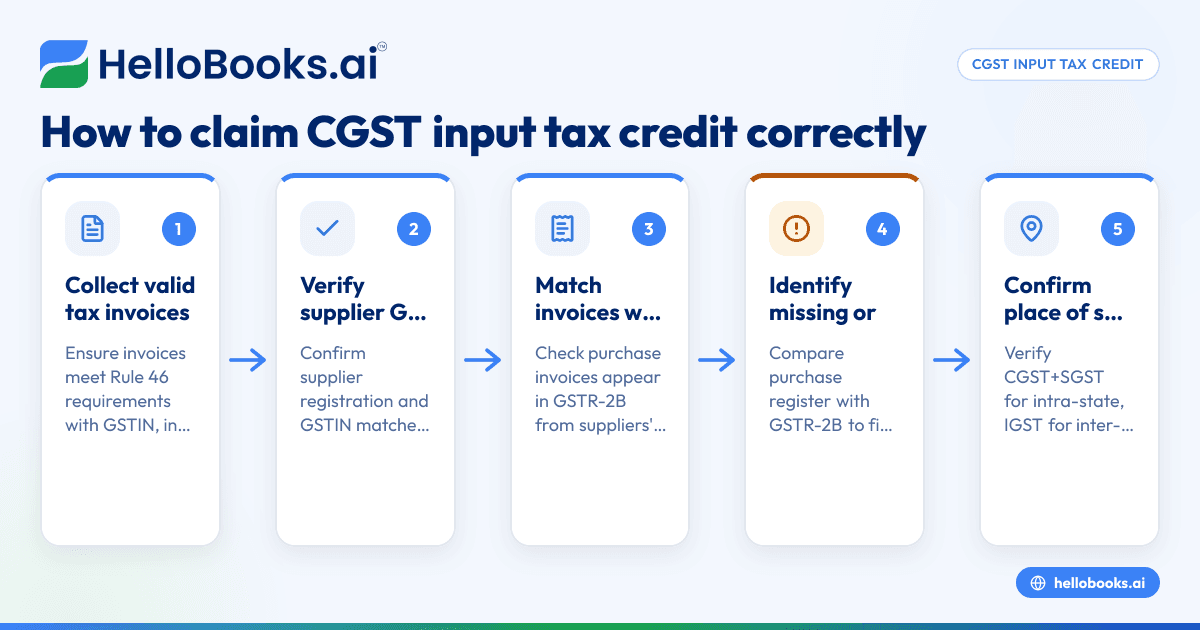
- Collect valid tax invoices: Ensure every purchase invoice contains all particulars required by Rule 46 of CGST Rules, including supplier and recipient GSTIN, invoice number and date, HSN/SAC codes, tax rates, place of supply, and signature [cgst-rule-46/rule46-particulars].
- Verify supplier details and GSTIN: Confirm that the supplier is registered under GST and that the GSTIN on the invoice matches the supplier’s registration.
- Match invoices with GSTR-2B: Check that the purchase invoices appear in your GSTR-2B, which is an auto-drafted ITC statement based on your suppliers’ GSTR-1 returns.
- Identify missing or mismatched invoices: Compare your purchase register against GSTR-2B to spot invoices not uploaded by suppliers or with discrepancies.
- Confirm the place of supply and tax head: Verify that intra-state supplies are charged CGST and SGST, and inter-state supplies are charged IGST. Incorrect tax head application can cause ITC denial [place-of-supply].
- Claim ITC in GSTR-3B: After reconciliation, claim ITC only on invoices that are valid, matched, and eligible.
- Maintain records for audit: Keep all invoices and reconciliation reports safely for future GST audits or assessments.
Example (fictional figures)
A Mumbai-based business purchases goods on 10/04/2023 from a supplier in Maharashtra. The invoice details are:
- Invoice value (taxable): ₹1,50,000
- CGST rate assumed: 9%
- SGST rate assumed: 9%
Calculations:
₹1,50,000 × 9% = ₹13,500 CGST
₹1,50,000 × 9% = ₹13,500 SGST
Total tax = ₹13,500 + ₹13,500 = ₹27,000
This ₹27,000 CGST + SGST paid is eligible as input tax credit, provided the invoice details are correct and reconciled with GSTR-2B before claiming in GSTR-3B.
Common mistakes
- Claiming ITC on invoices not appearing in GSTR-2B: Prevent this by regularly reconciling your purchase register with GSTR-2B using tools or software.
- Incorrect place of supply or tax head charged: Avoid this by verifying if CGST+SGST is charged on intra-state sales and IGST on inter-state sales [place-of-supply].
- Missing or incomplete invoice details: Ensure invoices comply fully with Rule 46 requirements to be valid.
- Claiming ITC on blocked or ineligible goods/services: Check GST ITC eligibility rules carefully before claiming.
- Not maintaining proper records: Keep all invoices and reconciliation reports organised for audits.
- Ignoring supplier GSTIN mismatches or errors: Verify supplier GSTIN on each invoice matches official records.
Doing this in HelloBooks
HelloBooks offers GSTR-2A/2B reconciliation and ITC tracking that automatically matches your purchase register with GSTR-2B nightly. It flags missing, mismatched, or excess-credit invoices and tracks ITC reversal rules before you file your GSTR-3B. The place-of-supply and tax head split feature helps prevent common tax head errors by deriving place of supply from the buyer's GSTIN and applying CGST+SGST or IGST accordingly. Learn more at GSTR-2B reconciliation and ITC.
Frequently asked questions
What is CGST input tax credit?
Input tax credit under CGST allows businesses to reduce the CGST paid on purchases from their output CGST liability, preventing tax-on-tax and reducing overall GST payments.
Can I claim ITC if my supplier has not filed GSTR-1?
No, if the supplier has not filed GSTR-1, their invoices won’t appear in your GSTR-2B, and you cannot claim ITC on those invoices until they are uploaded and matched.
What details must a tax invoice contain to claim ITC?
A tax invoice must contain supplier and recipient GSTIN, invoice number and date, HSN/SAC codes, taxable value, tax rates, place of supply, and signature as per Rule 46 [cgst-rule-46/rule46-particulars].
How often should I reconcile my purchase register with GSTR-2B?
It is best to reconcile monthly before filing your GSTR-3B to ensure all eligible ITC is claimed and discrepancies are resolved early.
What happens if I claim ITC incorrectly?
Incorrect ITC claims can lead to GST notices, penalties, and reversal of credit with interest. Maintaining proper records and reconciliation helps avoid this.
How does place of supply affect CGST ITC?
Place of supply determines whether CGST+SGST or IGST applies. Charging the wrong tax head can cause ITC denial. Use tools or GSTIN data to confirm place of supply [place-of-supply].
Can HelloBooks help with GST invoice errors?
Yes, HelloBooks automatically applies the correct tax head based on place of supply, preventing errors like charging CGST+SGST on inter-state sales or IGST on local sales. See GST invoicing.
Key takeaways
- Claim CGST input tax credit only on valid, reconciled invoices matching GSTR-2B.
- Verify invoice details comply with Rule 46 requirements.
- Regularly reconcile your purchase register against GSTR-2B to identify missing or mismatched invoices.
- Confirm correct place of supply and tax head to avoid ITC denial.
- Maintain records and reconciliation reports for GST audits.
- Use HelloBooks for automated GSTR-2B reconciliation and place-of-supply checks.
Start managing your CGST input tax credit claims accurately and efficiently. Start on the Free plan (200 transactions a year, GSTR-1 and 3B filing for one GSTIN).
This article is general information, not tax or legal advice. Rules change; confirm the current position on gst.gov.in or with your chartered accountant before acting.


