
Key takeaways
What this article covers, in order:
- Key takeaways
- Why does cash flow forecasting matter for small businesses in the United Kingdom?
- What should a weekly cash flow forecast include?
- How do you build a weekly cash flow forecast step by step?
- What is a simple example of a weekly cash flow forecast?
- How often should you update a cash flow forecast?
Cash flow forecasting for a small business in the United Kingdom means estimating the money coming in and going out over the next few weeks and months. The most practical method is usually a weekly forecast built from real invoice due dates, supplier bills, payroll, VAT payment timings and known one-off costs.
Key takeaways
- A weekly cash flow forecast is often more useful than a monthly one for small UK businesses.
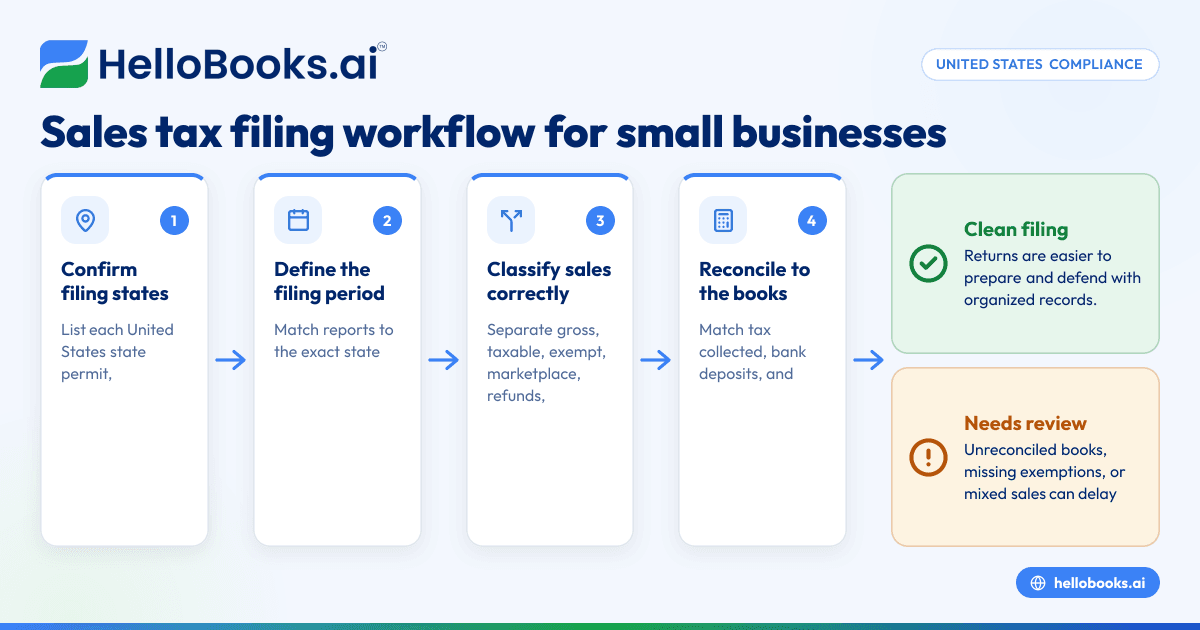
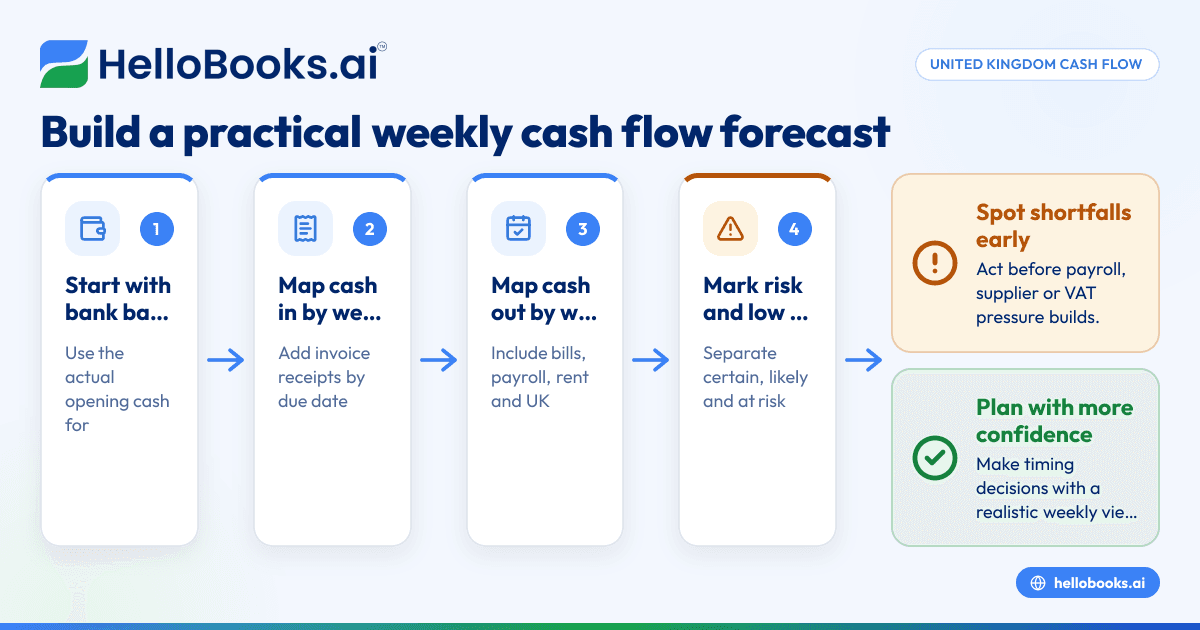
- Start with your current bank balance, then add expected receipts and subtract committed payments by week.
- Use invoice due dates, supplier terms, payroll dates, rent and VAT deadlines to make the forecast realistic.
- Separate “certain”, “likely” and “possible” cash movements so you can spot risk early.
- Review the forecast every week and update it with actual bank activity and new sales or bills.
- Simple automation, including AI bookkeeping and bank reconciliation software, can reduce manual updates.
Why does cash flow forecasting matter for small businesses in the United Kingdom?
Cash flow forecasting helps you see whether your business will have enough cash to pay wages, suppliers, rent and tax on time. It matters because profitable businesses can still run into trouble if cash arrives later than expected.
For many small businesses in London, Manchester or Birmingham, the problem is timing. A customer may pay in 45 days. A supplier may expect payment in 14 days. VAT may be due before several invoices are settled. That gap creates pressure.
A forecast gives you time to act. You can chase overdue invoices earlier. You can delay non-essential spending. You can speak to suppliers before a payment problem becomes urgent. You can also decide when it is safe to hire, order stock or invest in marketing.
This matters even more if you still manage finances in spreadsheets, or if your data sits across bank feeds, email invoices and accounting records. A forecast built once and ignored will not help. A simple weekly method, updated regularly, usually works far better.
What should a weekly cash flow forecast include?
A weekly cash flow forecast should include your opening bank balance, expected customer receipts, planned outgoing payments and your closing cash balance for each week. It should also include VAT dates, payroll, rent, debt repayments and any one-off costs you already know about.
To make it useful, build it around real business events rather than rough guesses. Small businesses often underestimate how much timing matters. A sale booked this week is not the same as cash received this week.
Include these core items:
1. Opening cash balance
Start with the actual amount in your business bank account at the beginning of the week. If you use more than one account, include all operating accounts and note any restrictions on cash use.
2. Money coming in
List expected receipts by week, including:
- Customer invoice payments by due date
- Direct debit or recurring service income
- Cash sales or card settlements
- Refunds due back to the business
- Loans or capital injections, if already confirmed
Do not assume every invoice will be paid on time. Use your actual payment pattern if you know it. If a customer regularly pays 10 days late, reflect that in the forecast.
3. Money going out
List planned and committed payments, such as:
- Supplier bills
- Payroll
- Pension contributions
- Rent and utilities
- Software subscriptions
- Loan repayments
- Insurance
- Corporation tax or other tax payments when known
- VAT liabilities based on your filing calendar
4. VAT timing
VAT can create a sharp drop in cash. If you are VAT registered, your forecast should show the likely payment week clearly. If you use Making Tax Digital compatible records, use the actual return period and expected payment timing from your system or adviser.
This is general information, not tax or legal advice. Check your own filing position and dates with your accountant if you are unsure.
5. One-off items
Add irregular costs early. These often cause surprise shortfalls:
- Annual insurance renewals
- Equipment purchases
- Deposit payments
- Repairs
- Bonus payments
- Seasonal stock buys
How do you build a weekly cash flow forecast step by step?
Build a weekly cash flow forecast by starting with today’s bank balance, then mapping expected cash in and out for each of the next 13 weeks. Update it weekly using actual receipts, overdue invoices, new bills and revised VAT or payroll dates.
Here is a practical method that works well for many small businesses.
Step 1: Choose a 13-week view
Thirteen weeks is long enough to spot problems and short enough to remain accurate. It also fits a normal business rhythm well. Most owners can make sensible assumptions over a quarter, but not over a full year.
Create columns for:
- This week
- Next week
- Week 3 to Week 13
Use week commencing dates in DD/MM/YYYY format.
Step 2: Enter your opening balance
Take the actual cash available at the start of Week 1. For example:
- Opening cash balance on 07/10/2026: £18,400
This is your anchor. If the opening figure is wrong, the whole forecast becomes unreliable.
Step 3: Add expected customer receipts
Now list unpaid sales invoices and place each expected receipt into the week it is likely to arrive.
Example:
- Invoice to a design client in London: £3,600 due in Week 1
- Invoice to a wholesaler in Manchester: £5,200 expected in Week 2
- Monthly retainer from a consultancy client in Birmingham: £1,500 in Week 1
Be conservative. If one customer usually pays late, move their receipt to a later week.
A useful approach is to label each receipt:
- Certain
- Likely
- At risk
This helps you see whether your cash position depends on optimistic assumptions.
Step 4: Add fixed and regular payments
Next, enter costs that happen on known dates:
- Payroll on the last working day of the month
- Rent on the first of each month
- Software and subscriptions by renewal date
- Loan repayments by direct debit date
- Insurance instalments
These are usually easy to map and form the backbone of the forecast.
Step 5: Add supplier bills by agreed payment date
Use actual bill due dates, not when the bill was received. If you know you normally pay some suppliers a few days after the due date, do not hide that pattern. Record what will really happen, then decide whether it is acceptable.
If you already use expense management software, it is easier to pull unpaid bills and due dates into your forecast.
Step 6: Add VAT and other known tax payments
Many businesses forget VAT until it is close. That is risky. Put expected VAT outflows into the correct week as early as possible.
If your figures are not final yet, use a reasonable estimate and mark it clearly. Then replace it with the actual amount once your records are updated.
Step 7: Calculate net cash movement and closing balance
For each week:
- Start with opening balance.
- Add total expected receipts.
- Subtract total expected payments.
- Record the closing balance.
Then carry that closing balance into the next week as the new opening balance.
Step 8: Review the low point, not just the end point
A forecast may show a healthy balance at the end of 13 weeks but still dip into a dangerous position in Week 4. The low point often matters more than the final number.
Look for:
- Weeks where cash turns negative
- Weeks where VAT and payroll fall together
- Periods with large stock or supplier payments before customer receipts land
What is a simple example of a weekly cash flow forecast?
A simple weekly forecast starts with your bank balance and tracks cash receipts and payments by week. For example, a business with £18,400 opening cash might expect £10,300 in receipts and £12,900 in payments over two weeks, leaving £15,800 before the next VAT payment falls due.
Here is a simplified example.
Week 1
- Opening balance: £18,400
- Customer receipts: £5,100
- Payroll: £4,800
- Supplier bills: £2,200
- Software and utilities: £450
Closing balance: £16,050
Week 2
- Opening balance: £16,050
- Customer receipts: £5,200
- Rent: £2,000
- Supplier bills: £2,900
- Loan repayment: £550
- Insurance: £300
Closing balance: £15,500
Week 3
- Opening balance: £15,500
- Customer receipts: £2,400
- VAT payment: £6,200
- Supplier bills: £1,900
- Payroll: £4,000
Closing balance: £5,800
This business is still positive, but Week 3 is clearly tight. That gives the owner time to chase invoices before the VAT payment week, move a discretionary purchase, or speak to suppliers in advance.
How often should you update a cash flow forecast?
Update a weekly cash flow forecast at least once a week. If cash is tight, update it twice a week or after major events such as payroll runs, large customer receipts or VAT submissions.
A forecast only works if it stays close to reality. The best routine is simple:
Every week, do these five checks
- Update the opening balance with the actual bank figure.
- Remove receipts and payments that have already happened.
- Move overdue invoices to a more realistic week.
- Add any new bills, contracts or one-off costs.
- Compare last week’s forecast with what actually happened.
That final step is important. If your forecast keeps overstating receipts, the issue may not be the model. It may be your debtor collection process.
If you want less manual work, AI accounting software can help keep invoice, bill and bank data current, which makes forecasting faster and more accurate.
Common mistakes in cash flow forecasting small business UK
When people search for cash flow forecasting small business uk, they usually want something practical, not a finance theory lesson. Most forecasting errors come from missed timings, weak assumptions and poor review habits.
Here are the common mistakes to avoid.
Treating sales as cash
Sales do not pay bills. Cash does. If you record revenue in the week of the sale but the customer pays 30 days later, the forecast will be too optimistic.
Ignoring VAT
VAT is often one of the largest scheduled cash outflows for a growing business. If it is not shown separately, you may think you have more free cash than you really do.
Forgetting annual or irregular costs
Monthly bills are easy to remember. Annual renewals and one-off expenses are often the real problem. Add them as soon as they are known.
Using only one scenario
A single forecast can hide risk. Create at least two views:
- Base case: most likely timings
- Cautious case: some receipts land later than planned
This shows how exposed you are to slow-paying customers.
Never comparing forecast to actuals
If you never look back, you never improve the forecast. A simple variance review each week helps you spot patterns quickly.
Keeping it in too many places
A spreadsheet can work, but only if the data is maintained. If invoices are in one tool, bills in email and bank transactions elsewhere, the forecast will drift out of date. This is where accounting software for small business can reduce chasing and rekeying.
Can AI cash flow tools help small businesses?
Yes. ai cash flow tools can speed up updates by pulling invoice, bill and bank data into one place. They still need human review, but they can reduce manual entry and help you spot upcoming shortfalls earlier.
The value is not just speed. The value is consistency. If your forecast depends on someone manually checking every invoice and bill, it can quickly fall behind.
Where automation helps most
Good forecasting tools can help with:
- Pulling unpaid invoices into the forecast
- Flagging overdue customer payments
- Matching bank transactions faster
- Keeping bill due dates visible
- Showing trends in late payments and cash gaps
This is especially useful if your team already spends hours chasing spreadsheets before month end.
Where human judgement still matters
No software fully knows your customer relationships. You may know a client will pay only after a project sign-off. You may know a supplier will accept staged payment. Those real-world details matter.
So use automation to gather and organise the data, then apply judgement to the timing.
If your current process is manual, a combination of invoice software and bank reconciliation software can make weekly forecasting much easier.
What should you do if the forecast shows a cash shortfall?
If your forecast shows a shortfall, act early. Chase overdue invoices, delay non-essential spending, review stock purchases, speak to suppliers and update the forecast with realistic payment timings.
The key word is early. A shortfall shown three weeks ahead is a management issue. A shortfall found the day before payroll is a crisis.
Practical actions to consider
- Chase customer payments sooner Contact overdue accounts before the pressure point. A polite, early reminder usually works better than a last-minute chase.
- Review discretionary spending Pause or move non-essential costs. This includes upgrades, equipment purchases or lower-priority marketing spend.
- Talk to suppliers early If a payment will be tight, speak before the due date. Suppliers tend to respond better to early communication than silence.
- Break large bills into smaller timings where possible Some payments can be staged. Record the agreed dates clearly in the forecast.
- Improve invoicing speed Late invoices create late cash. Send invoices as soon as work is delivered.
- Tighten weekly discipline When cash is under pressure, weekly updates may not be enough. Check the forecast more often until the risk passes.
A simple weekly forecast process for your team
The best forecast is one your team will actually maintain. Keep it simple enough to update in 20 to 30 minutes each week.
A practical routine
Every Monday morning:
- Check actual bank balances.
- Review unpaid sales invoices.
- Review unpaid supplier bills.
- Confirm payroll, rent and VAT timings.
- Update the next 13 weeks.
- Highlight the lowest cash week.
- Decide actions for any shortfall risk.
Who should own it?
In a very small business, the owner often owns the forecast. In a growing company, it may sit with the finance lead or bookkeeper. The important point is clear accountability.
If several people issue invoices or approve bills, one person should still own the final weekly view.
What format should you use?
A spreadsheet is enough at first. But once volume grows, a connected system is easier to trust. If you are moving away from fragmented records or looking for a QuickBooks alternative, it helps to choose tools that reduce duplicate entry and keep live figures visible.