
Key takeaways
What this article covers, in order:
- Key takeaways
- Why cash flow forecasting matters for service businesses
- What should a service business include in a cash flow forecast?
- How do you build a simple cash flow forecast?
- How do you plan around client payment delays?
- How should you forecast payroll, contractors, and monthly bills?
Cash flow forecasting for a service business in the United States means estimating when cash will actually enter and leave your bank account. It helps you plan for late client payments, fixed payroll dates, software bills, rent, and taxes so you can avoid surprises and make better decisions before cash gets tight.
Key takeaways
- Cash flow forecasting small business owners use most often is a simple 13-week view plus a monthly forecast.
- Service businesses should forecast by cash timing, not just by revenue on the profit and loss statement.
- Client payment delays matter more when payroll, rent, contractors, and software bills hit on fixed dates.
- A useful forecast starts with open invoices, recurring bills, payroll dates, and realistic collection assumptions.
- Review your forecast weekly and compare forecasted cash to actual bank activity.
- Tools like AI bookkeeping and bank reconciliation software can reduce manual updates and help you spot gaps sooner.
Why cash flow forecasting matters for service businesses
Service businesses often look profitable on paper and still run short on cash. That happens because revenue and cash do not arrive at the same time. You may invoice a client on 03/01/2026, but not receive payment until 04/10/2026. Your payroll, rent, and software subscriptions will not wait.
This is why cash flow forecasting small business teams need is different from a budget. A budget shows planned income and spending over time. A cash flow forecast shows when dollars will actually move in and out of your account.
That timing matters even more in service businesses because costs are front-loaded. You usually pay people before clients pay you. A marketing agency in Chicago may run payroll every other Friday. A consulting firm in Houston may pay contractors twice a month. A design studio in Detroit may bill clients net 30, yet many clients pay later than that.
A good forecast helps you answer practical questions:
- Can we make payroll this month?
- Which clients need follow-up now?
- Should we delay a nonessential expense?
- Do we need a deposit on new work?
- Is it safe to hire next month?
Without a forecast, you react after the problem appears. With a forecast, you can act earlier.
What should a service business include in a cash flow forecast?
A cash flow forecast should include beginning cash, expected customer collections, owner contributions or loan proceeds if any, payroll, contractor payments, rent, software, loan payments, taxes, insurance, and other monthly bills. The goal is not perfection. The goal is a realistic week-by-week view of cash timing.
Start with the money that is most predictable. Then layer in uncertainty with simple assumptions.
The inflows to include
For most service businesses, cash inflows come from a few common sources:
- Open invoices
- List all unpaid invoices.
- Note the due date.
- Estimate the likely payment date based on client behavior, not terms alone.
- New sales not yet invoiced
- Include only work that is very likely to happen.
- Use expected invoice dates and likely payment dates.
- Recurring retainers
- These are easier to forecast.
- Confirm billing dates and whether clients usually pay on time.
- Other cash sources
- Owner funding.
- Credit line draws.
- Tax refunds, if already expected and documented.
Do not count cash before you have a reason to trust the timing. If a client usually pays 15 days late, use that pattern.
The outflows to include
Most service businesses have a similar set of cash outflows:
- Payroll and payroll taxes.
- Contractor payments.
- Rent or coworking fees.
- Software and subscriptions.
- Internet, phone, and utilities.
- Insurance premiums.
- Loan or credit card payments.
- Travel and client delivery costs.
- Marketing spend.
- Estimated tax payments, if applicable.
- State sales tax payments, if your business collects sales tax on taxable services in your state.
This post is general information, not tax or legal advice. Sales tax rules and filing requirements depend on your state and the services you sell.
Why payroll deserves its own line
Payroll is usually the largest fixed outflow in a service business. It is also the least flexible in the short term. That is why you should model payroll separately from other expenses. Include pay dates, payroll tax timing, bonuses, commissions, and any benefits that hit on different dates.
How do you build a simple cash flow forecast?
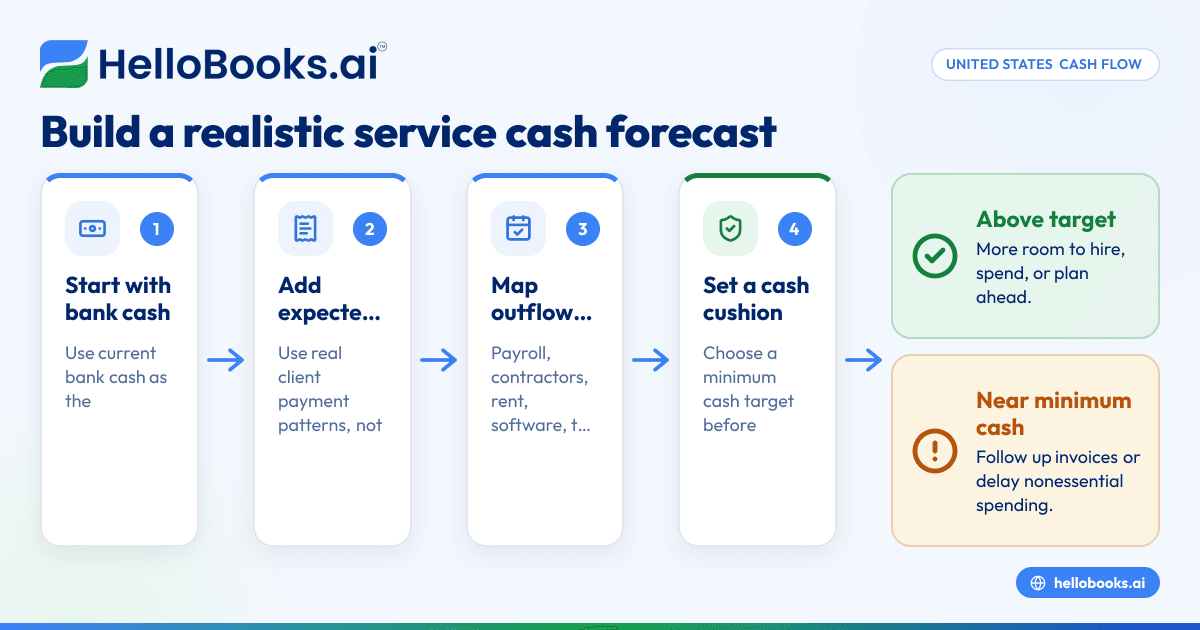
Use a 13-week cash flow forecast for weekly control and a monthly forecast for the next 6 to 12 months. Begin with bank cash, add expected collections by date, subtract bills by date, and update it every week with actual results. Simple, current, and realistic beats detailed but outdated.
Step 1: Pick your forecast periods
Use two views:
- 13-week weekly forecast
- Best for managing short-term cash risk.
- Ideal when client payments are uneven.
- Monthly forecast
- Best for hiring, pricing, and growth decisions.
- Use it for the next 6 to 12 months.
A weekly view is where most service businesses find problems early. Monthly views can hide a payroll crunch in the middle of the month.
Step 2: Start with actual bank cash
Use the current cash balance from your operating account. If you keep a separate tax or payroll account, decide whether to include it or track it separately. Be consistent.
This is where accurate books matter. If your transactions are not categorized and reconciled, your forecast will drift quickly. Many teams use accounting software in the USA to keep bank data and invoice records current.
Step 3: Add customer collections, not just invoices
This is the most common forecasting mistake. An invoice is not cash. Record expected collection dates using real payment patterns.
A simple method:
- Clients that usually pay on time: use due date.
- Clients that often pay 1 to 2 weeks late: shift expected cash date forward.
- Large enterprise clients: build in approval delays.
- New clients: assume a cautious timeline until a pattern appears.
If you accept cards or ACH, note processing timing too. The issue is not just whether a client pays. It is when funds reach your bank.
Step 4: Add all fixed and variable outflows
Map every payment to the date cash leaves. Fixed expenses are easier. Variable expenses need assumptions.
Examples:
- Payroll every other Friday.
- Rent on the first of the month.
- Software charges on different subscription dates.
- Contractor payments after project milestones.
- Insurance premiums quarterly.
- Credit card autopay on the 15th.
- Owner draws, if they happen regularly.
Do not forget annual charges. A once-a-year software renewal can distort a month if it is missing from the forecast.
Step 5: Add a cushion and define a minimum cash target
Every forecast needs a buffer. Clients pay late. Refunds happen. A project may slip. Set a minimum operating cash target based on your business model.
A practical approach is to choose a floor that covers the next payroll plus critical bills. If your forecast falls near that floor, take action early.
How do you plan around client payment delays?
Plan for payment delays by scoring clients based on payment behavior, asking for deposits or milestone billing, sending invoices quickly, and following up before due dates. Forecast collections using actual payment patterns, not contract terms. Late-paying clients should never be modeled as if they pay exactly on time.
Segment clients by payment risk
Not all clients are equal from a cash perspective. Separate them into groups:
- Reliable payers: Usually pay on time.
- Slow but predictable: Usually pay late, but consistently.
- Uncertain: New clients or clients with approval delays.
- High risk: Frequently disputed invoices or long payment cycles.
This makes your forecast more realistic. A law firm, agency, or IT services company may have a few large clients that dominate cash timing. One delayed payment can change the whole month.
Improve invoice timing and collections
If you wait too long to invoice, your forecast weakens before the collection process even starts. Tighten your process:
- Send invoices as soon as work is approved or milestones are hit.
- Make due dates clear.
- Confirm billing contacts and purchase order requirements early.
- Follow up before the due date, not only after it.
- Escalate politely when invoices age past your normal pattern.
If invoicing is still manual, invoice software can help shorten the lag between work delivered and cash collected.
Change contract terms where possible
Service businesses often accept poor payment terms without checking the cash effect. Consider:
- Upfront deposits for new clients.
- Milestone billing for long projects.
- Monthly retainers billed in advance.
- Late fee terms, if appropriate and enforceable.
- Pausing work on seriously overdue accounts, when the contract allows.
You do not need every client to pay faster. Often, changing terms for a few large accounts has the biggest impact.
How should you forecast payroll, contractors, and monthly bills?
Forecast payroll and contractor costs on exact pay dates, not monthly averages. Then layer fixed monthly bills and annual renewals on the dates cash actually leaves the bank. This prevents a profitable month on paper from turning into a short-term cash squeeze.
Treat payroll as non-negotiable
Payroll is not an estimate in the same way marketing spend is. List pay dates for the next 13 weeks. Include:
- Gross payroll.
- Employer payroll taxes.
- Benefits.
- Commissions or bonuses already expected.
- Contractor payments if they are effectively part of delivery payroll.
If you hire seasonally or use project-based contractors, build scenarios. One version can show baseline staffing. Another can show a heavier delivery month.
Add monthly bills with their real withdrawal dates
Service businesses often have many small recurring charges. Individually, they look harmless. Together, they can create real pressure.
Common examples:
- Project management software.
- Design or development tools.
- CRM subscriptions.
- Internet and phone.
- Office rent.
- Insurance.
- Cloud hosting.
- Loan payments.
If you pay by corporate card, map the charge date and the card payment date. Cash may leave later than the expense appears.
Do not ignore taxes and compliance-related payments
Even if you outsource tax work, forecast the cash effect. That can include estimated taxes, payroll tax deposits, annual report fees, or sales tax remittances where applicable. The exact rules depend on your business and state, so confirm them with your accountant.
If you need outside support, you can find an accountant to review your setup.
A practical 13-week example for a U.S. service business
Imagine a small marketing agency in Chicago with:
- Starting bank cash: $85,000
- Biweekly payroll: $24,000
- Monthly rent and utilities: $6,500
- Software and subscriptions: $3,200
- Contractor payments: $12,000 to $18,000 depending on projects
- Open invoices due over the next 30 days: $110,000
On paper, the business looks fine. But the timing may look like this:
- Week 1: payroll of $24,000, rent of $5,800, software charges of $1,100, collections of only $12,000
- Week 2: collections of $38,000, contractors of $9,000
- Week 3: payroll of $24,000, utilities and insurance of $3,200, collections of $15,000
- Week 4: collections of $42,000, card payment of $6,000
This business may dip close to its minimum cash target in Week 3 even though monthly revenue is strong. That is the value of a weekly forecast. It shows when action is needed.
Possible actions:
- Follow up now on the largest invoices due in Weeks 1 and 2.
- Delay a noncritical software purchase.
- Move a contractor payment to the next collection cycle, if agreed.
- Require a 50% upfront deposit on new project work.
- Pause owner draws for two weeks.
Can AI help with cash flow forecasting small business teams do every week?
Yes. AI can help by pulling bank and invoice data into one place, spotting overdue patterns, and highlighting weeks where cash may dip below your target. Good ai cash flow tools do not replace judgment, but they can reduce manual updates and make weekly reviews faster.
The biggest benefit of automation is not complexity. It is consistency. Many small businesses skip forecasting because the file is too hard to update. When your books, invoices, and bank activity stay current, forecasting becomes easier to maintain.
This is where AI accounting software can help. It can support cleaner transaction records, faster reconciliation, and a more current view of receivables and expenses. That makes your forecast less dependent on manual spreadsheet work.
What to automate first
If your process is still mostly manual, automate in this order:
- Bank feeds and reconciliation.
- Customer invoicing and invoice status tracking.
- Recurring expense capture.
- Weekly cash reporting.
- Forecast updates based on actual collections and bill payments.
This does not mean you lose control. It means you spend less time assembling data and more time making decisions.
What are the most common forecasting mistakes?
The most common mistakes are treating invoices like cash, forgetting annual or irregular bills, using monthly averages for payroll, and never comparing forecasted numbers to actual results. A forecast only improves when you update it with real collections and real spending.
Mistake 1: Forecasting revenue instead of cash
Profitability matters, but near-term survival depends on cash timing. Always translate revenue into expected collection dates.
Mistake 2: Being too optimistic about collections
Many owners use due dates as payment dates. Use historical behavior instead. If a client usually pays 10 days late, build that in.
Mistake 3: Forgetting one-time and annual expenses
Renewals, insurance, bonuses, and tax payments often get missed. Keep a rolling list of non-monthly items.
Mistake 4: Updating too rarely
A forecast made once a quarter is not enough when payroll is biweekly and clients pay late. Weekly review is the standard for tighter cash control.
Mistake 5: Not linking forecast to action
A forecast should trigger decisions. If cash will be tight in two weeks, decide today what to collect faster, delay, or renegotiate.
A simple weekly review process
Keep your review short and repeatable. A 20-minute weekly meeting is often enough.
- Check current bank cash.
- Compare last week’s forecast to actual inflows and outflows.
- Update expected collection dates for open invoices.
- Confirm the next payroll and major bills.
- Review the lowest projected cash point in the next 13 weeks.
- Assign actions for overdue invoices or discretionary spending.
This routine works whether you are using spreadsheets or accounting software for small business. The important part is discipline.
When should a service business worry about cash flow?
You should worry when your forecast shows cash dropping near payroll, when one client makes up too much of expected collections, or when you rely on future sales to cover current bills. Those are signs your cash position is fragile even if revenue looks healthy.
Watch for these warning signs: