
Key takeaways
What this article covers, in order:
- Key takeaways
- What is a cash flow forecast for a seasonal small business?
- Why seasonal businesses get surprised by cash shortages
- What should a cash flow forecast template include?
- How do you build a cash flow forecast template?
- What does a simple template look like?
A cash flow forecast helps a seasonal business see when cash will be tight, when it will be strong, and how much runway is available between those points. For a small business in the United States, a simple forecast template can guide inventory buys, payroll timing, rent, loan payments, and owner decisions before a slow month becomes a cash problem.
Key takeaways
- A cash flow forecast tracks when money enters and leaves the business, not just profit on paper.
- Seasonal businesses should build forecasts by week or month, depending on how quickly cash moves.
- The most useful template includes opening cash, expected cash in, expected cash out, and closing cash.
- Inventory, payroll, taxes, rent, and debt payments should be planned before peak season starts.
- A forecast should be updated often with real bank data, not left as a one-time spreadsheet exercise.
- Automation and AI bookkeeping can reduce manual updates and make forecasts more reliable.
What is a cash flow forecast for a seasonal small business?
A cash flow forecast is a forward-looking plan for your business cash balance. It estimates how much cash you will have at the start of a period, what cash will come in, what cash will go out, and what remains at the end.
For seasonal businesses, this matters more than usual. Revenue may spike during one part of the year and fall sharply in another. A garden center in Detroit, a pool service company in Houston, or a gift shop in Chicago may have strong sales for a few months and weak sales for others. Profit alone will not tell you whether you can cover payroll in February or fund inventory in October.
That is why the main search phrase matters: cash flow forecast template small business united states. Small businesses in the United States often deal with uneven sales, vendor terms, state sales tax obligations, merchant processor delays, and payroll deadlines. A forecast gives you time to act before cash gets tight.
A good forecast helps answer questions like:
- Can we afford to place a large inventory order now?
- Do we need a line of credit before the off-season?
- Should we delay equipment purchases?
- Are we collecting receivables fast enough?
- Will cash cover payroll, rent, and taxes during slow months?
Why seasonal businesses get surprised by cash shortages
Seasonality creates timing gaps. You often spend cash before revenue arrives. That is the root issue.
A retail business may buy inventory 30 to 90 days before a holiday rush. A landscaping company may hire crews and service trucks before spring demand ramps up. A specialty food business may stock raw materials before major events and then wait for customer payments to clear through card processors or wholesale terms.
Here are common causes of cash crunches in seasonal businesses:
1. Inventory is purchased too early or in too much volume
Inventory ties up cash. If products move slower than expected, cash stays stuck on shelves.
2. Payroll stays steady while revenue drops
Hourly labor can sometimes be adjusted. Salaried payroll, benefits, and employer tax costs are harder to cut quickly.
3. Receivables arrive later than expected
If customers pay in 15, 30, or 45 days, your income statement may look fine while your bank balance says otherwise.
4. Owners plan from revenue, not cash
Sales projections are useful, but they are not enough. A business can post a strong sales month and still struggle to make payroll if collections are delayed.
5. Taxes and annual payments are missed in the forecast
State sales tax remittances, insurance renewals, software subscriptions, and annual permit fees can hit in months that already have weak cash flow.
This is where a practical template helps. It forces you to put timing first.
What should a cash flow forecast template include?
A simple seasonal cash flow forecast template should be easy to maintain. If it is too complex, your team will stop updating it.
At minimum, include these rows for each week or month:
- Opening cash balance The cash available at the start of the period.
- Cash in from sales Separate by source if helpful, such as in-store sales, online sales, wholesale, or service revenue.
- Collections from accounts receivable This is money actually expected to land in the bank, not just invoices sent.
- Other cash in Owner contributions, loans, refunds, or asset sales.
- Inventory purchases Include deposits and final payments if they happen in different periods.
- Payroll and payroll taxes Include wages, salaries, benefits, and employer payroll costs.
- Rent and utilities Fixed overhead should be listed clearly.
- Loan and credit card payments Include principal and interest if relevant to your planning.
- Marketing and software Recurring subscriptions and campaign spend often increase before peak season.
- Taxes Include state sales tax payments and other scheduled tax outflows when due.
- Owner draws or distributions If these happen, they should be planned, not guessed.
- Other cash out Equipment repairs, insurance, freight, and one-time items.
- Net cash flow Total cash in minus total cash out.
- Closing cash balance Opening cash plus net cash flow.
If your cash moves fast, use a 13-week forecast. If your seasonality is broader, use a 12-month forecast with monthly columns. Many businesses need both.
How do you build a cash flow forecast template?
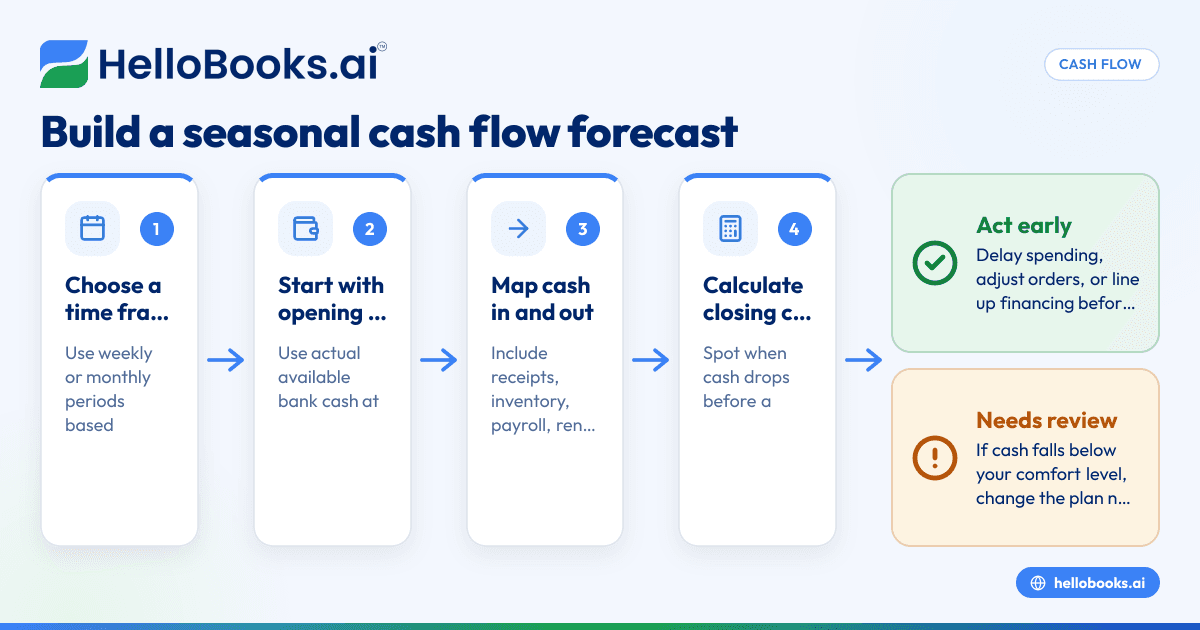
Start with a simple weekly or monthly table: opening cash, cash in, cash out, closing cash. Base every line on real timing, not hope. Then update it with bank activity, invoice collections, payroll dates, and vendor bills so the next decision is based on current cash.
Step 1: Choose the right time frame
Use a weekly forecast if:
- Payroll is weekly or biweekly
- Inventory orders are frequent
- Cash balances swing quickly
- You are already under cash pressure
Use a monthly forecast if:
- Revenue patterns are slower
- Expenses are mostly fixed
- You need a longer seasonal view
A 13-week forecast is often best for near-term control. A 12-month forecast is better for seasonal planning.
Step 2: Start with real opening cash
Use your actual bank balance, not your accounting balance if there are large uncleared items. If multiple accounts are used for operations, include the cash that is truly available to run the business.
Step 3: Forecast cash receipts by timing
Do not enter booked sales unless they are expected to convert to cash in that period.
For example:
- Credit card sales may settle in one to three business days.
- Invoices may be paid in 30 days.
- Marketplace payouts may be delayed.
- Large wholesale customers may pay late.
Build assumptions from your actual collection history.
Step 4: List all expected cash payments
This is where many forecasts fail. They include rent and payroll, but miss irregular outflows.
Look for:
- Seasonal inventory buys
- Freight and shipping
- Overtime and temporary labor
- Insurance renewals
- Tax payments
- Equipment maintenance
- Loan payments
- Owner draws
Step 5: Calculate closing cash for each period
This gives you the key result: when cash dips below your comfort level.
If the business is projected to fall short in a given month, you now have time to change the plan.
Step 6: Compare forecast to actuals every week
A forecast is only useful if it changes with reality. When actual sales or spending differ from the plan, update the next periods.
This is where ai cash flow tools can help. Instead of manually pulling numbers from spreadsheets, bank accounts, and invoices, automated systems can speed up updates and reduce missed items.
What does a simple template look like?
Below is a basic monthly structure you can copy into a spreadsheet.
Example cash flow forecast template
| Line item | Jan | Feb | Mar |
|---|---|---|---|
| Opening cash | $45,000 | $31,500 | $22,000 |
| Cash sales received | $18,000 | $14,000 | $26,000 |
| Invoice collections | $12,000 | $10,000 | $15,000 |
| Other cash in | $0 | $0 | $5,000 |
| Total cash in | $30,000 | $24,000 | $46,000 |
| Inventory purchases | $16,000 | $8,000 | $18,000 |
| Payroll and taxes | $14,500 | $14,500 | $15,500 |
| Rent and utilities | $4,000 | $4,000 | $4,000 |
| Marketing | $2,000 | $1,500 | $3,000 |
| Loan payments | $3,000 | $3,000 | $3,000 |
| Sales tax payment | $4,000 | $2,500 | $5,000 |
| Other cash out | $0 | $0 | $1,500 |
| Total cash out | $43,500 | $33,500 | $50,000 |
| Net cash flow | -$13,500 | -$9,500 | -$4,000 |
| Closing cash | $31,500 | $22,000 | $18,000 |
This example shows a business staying positive, but steadily losing cash during a build period. That creates time to act before the balance gets too low.
How should you plan inventory for peak and slow seasons?
Buy inventory as late as practical, in the smallest useful batches, and based on demand patterns you can defend. The goal is to protect cash first, then chase sales with better reorder timing instead of one large early purchase.
Inventory planning is where many seasonal businesses win or lose their year.
Use historical demand carefully
Look at last year's peak months, but do not copy them blindly. Review:
- Unit sales by month
- Gross margin by product
- Stockout patterns
- Slow-moving items
- Vendor lead times
- Return rates
If one product line sold well but took heavy discounting, treat it cautiously.
Break inventory into categories
Separate purchases into:
- Core items that always sell
- Seasonal fast movers
- Speculative or trend-driven items
Fund core items first. Challenge the third category hardest.
Match payment timing to sales timing
If a vendor requires payment long before sales happen, the inventory buy becomes a financing decision. Forecast that timing in your template.
Model three cases
Create a base case, strong case, and weak case. That helps you see:
- Minimum cash needed to carry stock
- Risk if sales come in soft
- Best time to reorder
For businesses with many SKUs, using expense management software and bank reconciliation software can make it easier to capture the true timing of spend and supplier payments.
How should you plan payroll during seasonal swings?
Payroll should be forecast by pay date, not by monthly averages. That lets you see the exact weeks when labor costs hit cash, especially during low-revenue periods.
Separate fixed and variable labor
List:
- Salaried employees
- Hourly base staff
- Overtime
- Seasonal hires
- Commissions
- Employer payroll taxes
- Benefits
This shows what can flex and what cannot.
Build staffing scenarios before peak season
Ask:
- What is the minimum team needed in slow months?
- At what sales level do we add shifts or temporary staff?
- Can some roles be cross-trained?
- Which weeks create the biggest payroll pressure?
Avoid forecasting only gross wages
Cash out for payroll includes more than wages. Add payroll taxes, benefits, bonuses, and timing of related payments.
Tie staffing to revenue signals
If bookings, orders, or foot traffic are ahead of plan, adjust early. If demand is soft, reduce overtime and discretionary hours before cash tightens further.
If your business still runs payroll forecasting from spreadsheets alone, accounting software for small business can make recurring labor costs easier to monitor against actual bank activity.
How do you plan for slow months without panic?
Plan slow months while cash is still strong. Lock in minimum cash targets, delay nonessential spending, and decide in advance what gets cut first. A good forecast turns slow months into a managed phase, not a surprise.
The right time to plan for a slowdown is during your strong season. Do not wait until the bank balance is already falling.
Set a minimum cash threshold
Choose a floor below which you do not want the business to drop. That might be enough to cover:
- One or two payroll cycles
- Rent and utilities
- Debt payments
- Basic inventory replacement
This becomes your early warning point.
Make a slow-month action list
Before the slow period begins, decide:
- Which expenses can be paused
- Which marketing channels still produce profitable sales
- Which inventory orders can be delayed
- Whether owner draws should be reduced
- Whether financing should be lined up early
Watch collection speed
During slow periods, receivables matter more. Follow up on overdue invoices quickly. Shortening collection time by even a few days can protect cash.
Review subscriptions and recurring spend
Software, contractors, ad campaigns, and service retainers often continue long after demand falls. Cut what is not supporting operations or revenue.
This is also where AI accounting software can help surface recurring expenses and unusual cash patterns faster than a manual review.
Common mistakes in seasonal cash flow forecasting
Even a simple template works if it is updated honestly. Most failures come from bad assumptions or missing items.
Treating revenue as cash
Booked sales are not the same as collected cash. Forecast collections by date.
Ignoring one-time payments
Insurance, annual licenses, repairs, and tax payments can distort a month. Include them.
Underestimating payroll burden
Gross pay is only part of total payroll cash out.
Buying too much inventory too early
Inventory may look like an asset, but it still reduces cash today.
Updating the forecast too rarely
A forecast built in January and ignored until April is not a forecast. It is a document.
Forgetting owner behavior
If owner draws happen regularly, they belong in the model.
When should you move beyond a spreadsheet?
Spreadsheets are fine when the business is simple, transactions are limited, and one person owns the process. They become risky when the business grows, has multiple payment channels, or needs weekly visibility.
You may need a better system if:
- Bank reconciliation takes too long
- Forecasts are built from stale data
- Invoices and collections live in different tools
- You cannot quickly explain cash changes
- Multiple people edit the same spreadsheet
In those cases, using accounting software in the USA, invoice software, or a QuickBooks alternative may give you cleaner data for forecasting. The goal is not more software. The goal is faster, more reliable cash decisions.
A practical routine to keep your forecast useful
The best forecast is not the fanciest one. It is the one your team updates every week.
Use this routine:
- Update bank balances at the same time each week.
- Mark large receipts and payments that cleared.
- Compare actual sales collections to forecast.
- Update inventory purchase timing.
- Confirm the next payroll and tax dates.
- Recalculate the next 13 weeks or 12 months.
- Decide one action if cash is trending down.
This post is general information, not tax or legal advice. If your forecast affects tax payments, financing, or major owner distributions, review it with your accountant. If you do not have one, you can find an accountant.
If you want to spend less time updating spreadsheets and more time making decisions, HelloBooks can help automate bookkeeping, invoicing, expense tracking, and cash visibility. You can book a demo or compare plans on the pricing page.