
Key takeaways
What this article covers, in order:
- Key takeaways
- Why a cash flow forecast matters for a Delaware small business
- What is a cash flow forecast for a Delaware small business?
- What should go into a weekly cash flow forecast?
- How do Delaware owners handle gross receipts tax in a cash flow forecast?
- How far ahead should a Delaware small business forecast cash?
A cash flow forecast for a Delaware small business is a simple week-by-week plan for money coming in and going out. It helps you see cash gaps early, time payments better, and avoid surprises around invoices, payroll, rent, and Delaware gross receipts tax.
Key takeaways
- A weekly cash flow forecast is usually more useful than a monthly one for Delaware small-business owners.
- Your forecast should track opening cash, expected receipts, fixed outflows, tax set-asides, and closing cash.
- In Delaware, gross receipts tax can affect cash timing even when profits look healthy.
- Late customer payments are often the biggest reason forecasts fail, so build best case, expected case, and late case collections.
- A simple system with bank feeds, invoicing, and bank reconciliation software can reduce manual errors.
- This article is general information, not tax or legal advice.
Why a cash flow forecast matters for a Delaware small business
If you run a small business in Delaware, cash timing matters as much as profit. You can show a profit on paper and still feel squeezed if customers pay late, payroll hits on Friday, and rent clears before a large invoice is collected.
This happens often in owner-managed businesses in Wilmington, Dover, and Newark. Many small companies still track cash in spreadsheets or review only the bank balance. That works until sales grow, payroll expands, or tax payments start stacking up.
A cash flow forecast gives you a clearer view. You are not guessing based on today's balance. You are planning the next 13 weeks, week by week, with realistic dates for receipts and payments.
For most Delaware small businesses, a 13-week forecast is the best starting point. It is short enough to be accurate and long enough to catch trouble early.
What is a cash flow forecast for a Delaware small business?
A cash flow forecast shows when cash is expected to enter and leave your business each week. It focuses on timing, not just totals, so you can spot a shortfall before it happens.
Think of it as a working calendar for cash. It is not the same as your profit and loss statement. It is also not the same as a budget. A budget tells you what you plan to earn and spend over time. A cash flow forecast tells you whether enough money will actually be in the bank when bills are due.
For a Delaware small-business owner, the forecast should answer a few practical questions:
- Will I have enough cash for payroll next week?
- Which customer invoices are expected to clear this month?
- How much should I set aside for Delaware gross receipts tax and federal payroll taxes?
- Can I buy inventory now, or should I wait one more week?
- If sales slow for two weeks, what happens to my bank balance?
Those are owner questions. They are immediate and operational. That is why weekly forecasting works well.
What should go into a weekly cash flow forecast?
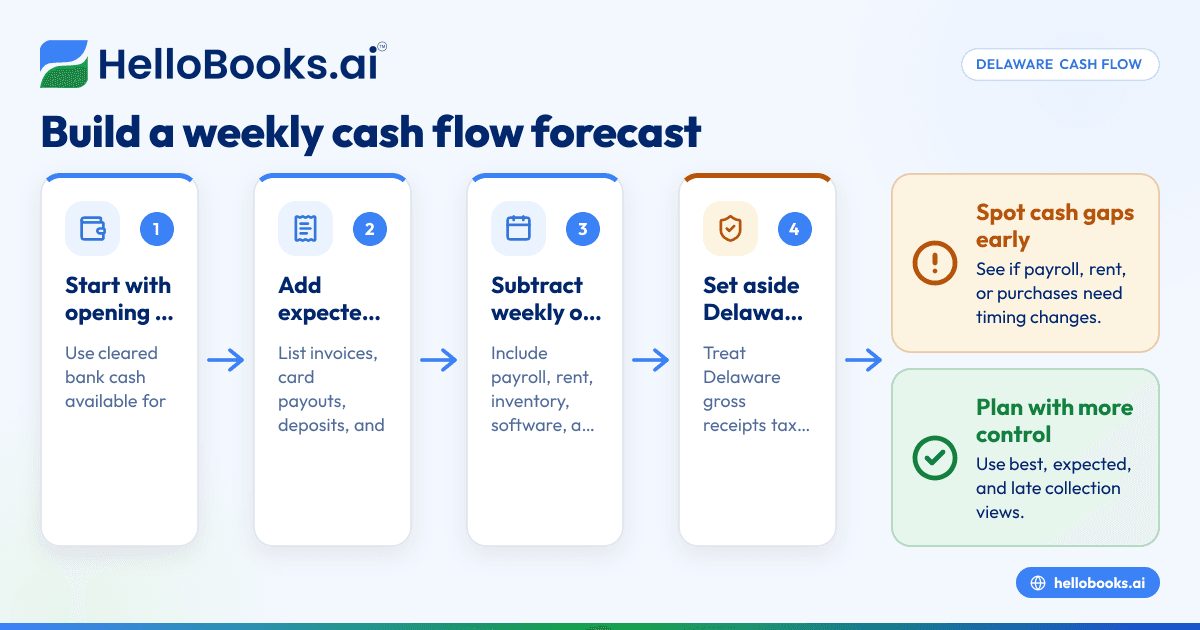
Start with your current bank balance, then add expected cash in and subtract expected cash out by week. Keep it simple, but complete.
The five core lines every owner should track
- Opening cash balance This is your available bank cash at the start of the week.
- Cash in Include customer invoice collections, card settlements, deposits, and any other expected receipts.
- Cash out Include payroll, rent, software, loan payments, utilities, inventory, contractor payments, and owner draws if applicable.
- Tax set-asides and tax payments Include federal payroll tax deposits, estimated tax if relevant, and Delaware gross receipts tax planning.
- Closing cash balance This is opening cash plus inflows minus outflows.
That structure is enough for most small businesses. You do not need a complicated model to get value.
Add these practical details
Under those core lines, break receipts and payments into categories you actually use. For example:
- Open invoices due this week
- Card payouts from Stripe
- Recurring subscriptions
- Payroll and benefits
- Rent and lease payments
- Inventory reorders
- Marketing spend
- Insurance
- Sales commissions
- Tax payments
- Loan or credit card payments
If you already use invoice software or expense management software, pull your timing from there instead of estimating from memory.
How do Delaware owners handle gross receipts tax in a cash flow forecast?
Set aside cash as sales happen, not when the filing date arrives. Delaware gross receipts tax can create a cash squeeze because it is based on gross receipts, not profit.
That short answer matters because many owners treat tax as a future problem. In reality, taxes affect weekly cash planning now.
Delaware does not have a state sales tax, but many Delaware businesses may owe Delaware gross receipts tax depending on their activity. The rate and filing frequency can vary by business type and revenue level. Because rules can change and categories matter, check the Delaware Division of Revenue instructions that apply to your business.
For forecasting, the key lesson is simple. Do not wait until the filing month to think about it.
A simple way to plan for Delaware gross receipts tax
Use this process:
- Identify whether your business is subject to gross receipts tax If you are unsure, confirm your business activity classification with your accountant or the Delaware Division of Revenue.
- Estimate the set-aside weekly As revenue comes in, move a portion into a tax reserve line in your forecast.
- Separate tax cash mentally and operationally Many owners keep one operating account and then forget part of the balance is already spoken for. Your forecast should treat tax reserves as unavailable cash.
- Reconcile against actual filings When you file, compare what you reserved with what you paid and adjust future weeks.
This is one place where discipline matters more than complexity.
How far ahead should a Delaware small business forecast cash?
For most Delaware small businesses, 13 weeks is the right horizon. It is close enough to estimate collections and expenses, but long enough to spot payroll or tax pressure early.
A 13-week view is standard because many important payments repeat in that window. You will see at least several payroll cycles, monthly rent, recurring subscriptions, and likely a tax-related cash event. That gives you time to act.
If your business is seasonal, add a monthly layer beyond 13 weeks. For example, a beach-area service business in Delaware may need a longer outlook before summer hiring or off-season slowdowns. But the weekly forecast should still be your operating tool.
When to shorten or extend the horizon
Use 4 to 6 weeks if:
- Your business is very new
- Receipts are highly uncertain
- You are in active turnaround mode
Use 13 weeks if:
- You have regular payroll
- You invoice customers on terms
- You have recurring overhead
- You need better control without too much complexity
Use 6 to 12 months monthly if:
- You are planning hiring
- You expect financing needs
- You are opening a new location
- You have strong seasonality
Build your forecast in 7 steps
Here is a practical process that works for many Delaware owners.
1. Start with actual bank cash
Use today's cleared cash, not your accounting profit. If you have multiple accounts, total only the amounts available for operations.
2. List open customer invoices by expected payment week
Do not use invoice due dates blindly. Use actual customer behavior. If a customer in Wilmington usually pays 10 days late, forecast it that way.
You can improve this step with AI bookkeeping tools that surface open invoices and recent payment trends in one place.
3. Add other weekly cash inflows
Include card settlements, deposits, recurring service revenue, refunds due back to you, or any financing already approved.
Be conservative. Cash should not go in the forecast until you have a reason to expect it.
4. List all weekly cash outflows
Start with fixed items:
- Payroll
- Rent
- Insurance
- Loan payments
- Software
- Internet and phone
Then add variable items:
- Inventory
- Shipping
- Advertising
- Contractor payments
- Repairs
- Travel
5. Include tax lines
This is where many forecasts break. Add tax reserves and expected payment dates. In Delaware, gross receipts tax planning belongs here if your business is subject to it.
6. Calculate ending cash each week
For each week:
Opening cash + inflows - outflows = closing cash
That closing cash becomes the next week's opening cash.
7. Review and update every week
A forecast is not a one-time sheet. Update actuals, move delayed receipts, and revise upcoming weeks every Friday or Monday.
This regular update is what makes the tool useful.
What usually goes wrong with a cash flow forecast?
Most forecast errors come from timing, not math. Owners often overestimate how fast customers pay and underestimate how many “small” expenses hit in the same week.
The biggest problems are predictable:
Late collections
If your business sends invoices on net terms, your expected receipt date is often too optimistic. Build three views:
- Best case
- Expected case
- Late case
That gives you a more realistic range.
Missing annual or quarterly costs
Insurance renewals, software renewals, local license fees, and tax payments often get missed. Put them in the forecast as soon as you know the month.
Mixing business and personal cash
Owner-paid expenses and irregular draws can distort your view. If you take draws, forecast them like any other outflow.
Treating tax cash as free cash
This is common in growing businesses. A strong sales month can make the bank balance look healthy, while part of that balance should already be reserved.
Can ai cash flow tools help a Delaware small-business owner?
Yes, if they reduce manual work and make weekly updates easier. The best ai cash flow setup helps you pull invoices, bank activity, and recurring expenses into one current forecast.
That short answer is enough for many owners. The real value is not magic predictions. It is speed, visibility, and fewer manual misses.
A practical ai cash flow workflow can help in three ways:
1. Faster updates
Instead of editing a spreadsheet line by line, connected systems can pull current transactions, open invoices, and categorized expenses into your forecast view.
2. Better pattern spotting
If certain customers always pay late, or payroll always lands in your lowest-cash week, software can make that trend easier to see.
3. Tighter owner control
You still decide what is likely to happen. Software just gives you a cleaner starting point.
If you are reviewing options, look for AI accounting software or accounting software in the USA that supports your weekly review process instead of adding complexity.
A simple 13-week example for a Delaware business
Imagine a small HVAC company in Newark, Delaware.
- Opening cash this week: $28,000
- Expected customer collections: $14,000
- Payroll on Friday: $9,500
- Rent: $3,200
- Fuel and supplies: $2,800
- Software and phone: $600
- Gross receipts tax reserve: $1,200
The week would look like this:
- Opening cash: $28,000
- Total cash in: $14,000
- Total cash out: $17,300
- Closing cash: $24,700
That seems fine. But now assume $6,000 of collections slips by one week. Closing cash falls to $18,700. Add an equipment repair for $4,500, and you are down to $14,200.
That is why timing matters. You were profitable on the jobs. But your weekly cash got tighter than expected.
What should the owner do?
Options may include:
- Call overdue customers earlier.
- Delay a non-urgent purchase by one week.
- Reduce discretionary spend temporarily.
- Ask for larger customer deposits on future jobs.
- Review whether invoice timing can improve.
These are operating actions, not accounting theory.
How to make your forecast accurate enough to trust
Accuracy does not mean perfection. It means the forecast is useful for decisions.
Use actual customer payment behavior
Track how long customers really take to pay. A due date is not a payment pattern.
Update weekly on the same day
Pick Friday afternoon or Monday morning. Consistency matters.
Compare forecast to actual
At the end of each week, ask:
- Which receipts slipped?
- Which expenses were not planned?
- Which assumptions were wrong?
Then improve next week's forecast.
Keep categories simple
If your sheet has 50 lines, you may stop using it. Start with the categories that drive cash.
Reconcile the books
Your forecast depends on clean records. If invoices, expenses, and bank activity are not up to date, your numbers will drift. This is where accounting software for small business can help by reducing manual entry and keeping the underlying data current.
When should a Delaware owner change pricing, terms, or payroll timing?
Change something when the forecast shows a repeated cash squeeze, not just a one-time dip. If the same low-cash pattern appears for several weeks, the issue is operational.
Look for recurring signals:
- Customers pay slower than your terms
- Payroll falls before major collections every cycle
- Inventory purchases happen too early
- Tax reserves keep getting borrowed
- Gross margin is not covering overhead quickly enough in cash terms
Actions that can improve cash flow
You may be able to:
- Send invoices the same day work is completed.
- Require deposits upfront.
- Shorten payment terms for new customers.
- Follow up on overdue invoices earlier.
- Spread large vendor payments where possible.
- Time purchases closer to demand.
- Review staffing and overtime patterns.
These changes are often more effective than just watching the bank balance.
Frequently asked questions
Is a cash flow forecast the same as a budget?
No. A budget is a plan for revenue and expenses over a period. A cash flow forecast focuses on when cash actually moves in and out of your business.
How often should I update my forecast?
Weekly is best for most Delaware small businesses. If cash is tight, update it more often until the business is stable.
Do Delaware small businesses need to plan for sales tax in the forecast?
Delaware does not have a state sales tax. But some businesses may need to plan for Delaware gross receipts tax, along with federal payroll taxes and other obligations.
What is the biggest mistake owners make?
The most common mistake is assuming customers will pay on the invoice due date. Late collections can quickly throw off payroll, rent, and tax planning.
Can software replace my judgment?
No. Software can speed up updates and surface patterns, but you still need to decide what is realistic. Good tools support your process rather than replace it.
If you want a simpler way to stay on top of cash, bookkeeping, invoices, and weekly visibility, you can book a demo with HelloBooks or compare options on the pricing page.