
Key takeaways
What this article covers, in order:
- Why this comes up / what goes wrong
- Step-by-step
- Example (fictional figures)
- Common mistakes
- Frequently asked questions
- Key takeaways
Bookkeeping in the Czech Republic means maintaining accurate and complete records of your business’s financial transactions. This is essential to meet the requirements of Czech accounting laws and tax authorities and to keep your business finances clear and organised.
Why this comes up / what goes wrong
Small business owners in the Czech Republic often face challenges with bookkeeping because Czech accounting rules can be complex and differ from those in other countries. Many entrepreneurs struggle with knowing which documents to keep, how to classify expenses and revenues, and how to prepare for tax filings. Mistakes in bookkeeping can lead to fines, incorrect tax payments, or difficulties in understanding the financial health of the business. For Indian business owners or those familiar with Indian bookkeeping methods, adapting to Czech bookkeeping standards requires clear guidance.
Step-by-step
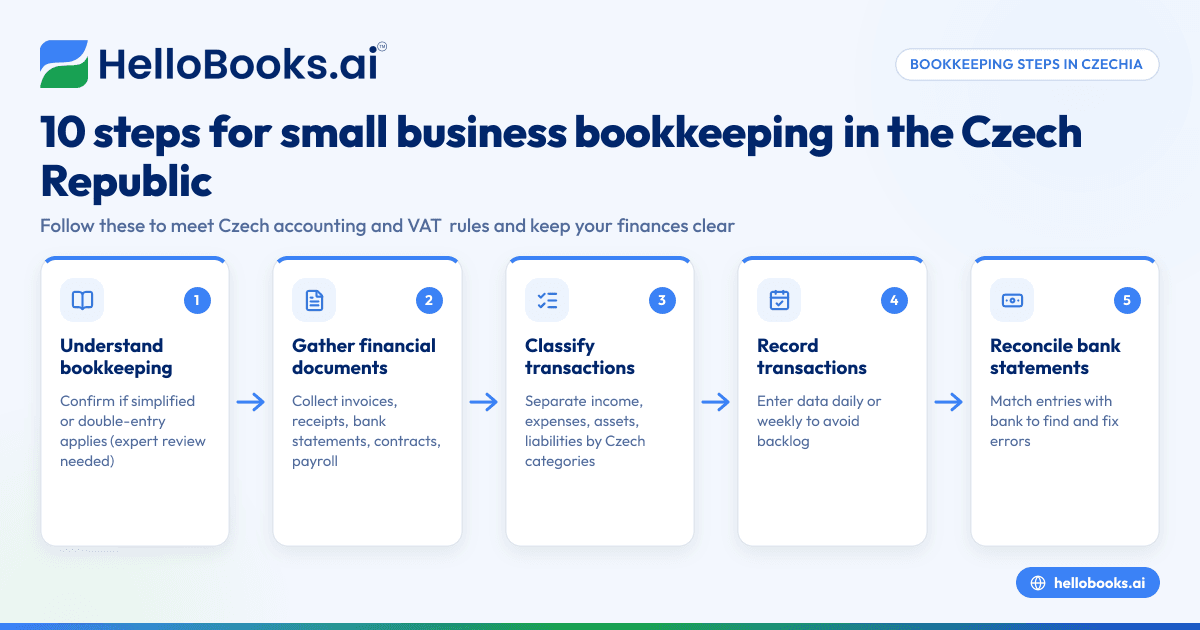
- Understand your bookkeeping obligations: Check if your business is required to keep double-entry accounting records or can use simplified bookkeeping (NEEDS EXPERT REVIEW). Small businesses usually follow simplified rules but must confirm.
- Gather all financial documents: Collect invoices, receipts, bank statements, contracts, and payroll records. Ensure every transaction is backed by a document.
- Classify transactions correctly: Separate income, expenses, assets, and liabilities. Use Czech accounting categories if available.
- Record transactions regularly: Enter transactions chronologically, ideally daily or weekly, to avoid backlog.
- Reconcile bank statements monthly: Match your bookkeeping entries with your bank statements to find and correct errors.
- Prepare VAT reports if applicable: If your business is VAT registered, maintain records for VAT returns and ensure compliance with Czech VAT laws (NEEDS EXPERT REVIEW).
- Keep digital or physical copies securely: Store all documents for the legally required period, usually 10 years (NEEDS EXPERT REVIEW).
- Review financial reports periodically: Use profit and loss statements and balance sheets to understand your business performance.
- Consult a Czech accountant or tax advisor: Especially for tax filing and legal compliance, professional help is important.
- Use bookkeeping tools or software if possible: To reduce manual errors and save time, consider digital solutions that support Czech accounting standards.
For Indian business owners looking to manage bookkeeping efficiently, understanding these steps is crucial. You can also explore AI bookkeeping to automate data entry and reconciliation.
Example (fictional figures)
Suppose an Indian-owned small business in Prague sells goods and keeps books in INR for internal use. On 15/03/2024, the business made a sale worth ₹1,00,000 with an assumed VAT rate of 21% for illustration.
- Sale amount = ₹1,00,000
- VAT (assumed) = ₹1,00,000 × 21% = ₹21,000
- Total invoice value = ₹1,00,000 + ₹21,000 = ₹1,21,000
The bookkeeping entry would be:
- Debit Accounts Receivable ₹1,21,000
- Credit Sales Revenue ₹1,00,000
- Credit VAT Payable ₹21,000
When payment is received on 30/03/2024:
- Debit Bank ₹1,21,000
- Credit Accounts Receivable ₹1,21,000
This example shows how to record sales and VAT in bookkeeping. For Indian businesses, converting local currency transactions to INR helps internal management.
Common mistakes
- Not keeping all source documents: Prevent by organising and filing every invoice, receipt, and contract immediately.
- Delaying bookkeeping entries: Avoid backlog by scheduling regular data entry sessions weekly or monthly.
- Mixing personal and business expenses: Keep separate bank accounts and records to prevent confusion.
- Ignoring VAT rules: Understand VAT registration thresholds and filing requirements; consult a tax advisor.
- Failing to reconcile bank statements: Monthly reconciliation helps detect errors or fraud early.
- Not backing up digital records: Use cloud storage or external drives to keep copies safe.
For small businesses in India, tools like HelloBooks for India can help manage GST invoicing and filing, which is a similar concept to managing VAT in the Czech Republic.
Frequently asked questions
What bookkeeping system is used in the Czech Republic?
Small businesses commonly use simplified bookkeeping or double-entry accounting depending on their size and turnover. The exact system depends on Czech accounting laws (NEEDS EXPERT REVIEW).
How long should I keep my bookkeeping records in the Czech Republic?
Typically, records must be retained for 10 years, but confirm with local regulations or a tax advisor.
Do I need to file VAT returns?
If your business is registered for VAT in the Czech Republic, you must file periodic VAT returns according to local deadlines (NEEDS EXPERT REVIEW).
Can I use Indian bookkeeping software for my Czech business?
You can use software for bookkeeping but ensure it supports Czech accounting standards and VAT reporting. Consider software tailored for Czech tax laws or consult an accountant.
How can I simplify bookkeeping?
Automate data entry and reconciliation where possible. Using digital tools that support your local tax rules can reduce errors and save time. Learn more about GST invoicing for Indian tax compliance as a related concept.
Key takeaways
- Bookkeeping in the Czech Republic requires accurate recording of all financial transactions.
- Small business owners must understand local accounting rules and VAT obligations.
- Regular recording, document organisation, and bank reconciliation prevent errors.
- Consulting a Czech accountant helps ensure compliance and accurate tax filing.
- Using bookkeeping tools or software can simplify the process and reduce manual work.
Start managing your business finances confidently by following these steps. To begin with bookkeeping and GST compliance in India, you can Start on the Free plan (200 transactions a year, GSTR-1 and 3B filing for one GSTIN).