
Key takeaways
What this article covers, in order:
- Why this comes up / what goes wrong
- Step-by-step
- Example (fictional figures)
- Common mistakes
- Frequently asked questions
- Key takeaways
Bookkeeper software automates essential tasks like data entry, GST invoicing, bank statement and GSTR-2B reconciliation, and GST return filing for Indian Chartered Accountant (CA) firms and bookkeeping businesses. Using the right software can reduce manual work, prevent errors, and improve compliance.
Why this comes up / what goes wrong
Bookkeeper business owners and accountants in India often rely on spreadsheets, Tally, or manual bill books to manage their clients’ accounts. These methods are time-consuming and prone to errors, especially when handling GST invoicing, GSTR-1/3B filing, and reconciliation. For example, a three-partner CA firm in Ahmedabad managing 80 GST clients deals with large volumes of invoices and returns monthly, requiring scalable and reliable software. Meanwhile, a solo tax practitioner in Nagpur needs an affordable and easy-to-use solution to manage their GST filings and bookkeeping efficiently.
Without proper software, manual data entry leads to mistakes and delays. Reconciling GST input tax credit (ITC) with GSTR-2B and bank statement reconciliation become tedious. Meeting GST compliance deadlines becomes stressful, risking penalties. These challenges drive the search for suitable bookkeeper software tailored for Indian CA and bookkeeping firms.
Step-by-step
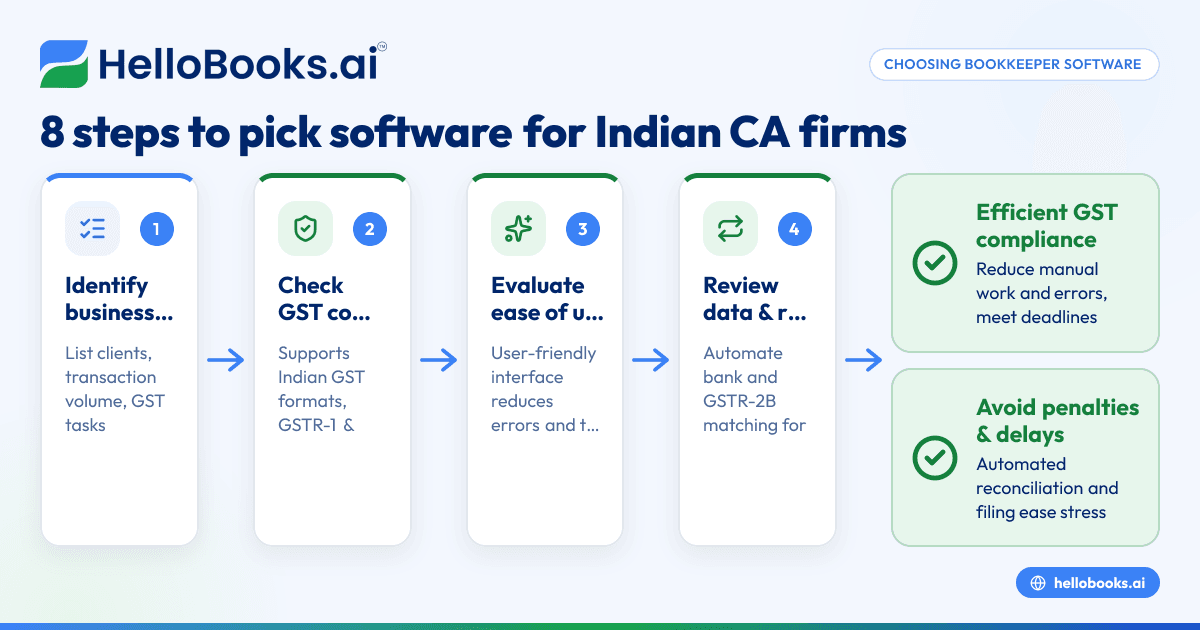
- Identify your business needs: List your transaction volume, number of clients, and GST compliance requirements. Determine if you need features like GSTR-2B reconciliation, e-invoicing with IRN, inventory management, or multi-client handling.
- Check GST compliance support: Verify the software supports Indian GST formats including HSN/SAC codes, IRN for e-invoices, and filing of GSTR-1 and GSTR-3B returns. This ensures you meet statutory requirements accurately.
- Evaluate ease of use: Choose software with a user-friendly interface suitable for your team’s skills—whether they are used to Tally, Excel, or manual bookkeeping. Clear navigation reduces training time and errors.
- Review data entry and reconciliation features: Look for automated bank statement upload and reconciliation, and automatic matching of purchase records with GSTR-2B to simplify ITC verification.
- Assess reporting capabilities: The software should generate financial reports and GST summaries easily to facilitate audits and business decisions.
- Consider scalability and support: Ensure the software can handle your current client base and grow as your firm expands. Reliable customer support is important for troubleshooting.
- Compare pricing and plans: Balance features with your budget. Use trial versions or demos to test suitability. You can compare plans for India to find options that fit.
- Test before committing: Use free trials or demos to confirm the software integrates well with your workflow and meets your compliance needs.
Example (fictional figures)
A three-partner CA firm in Ahmedabad manages 80 GST clients. They require software to handle monthly GSTR-1 and GSTR-3B filings, GST reconciliation, and invoicing efficiently.
- Total GST invoices generated in a month: ₹1,20,00,000 (assumed illustrative figure)
- GST collected (assuming 18% rate): ₹1,20,00,000 × 18% = ₹21,60,000
- Number of clients: 80
- Time taken for manual invoice entry per client per month: 15 minutes
Calculations:
Manual entry time total = 80 clients × 15 minutes = 1,200 minutes
Convert minutes to hours = 1,200 ÷ 60 = 20 hours saved monthly by automation
Using software that automates invoice creation and GST filing reduces manual work by 20 hours every month, improving accuracy and freeing staff for higher-value tasks.
Common mistakes
- Choosing software without full GST compliance: Avoid this by confirming support for GSTR-1 and GSTR-3B filing, e-invoicing with IRN, and HSN/SAC code integration.
- Ignoring ease of use and training needs: Complex software can cause errors and slow adoption. Test interfaces with your team before purchase.
- Skipping reconciliation automation: Manual reconciliation of GSTR-2B and bank statements is error-prone and slow. Opt for software with automatic reconciliation features.
- Not considering scalability: Software that cannot handle more clients or transactions will limit growth. Choose solutions designed for CA firms and bookkeeping businesses.
- Neglecting reporting features: Without clear financial and GST reports, audits and decision-making become difficult. Confirm reporting capabilities upfront.
- Failing to test software before buying: Always use trial versions or demos to ensure the software fits your firm’s workflow and compliance needs.
Frequently asked questions
What features should a bookkeeper software for Indian CA firms have?
It should support GST invoicing, GSTR-1 and GSTR-3B filing, GSTR-2B reconciliation, bank statement reconciliation, and generate financial reports. Easy data entry and inventory management features are also valuable. For more on GST invoicing, see GST invoicing.
Can bookkeeper software replace Tally for small firms?
Many modern bookkeeper software solutions offer similar or better features than Tally, especially for GST compliance and automated filing. However, firms should carefully compare features, ease of use, and support before deciding.
How does bookkeeper software help with GST compliance?
It automates invoice generation with correct HSN/SAC codes, calculates GST, prepares GSTR-1 and GSTR-3B returns, and helps reconcile ITC with GSTR-2B. This reduces errors and saves time.
Is cloud-based software better for bookkeeping firms?
Cloud-based software offers accessibility from anywhere, automatic updates for GST rules, and easier collaboration among partners. However, ensure your internet connection is reliable.
Are there bookkeeper software options tailored for CA firms?
Yes, some software are designed specifically for CA and bookkeeping firms, supporting multiple clients, bulk GST filing, and audit reports. Learn more about Chartered accountants and bookkeeping firms.
Key takeaways
- Identify your firm’s GST compliance and bookkeeping needs before choosing software.
- Prioritise software that supports automated GST invoicing, filing, and reconciliation.
- Test software usability and scalability with your team before purchase.
- Avoid manual reconciliation by selecting software with GSTR-2B and bank statement reconciliation features.
- Use trial versions or demos to ensure software fits your firm’s workflow.
- Consider cloud-based options for flexibility and automatic GST updates.
Choosing the right bookkeeper software can streamline your CA or bookkeeping firm’s GST compliance and accounting tasks. To find a plan that suits your business size and needs, compare plans for India.