
Key takeaways
What this article covers, in order:
- Why this comes up / what goes wrong
- Step-by-step
- Example (fictional figures)
- Common mistakes
- Doing this in HelloBooks
- Frequently asked questions
Cross-border startups with Delaware entities face unique accounting challenges involving multiple tax jurisdictions, currency conversions, and compliance in both India and the US. The best automated accounting platforms for these startups handle multi-currency invoicing, Indian GST compliance including e-invoicing, US accounting standards, and automate bookkeeping tasks like bank statement reconciliation and purchase bill entry.
Why this comes up / what goes wrong
Startups with Delaware entities often have Indian operations managing local expenses, invoicing Indian clients, and handling GST compliance, while also maintaining US accounting records for Delaware entity requirements such as US GAAP or tax filings. Many still rely on spreadsheets, Tally, or manual bill books, which leads to errors, time-consuming reconciliations, and missed deadlines. Multi-currency invoicing and fluctuating exchange rates add complexity. Without automation, startups struggle to maintain accurate financials and risk compliance penalties.
Step-by-step
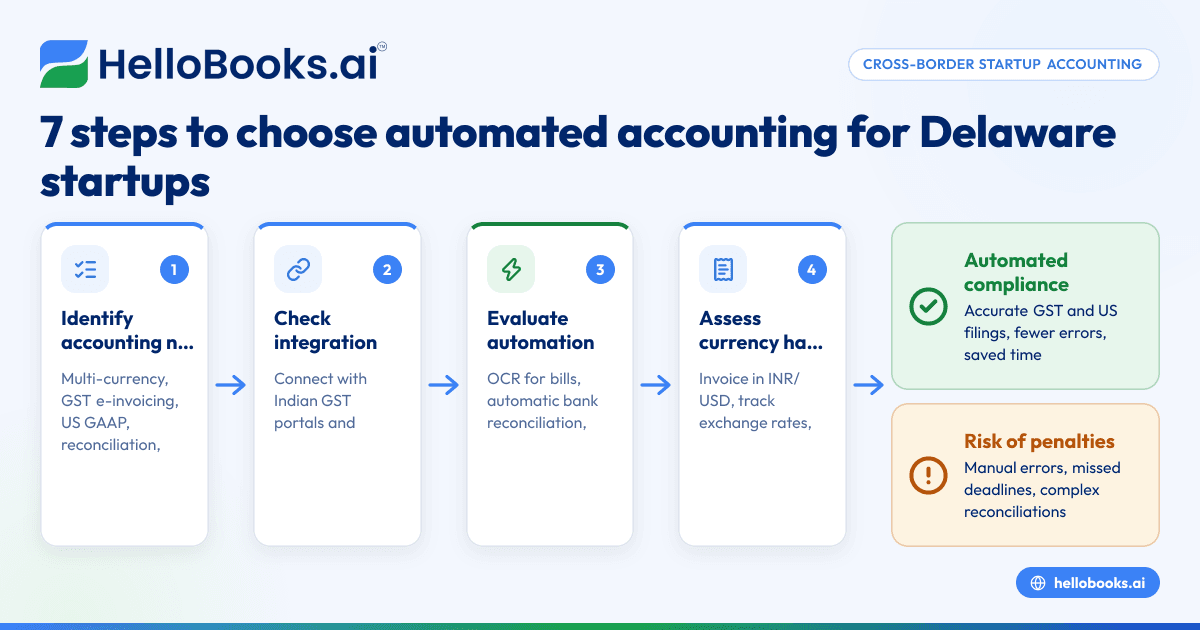
- Identify your accounting needs: List requirements like multi-currency support, GST invoicing with e-invoice compliance (if turnover exceeds ₹5 crore), US accounting standards, bank statement reconciliation, and inventory management.
- Check integration capabilities: Ensure the platform integrates with Indian GST portals for GSTR-1 and GSTR-3B filing and supports export of data suitable for US tax filings.
- Evaluate automation features: Look for OCR for purchase bills to reduce manual entry, automatic bank statement reconciliation, and inventory tracking.
- Assess multi-currency and payment handling: Confirm the platform can issue invoices in INR and USD, track exchange rates, and reconcile payments from multiple countries.
- Verify compliance and reporting: The platform should generate GST-compliant invoices with all particulars as per Rule 46, including supplier and recipient GSTINs, HSN/SAC codes, IRN QR codes for e-invoiced bills, and export invoice endorsements where applicable. It should also provide US-compliant financial reports or data export.
- Test user experience and support: Choose software with an intuitive interface and responsive support, especially for queries on cross-border tax compliance.
- Plan data migration and training: Prepare to migrate existing data from spreadsheets or Tally and train your team on the new platform.
Example (fictional figures)
A 12-person SaaS startup in Bengaluru with a Delaware entity has August 2023 figures as follows:
- Revenue from Indian clients: ₹25,00,000
- Revenue from US clients (in USD): $10,000 (assumed ₹8,00,000)
- Monthly expenses in India: ₹12,00,000
Calculations:
- Total revenue in INR = ₹25,00,000 + ₹8,00,000 = ₹33,00,000
- GST on Indian revenue (assumed 18%) = ₹25,00,000 × 18% = ₹4,50,000
- GST on US revenue = ₹0 (export services zero-rated under GST) [NEEDS EXPERT REVIEW]
- Net revenue excluding GST = ₹33,00,000 - ₹4,50,000 = ₹28,50,000
The startup uses an automated platform to issue GST-compliant invoices containing all mandatory details per Rule 46, capture purchase bills via OCR scanning, and reconcile bank statements in INR and USD. It files GSTR-1 and GSTR-3B monthly and prepares reports for US tax filings.
Common mistakes
- Ignoring multi-currency reconciliation: Avoid by choosing software with built-in currency conversion and automatic reconciliation.
- Manual data entry of purchase bills: Prevent errors and save time by using OCR scanning for bills.
- Non-compliance with GST invoice rules: Ensure invoices include all mandatory details as per Rule 46, such as supplier and recipient GSTIN, HSN/SAC codes, and IRN QR codes if e-invoiced.
- Failing to file timely GSTR-1 and GSTR-3B: Use platforms with GST filing automation or reminders to meet deadlines.
- Overlooking export invoice endorsements: For exports, include the correct endorsement on invoices as per GST Rule 46.
- Not planning data migration properly: Prevent data loss by mapping old data fields accurately during migration.
Doing this in HelloBooks
HelloBooks offers OCR for purchase bills, allowing startups to capture supplier bills from photos or PDFs instead of manual entry. This feature reduces errors and speeds up bookkeeping, especially useful for startups managing multiple invoices and expenses across currencies. Learn more at HelloBooks for India.
Frequently asked questions
What features should cross-border startups look for in accounting software?
Look for multi-currency support, GST invoicing with e-invoice compliance, bank statement reconciliation, automated purchase bill entry, and export-friendly reporting. These features streamline compliance and bookkeeping.
Can Indian GST compliance be automated for startups with Delaware entities?
Yes, platforms integrated with the GST portal can automate GSTR-1 and GSTR-3B filing, including e-invoicing if turnover exceeds ₹5 crore, helping startups meet Indian tax requirements efficiently.
How do I handle currency conversion in such platforms?
Choose software that tracks exchange rates, allows invoicing in multiple currencies, and automatically reconciles payments to avoid manual conversion errors.
Are there specific invoice requirements for exports from India?
Yes, export invoices must carry an endorsement such as 'SUPPLY MEANT FOR EXPORT' and include recipient details and destination country as per GST Rule 46 [cgst-rule-46/rule46-export-endorsement].
Is HelloBooks suitable for startups managing Indian and US accounting?
HelloBooks supports Indian GST invoicing and compliance with features like OCR for purchase bills. For US accounting specifics, data export or integration with US accounting tools may be needed. See Startups and technology companies for more.
Key takeaways
- Select platforms that support multi-currency and cross-border compliance.
- Automate GST invoicing and filing to avoid compliance penalties.
- Use OCR scanning to reduce manual data entry of purchase bills.
- Ensure invoices comply with Rule 46 GST requirements, including export endorsements.
- Plan data migration and team training carefully.
- HelloBooks provides OCR for purchase bills to simplify bookkeeping.
For startups managing Indian and US accounting, automated platforms streamline compliance and save time. To get started, explore HelloBooks for India and consider GST invoicing features.
Start on the Free plan (200 transactions a year, GSTR-1 and 3B filing for one GSTIN) at HelloBooks pricing.