
Key takeaways
What this article covers, in order:
- Key takeaways
- What are bank reconciliation steps for small business?
- Why bank reconciliation matters for US small businesses
- When should a small business reconcile bank accounts?
- Documents and records you need before you start
- Bank reconciliation steps for small business
Bank reconciliation is the process of matching your business bank statement to the cash activity in your books. For a small business in the United States, the goal is simple: confirm that every deposit, payment, fee, and transfer is recorded correctly, then fix any missing or duplicate entries.
If you follow a clear monthly routine, bank reconciliation becomes faster and less stressful. It also helps you catch fraud, avoid cash flow surprises, and keep your financial reports accurate for taxes, lenders, and decision-making.
Key takeaways
- Bank reconciliation compares your bank statement with your accounting records and explains every difference.
- The best time to reconcile is at least once a month, and often weekly if transaction volume is high.
- Common differences include outstanding checks, deposits in transit, bank fees, card settlements, and data entry mistakes.
- A simple step-by-step process helps small businesses reconcile faster and with fewer errors.
- Clean reconciliations support better cash flow planning, easier month-end close, and more reliable financial statements.
- Tools like bank reconciliation software and AI accounting software can reduce manual matching work.
What are bank reconciliation steps for small business?
Bank reconciliation steps for small business are the practical actions you take to match the ending balance on your bank statement with the cash balance in your accounting records. This usually includes checking the opening balance, comparing transactions, marking matched items, identifying differences, making corrections, and confirming the adjusted balances agree.
For many small businesses in the United States, reconciliation is harder than it sounds. Money comes in through Stripe, ACH, checks, wires, and card processors. Money goes out through payroll, subscriptions, rent, merchant fees, and transfers. If your team still tracks cash in spreadsheets or enters transactions by hand into QuickBooks, errors build up quickly.
A good reconciliation process creates trust in your numbers. If your books say you have $48,200 but the bank shows $41,900, you need to know why. Sometimes the reason is harmless, like checks that have not cleared. Sometimes it points to duplicate entries, missing fees, or unauthorized activity.
Why bank reconciliation matters for US small businesses
Bank reconciliation is not just a bookkeeping task. It affects daily business decisions.
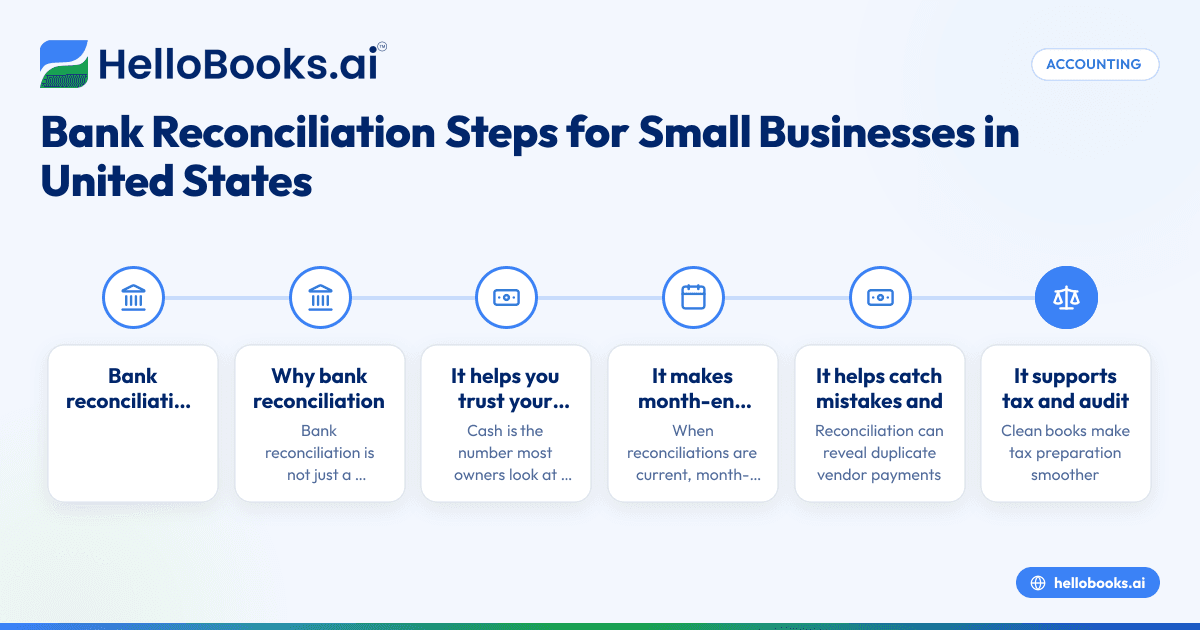
It helps you trust your cash position
Cash is the number most owners look at first. If it is wrong, everything else gets harder. You may delay payments you could afford, or spend money you do not really have.
A restaurant in Houston, a machine shop in Detroit, and a marketing agency in Chicago all have different operations. But they all need one thing: a reliable view of cash.
It makes month-end close easier
When reconciliations are current, month-end closing is faster. Your accountant does not need to guess what happened in the bank account. Reports such as the profit and loss statement and balance sheet become more dependable.
It helps catch mistakes and fraud early
Reconciliation can reveal duplicate vendor payments, missing deposits, unusual withdrawals, or bank errors. The faster you spot these items, the easier they are to investigate and fix.
It supports tax and audit readiness
Clean books make tax preparation smoother. They also make lender reviews, investor questions, and internal reviews easier. This article is general information, not tax or legal advice.
When should a small business reconcile bank accounts?
Most small businesses should reconcile bank accounts every month, after the bank statement period ends. If you have heavy transaction volume, multiple payment channels, or tight cash flow, weekly reconciliation is better.
Here is a simple rule:
- Reconcile monthly if you have low transaction volume.
- Reconcile weekly if you process many card payments, ACH collections, refunds, or vendor payments.
- Reconcile daily for high-risk accounts, such as accounts with large cash movement or many users.
Do not wait until quarter-end or tax season. By then, errors are much harder to trace.
Documents and records you need before you start
Before you begin, gather the same records each time. This keeps the process consistent.
Core records
You will usually need:
- The bank statement for the period
- Your general ledger or cash account activity
- Check register, if you use checks
- Deposit records
- Payment processor reports, such as Stripe payouts
- Loan and transfer records
- Prior month reconciliation report
Supporting records for special items
You may also need:
- Merchant fee statements
- Bank fee notices
- Payroll reports
- Wire confirmations
- Refund records
- Copies of unusual checks or deposits
If your records are spread across email, spreadsheets, and different apps, reconciliation takes much longer. This is one reason many teams move from manual workflows to accounting software in the USA.
Bank reconciliation steps for small business
Here is a practical process you can use every month.
1. Confirm the opening balances match
Start with the prior period. The beginning balance in your books should match the beginning balance on the bank statement.
If they do not match, do not continue yet. Check whether someone changed a prior reconciled transaction, deleted an entry, or posted a late adjustment. Fixing the opening balance first prevents more confusion later.
2. Compare the ending balances
Look at:
- Ending balance on the bank statement
- Ending cash balance in your books before new adjustments
These numbers often do not match at first. That is normal. Your job is to explain the differences.
3. Match deposits and incoming payments
Go line by line through deposits on the bank statement and match them to your books.
Look for:
- Customer payments received by ACH
- Check deposits
- Card processor payouts
- Owner contributions
- Loan proceeds
- Refund reversals
Be careful with card settlements. A payment processor may batch several customer payments into one bank deposit. The gross sales, fees, chargebacks, and net payout may all need separate treatment in the books.
4. Match checks, ACH, card payments, and wires
Next, match outgoing transactions.
Review:
- Checks that cleared
- ACH vendor payments
- Debit card transactions
- Bank transfers
- Wire payments
- Loan payments
- Bank service charges
Use exact amounts where possible. If the amount is close but not exact, investigate. A small difference can indicate a fee, discount, or data entry error.
5. Mark outstanding items
Some items appear in your books but not yet on the bank statement. These are common and often valid.
Examples include:
- Outstanding checks
- Deposits in transit
- Pending ACH payments
- Card settlements not yet deposited
Keep a clear list of these items. They should usually clear in the next statement period. If they do not, review them again.
6. Record bank-only transactions
Some transactions show up on the bank statement before they appear in your books.
Common examples:
- Monthly bank fees
- Interest earned
- NSF or returned item fees
- Wire fees
- Merchant fees
- Automatic loan deductions
Create the missing journal entries or transaction records in your accounting system so your books reflect reality.
7. Investigate unmatched transactions
Anything left unmatched needs review. This is where most errors are found.
Common causes include:
- Duplicate entries
- Missing entries
- Wrong dates
- Wrong amounts
- Personal spending mixed into business activity
- Transfers recorded in one account but not the other
- Checks entered with the wrong check number
- Voided transactions not handled correctly
Work through unmatched items one by one. Do not force a match just to finish faster.
8. Adjust the books, not the bank statement
Your bank statement is the external record. In most cases, you adjust your books to reflect valid bank activity.
The exception is when the bank made an error. That does happen, but it is less common. If you suspect a bank error, contact the bank and keep documentation.
9. Confirm the adjusted balances agree
After posting missing items and identifying timing differences, calculate the adjusted balance.
A completed reconciliation should show that:
- Bank statement balance
- Plus or minus reconciling items
- Equals adjusted cash balance in your books
If the numbers still do not match, there is still an unresolved issue.
10. Save the reconciliation report and support
When the reconciliation is complete, keep the documentation.
Save:
- The reconciliation report
- Bank statements
- Notes on unusual items
- Support for adjustments
- Aged list of outstanding checks or deposits
This creates a clear audit trail and helps next month go faster.
Common bank reconciliation problems and how to fix them
Small businesses often run into the same issues. Here is how to handle them.
Deposits do not match Stripe or payment processor payouts
This is common in ecommerce, SaaS, and service businesses. The amount deposited into the bank is often net of fees, refunds, or chargebacks.
Fix this by recording gross customer receipts separately from processing fees and refunds. Do not book the net deposit as sales without support.
Old outstanding checks never clear
A check may remain outstanding for months because it was lost, never cashed, or replaced.
Review old checks regularly. Follow your state’s unclaimed property rules if they apply. You may need to void and reissue a payment after confirming the facts.
Transfers are recorded once instead of twice
A transfer between two business accounts should affect both accounts. If you record only one side, one account may reconcile while the other stays off.
Always check both the sending and receiving account.
Owner transactions mix with business spending
This is a frequent issue in very small businesses. Personal purchases, owner draws, and reimbursements often get mixed into the same account.
The fix is part bookkeeping and part process. Separate business and personal banking where possible. Then classify owner-related activity consistently.
Reconciliation was skipped for several months
If you are behind, do not start with the oldest month by guessing. Reconcile in order, one statement at a time.
If the backlog is large, it may be worth using AI bookkeeping tools or asking a professional to help you find an accountant.
Best practices to make reconciliation faster
A few habits can cut reconciliation time significantly.
Standardize your close schedule
Set a recurring date each month. For example:
- Download statements on the 2nd business day.
- Reconcile all bank accounts by the 5th.
- Review exceptions by the 7th.
- Lock the month after review.
Consistency matters more than complexity.
Reduce manual entry
Manual entry creates avoidable errors. If possible, use direct bank feeds, rules, and automated categorization. Many businesses looking for an easier workflow start with accounting software for small business.
Reconcile all cash-related accounts
Do not stop at the main checking account. Also reconcile:
- Savings accounts
- Credit card accounts
- Payment processor clearing accounts
- Petty cash, if material
- Loan-linked bank accounts
Review unusual transactions separately
Large wires, owner transactions, cash withdrawals, and manual journal entries deserve extra attention. These are the items most likely to cause reporting issues later.
Keep one person responsible
Even if several people enter transactions, one person should own the reconciliation checklist. Clear ownership reduces missed steps.
Manual vs software-based bank reconciliation
You can reconcile in a spreadsheet, but it becomes difficult as volume grows.
Manual reconciliation
Manual methods can work if:
- Transaction volume is low
- You have one bank account
- Payment methods are simple
- The owner reviews every transaction
But spreadsheets can break easily. Version control, duplicate work, and missed entries are common.
Software-based reconciliation
Software is useful when you have:
- Multiple bank accounts
- Frequent ACH and card activity
- Team members entering data
- Monthly close deadlines
- Need for cleaner reporting
A good system helps import transactions, suggest matches, flag exceptions, and maintain documentation. If you are comparing options beyond QuickBooks, a QuickBooks alternative may be worth reviewing based on your workflow and team size.
A simple monthly bank reconciliation checklist
Use this checklist each month.
- Gather bank statements and ledger reports.
- Confirm the opening balance matches last month’s close.
- Match all deposits.
- Match all payments and withdrawals.
- Record fees, interest, and other bank-only items.
- List outstanding checks and deposits in transit.
- Investigate all unmatched items.
- Post necessary corrections.
- Confirm adjusted balances agree.
- Save reports and supporting documents.
- Review old outstanding items.
- Lock the period after approval.
This checklist works well for service businesses, retail stores, ecommerce brands, contractors, and small manufacturers.
Final thoughts
Bank reconciliation is one of the simplest ways to improve your financial accuracy. When done consistently, it gives you a clear view of cash, supports cleaner reporting, and reduces month-end stress.
If your team is spending too much time matching transactions by hand, HelloBooks can help simplify bookkeeping and reconciliation workflows. You can book a demo or compare options on the pricing page.
Frequently asked questions
How often should a small business do bank reconciliation?
Most small businesses should reconcile monthly at a minimum. If you have high transaction volume or tight cash flow, weekly is usually better.
What is the difference between bank balance and book balance?
The bank balance is the amount shown by your bank at the statement date. The book balance is the cash balance in your accounting records, which may differ until timing items and missing entries are resolved.
What are the most common bank reconciliation errors?
The most common issues are missing transactions, duplicate entries, wrong amounts, unrecorded bank fees, and transfers recorded incorrectly. Old outstanding checks and grouped card payouts also cause problems.
Can I do bank reconciliation in Excel?
Yes, you can, especially if your transaction volume is low. But as your business grows, spreadsheets become harder to control and review, which increases the risk of errors.
What should I do if a transaction appears on the bank statement but not in my books?
Investigate the transaction first and confirm what it is. If it is valid, record it in your books with the correct date and account classification, then complete the reconciliation.
Should I reconcile credit cards too?
Yes. Credit card accounts should also be reconciled regularly. This helps you catch duplicate charges, missing receipts, unrecorded payments, and employee spending issues.