
Key takeaways
What this article covers, in order:
- Key takeaways
- Why bank reconciliation matters for small businesses in the United States
- What are the most common bank reconciliation problems small businesses face each month?
- Why does my bank balance not match my books?
- How do credit card processors create reconciliation mismatches?
- Sales tax, payroll, and loan payments that often break reconciliations
Bank reconciliation problems in the United States usually come from timing differences, missing transactions, duplicate entries, bank fees, card settlements, and bookkeeping errors. Small businesses must fix these issues every month because unreconciled accounts distort cash flow, profit, tax records, and management decisions.
Key takeaways
- Most reconciliation issues are routine, but they still need a clear monthly process.
- The biggest mismatches often come from deposits in transit, outstanding checks, fees, refunds, and duplicate postings.
- Credit card processors, ACH payments, and payroll activity create common reconciliation gaps for US businesses.
- If you wait too long, small errors can turn into inaccurate financial statements and tax-time cleanup.
- Good systems, clean workflows, and bank reconciliation software can reduce manual work and missed items.
- This article is general information, not tax or legal advice.
Why bank reconciliation matters for small businesses in the United States
Bank reconciliation is the process of matching your bookkeeping records to your bank and credit card statements. The goal is simple. Every transaction in your books should agree with what actually cleared the bank, or you should know exactly why it does not yet match.
For a small business in Chicago, Houston, or Detroit, this is not just an accounting task. It is how you confirm your cash position. It is also how you catch errors before they affect payroll, vendor payments, owner draws, and tax reporting.
Many small businesses still reconcile late or only when a problem appears. That creates risk. If your books are behind by two or three months, you may not know whether a cash shortage is real, whether a customer payment was missed, or whether a duplicate expense hit the books.
Monthly reconciliation helps you:
- Verify real cash on hand.
- Catch fraud or unauthorized charges faster.
- Clean up duplicate or missing entries.
- Support accurate financial reports.
- Make month-end closing faster and less stressful.
Businesses that use spreadsheets or disconnected tools often struggle here. If your team is juggling exports from banks, payment processors, and accounting systems, the chance of mismatch rises fast. That is where AI bookkeeping workflows can help reduce repetitive review and matching work.
What are the most common bank reconciliation problems small businesses face each month?
The most common issues are timing differences, missing transactions, duplicate entries, bank fees, processor payouts, returned payments, and data entry mistakes. Most are fixable, but only if someone reviews the differences line by line and documents the reason for each mismatch.
1. Deposits in transit
A deposit in transit happens when you record a payment in your books before the bank shows it as cleared. This is common near month-end.
Example: A retail business records a $4,250 deposit on 03/31/2026. The bank posts it on 04/01/2026. Your books and statement will differ until the next statement period.
This is normal. The problem starts when deposits in transit stay open too long. If a deposit is still unreconciled after several days, check whether:
- The amount was entered incorrectly.
- The deposit was split across several bank entries.
- The payment processor netted out fees.
- The customer payment was reversed or failed.
2. Outstanding checks and uncleared payments
Checks, ACH payments, and bill payments may be recorded in your books before they clear the bank. That creates a temporary mismatch.
This is common with:
- Rent checks
- Vendor checks
- Printed checks sent by mail
- Bank bill-pay transactions
- ACH payments initiated late in the month
If a payment remains outstanding for too long, do not assume it will clear eventually. Review whether it was voided, replaced, lost, or entered twice.
3. Bank fees and service charges
Banks often deduct monthly fees, wire charges, overdraft fees, and merchant service charges directly from the account. If no one records them in the books, the reconciliation will be off.
These are easy to miss because they are usually small. But over several months, unrecorded fees can affect profit and cash balances.
Typical examples include:
- Monthly maintenance fees
- Outgoing wire fees
- Returned deposit fees
- ACH reject fees
- Positive pay fees
4. Interest income and bank credits
Some businesses forget to record small amounts of bank interest or account credits. These items also create differences.
Even if the amount is minor, it still needs to be posted correctly. A clean reconciliation means every statement line has a matching entry or a clear explanation.
Why does my bank balance not match my books?
Your bank balance usually does not match your books because of timing, missing entries, duplicates, or transactions recorded with the wrong amount or date. The mismatch may be normal for a few days, but it must be reviewed and resolved each month.
A mismatch does not always mean something is wrong. Some differences are expected during the month. The issue is whether you can explain them clearly by the statement end date.
5. Duplicate transactions
Duplicates are one of the most common bank reconciliation problems small business United States teams deal with. They happen when the same transaction gets posted more than once.
Common causes include:
- Importing the same bank feed twice
- Recording an expense manually and then accepting the bank feed version
- Posting a customer payment and also recording the bank deposit separately
- Entering a transfer on both sides incorrectly
Duplicates can overstate income, expenses, or cash movement. They also make financial reports unreliable.
A simple example: your office manager enters a $680 software expense manually. Later, the bank feed imports the same debit, and it gets accepted again. Your expenses are now overstated by $680 until someone catches it.
6. Missing transactions
The opposite problem is also common. A transaction clears the bank, but it never reaches the books.
This often happens with:
- Bank charges
- Owner withdrawals
- Card refunds
- Loan payments
- Automatic subscriptions
- Payroll tax debits
- Merchant account adjustments
Missing transactions create false cash balances. You may think you have more cash than you really do. That can lead to overdrafts, missed payments, or poor decisions.
7. Errors in transaction amounts
A payment may be real, but the amount in your books may be wrong. This usually comes from manual keying mistakes.
Example:
- Actual vendor payment: $1,950
- Entered in books: $1,590
That single typo creates a $360 difference. If your team is reconciling quickly at month-end, small transposition errors like this can take time to find.
8. Wrong dates or wrong periods
A transaction may be posted to the wrong month in your books. This causes reconciliation issues and also affects monthly reporting.
For example, if payroll clears on 05/01/2026 but was booked entirely in April without proper accrual handling, your April and May records may both need review. The bank reconciliation may still uncover the timing issue even if the total expense is correct.
How do credit card processors create reconciliation mismatches?
Card processors often deposit net amounts, not gross sales amounts, so your bank does not show the same figures as your sales system. Fees, refunds, chargebacks, and delayed settlements must be matched correctly to avoid reconciliation errors.
This issue affects many US small businesses that accept card payments online, in store, or by invoice. If you use Stripe or another processor, your bank may receive one net payout that combines many customer payments.
Gross sales versus net deposits
Suppose your business records $5,000 in customer card sales for one day. Your processor may deposit $4,842 to your bank after fees, refunds, or reserves. If your books expect one clean $5,000 deposit, the reconciliation will fail.
To fix this, record:
- Gross sales
- Processing fees
- Refunds or chargebacks
- Net payout to the bank
That creates a proper audit trail and cleaner month-end reports.
Delayed settlements
Processor payouts may hit the bank one or two business days after the customer pays. This timing gap becomes more visible near month-end.
Without a clearing account or proper processor reconciliation workflow, your books can show sales in one period and bank cash in another, with no easy bridge between them.
Chargebacks and refunds
If a customer disputes a transaction or receives a refund, the processor may deduct the amount from a later payout. If your accounting records do not reflect that deduction, the bank deposit will not match expected receipts.
Sales tax, payroll, and loan payments that often break reconciliations
Not all bank reconciliation problems come from customer payments or vendor bills. Many come from automatic transactions tied to compliance, payroll, and debt.
Sales tax payments
Businesses that collect state or local sales tax often make periodic remittances by ACH or online payment. If the liability account is not cleared correctly when the payment leaves the bank, you may end up with mismatches in both cash and liabilities.
This is especially common when a payment is posted directly as an expense instead of against the sales tax payable balance.
Payroll and payroll tax withdrawals
Payroll creates several moving parts:
- Net pay
- Employer tax expense
- Employee tax withholdings
- Payroll service fees
- Benefit deductions
A payroll provider may debit one lump sum or several separate amounts. If your books expect a single number and the bank shows multiple debits, reconciliation becomes messy fast.
Loan and credit line payments
Loan payments often include both principal and interest. If the full payment is posted to expense, the books will be wrong even if the bank amount matches.
For reconciliations, this usually appears as a posted bank payment that does not match the expected loan entry structure.
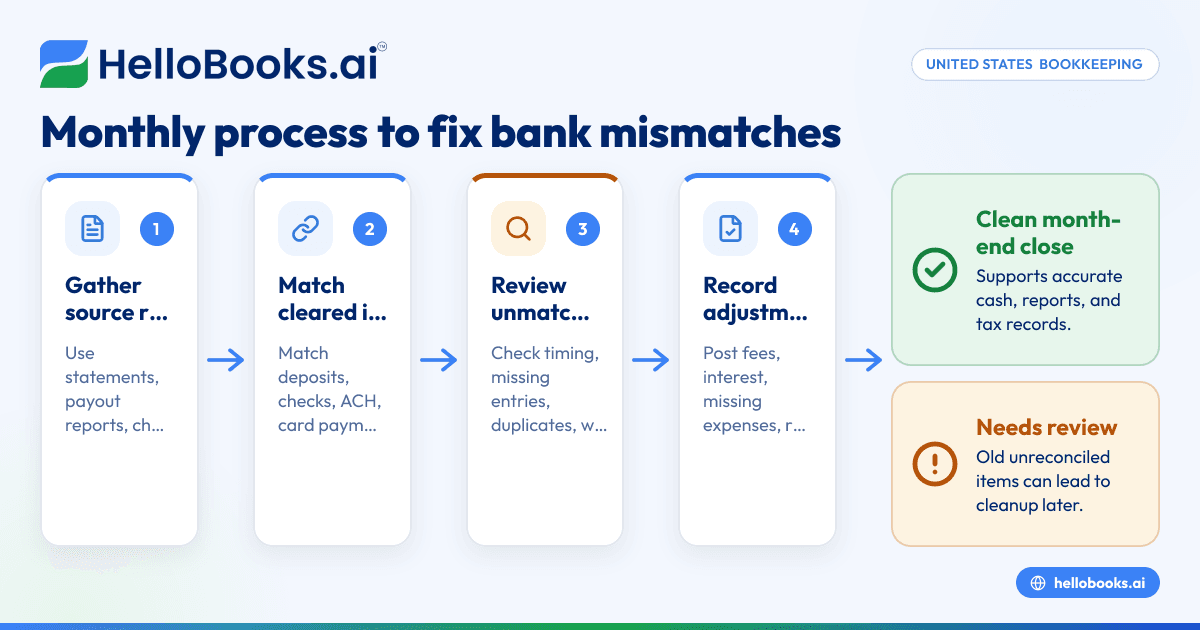
A practical monthly process to fix bank reconciliation problems
A strong process matters more than heroic cleanup. If you reconcile every month, most issues stay small and easy to fix.
1. Gather all source records
Before you start, collect:
- Bank statements
- Credit card statements
- Processor payout reports
- Check registers
- Loan statements
- Payroll reports
Do not reconcile from memory. Use source documents.
2. Match cleared transactions first
Start with transactions that clearly appear in both places. Match:
- Deposits
- Checks
- ACH debits and credits
- Card payments
- Transfers
This narrows the list of exceptions quickly.
3. Review every unmatched item
For each difference, ask:
- Is this a timing difference?
- Is the amount wrong?
- Is the transaction missing?
- Is it duplicated?
- Was it posted to the wrong account?
- Does it belong to another period?
Document the answer. Do not leave unexplained items in a suspense account if you can avoid it.
4. Record necessary adjustments
Post only the adjustments needed to bring the books in line with reality. Common adjustments include:
- Bank fees
- Interest income
- Missing expenses
- Processor fees
- Returned payments
- Correction of duplicate entries
5. Confirm the ending balance
At the end of the process, your adjusted book balance should agree to the reconciled bank balance. Save your reports and support. This helps with month-end review and any later audit or tax work.
Should small businesses use ai bank reconciliation?
Yes, if your business has enough transaction volume that manual matching wastes time or causes errors. ai bank reconciliation can speed up matching, flag exceptions, and help your team focus on unusual items instead of routine ones.
The best use case is not just high volume. It is complexity. If your business has many bank accounts, processor payouts, refunds, and recurring transactions, automated matching can reduce month-end pressure.
Useful capabilities include:
- Suggested matches for recurring transactions
- Detection of likely duplicates
- Identification of amount variances
- Faster review of bank feed exceptions
- Cleaner month-end close workflow
This is where AI accounting software can help a small finance team work faster without losing control. The goal is not to skip review. The goal is to spend human time on exceptions that actually need judgment.
Warning signs your reconciliation process needs improvement
Some businesses technically reconcile every month but still have a weak process. Watch for these signs:
Old unreconciled items stay open for months
A deposit in transit or outstanding payment should not sit unresolved indefinitely. Long-open items usually point to missing entries, duplicates, or process failures.
The owner asks for cash numbers no one trusts
If management relies on rough estimates because the books are not current, reconciliation is not working as it should.
Month-end close keeps slipping
When one reconciliation delay pushes back the entire close, your bookkeeping workflow needs attention.
Staff rely on spreadsheets outside the accounting system
Spreadsheets can help with analysis, but they should not become the main reconciliation record. That creates version confusion and weak control.
Different systems tell different stories
If your bank, sales system, and accounting records all show different balances, someone must create a clear source-of-truth process. Many businesses in this situation start looking for accounting software in the USA that better supports daily bookkeeping and reconciliation.
How to reduce bank reconciliation problems going forward
You do not need a perfect process. You need a repeatable one.
Standardize transaction posting
Create simple rules for:
- Customer deposits
- Refunds
- processor fees
- owner draws
- transfers
- loan payments
- payroll entries
If everyone records the same type of transaction differently, reconciliation will always be harder.
Reconcile every month, not every quarter
Monthly review keeps the problem set small. Quarterly cleanup usually means more confusion, weaker memory, and more missing documents.
Separate review from data entry when possible
Even in a small business, a second review helps catch duplicates and unusual postings. That is basic internal control.
Use tools that reduce manual matching
If your team spends hours clicking through repetitive transactions, consider software that combines bookkeeping workflows with automation. For many small companies, accounting software for small business is worth evaluating if the current process depends too much on manual imports and spreadsheet cleanup.
Keep documentation for unusual items
When a transaction needs special treatment, add a note and keep support. This saves time during month-end and tax season.
When to get outside help
Some reconciliation issues signal a larger accounting problem. Consider getting help if:
- You cannot reconcile cash for more than one month
- Large differences repeat each month
- Loan, payroll, or sales tax entries seem unreliable
- You suspect unauthorized transactions
- Your books were updated by several people without controls
In those cases, it may help to find an accountant who can review the process, clean up old periods, and set a tighter month-end workflow.
If your business is ready to reduce manual reconciliation work, HelloBooks can help streamline bookkeeping, matching, and review. You can book a demo or compare options on the pricing page.
Frequently asked questions
How often should a small business reconcile bank accounts?
At minimum, reconcile every month when the bank statement arrives. If you have high transaction volume, weekly reconciliation is often better because problems are easier to spot early.