
Key takeaways
What this article covers, in order:
- Why this comes up / what goes wrong
- Step-by-step
- Example (fictional figures)
- Common mistakes
- Doing this in HelloBooks
- Frequently asked questions
Bookkeeping for marketing agencies involves managing invoices, expenses, GST filings, and reconciliations, which can be time-consuming when done manually. Automation tools help streamline these tasks, enabling agency owners and accountants to focus on business growth rather than paperwork.
Why this comes up / what goes wrong
Marketing agencies in India often struggle with bookkeeping because they handle multiple clients, varied expense types, and complex GST rules. Many still use Excel, Tally, or manual bill books, leading to errors, delayed filings, and missed input tax credits (ITC). Agencies also face challenges in reconciling purchase bills with GST returns and bank statements. Without automation, this consumes hours every week, increasing compliance risks and reducing time for strategic work.
Step-by-step
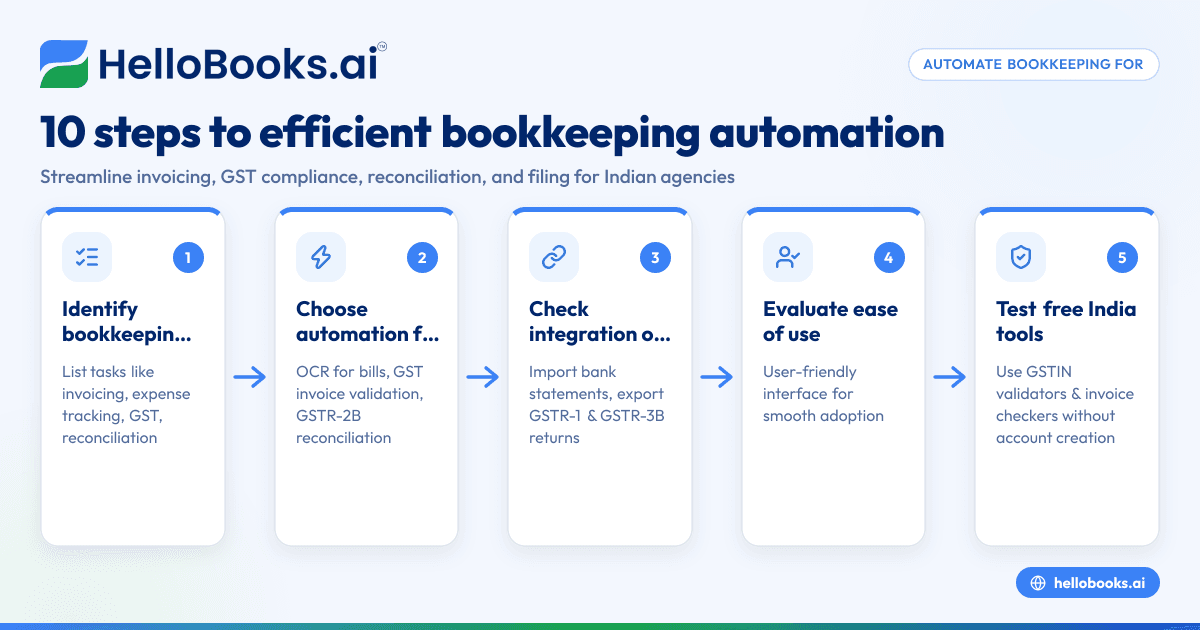
- Identify your bookkeeping needs: List key tasks such as invoicing, expense tracking, GST compliance, bank reconciliation, and inventory management if applicable. Determine if you need multi-GSTIN support for clients or branches.
- Look for automation features: Prioritise tools offering OCR for purchase bills to reduce manual entry and features for GST invoice validation and reconciliation with GSTR-2B.
- Check integration options: Ensure the tool can import bank statements and export GST returns like GSTR-1 and GSTR-3B for easier filing.
- Evaluate ease of use: Choose software with a user-friendly interface suitable for your team’s skill level to avoid adoption issues.
- Test free India tools: Use free online tools such as GSTIN validators and invoice checkers to verify data accuracy before filing. These tools do not require account creation.
- Plan your data migration: Prepare existing records from Excel, Tally, or manual books for import into the new system, ensuring data consistency.
- Train your team: Provide training on the software to ensure smooth adoption and correct use of features.
- Set up regular reconciliation: Automate monthly reconciliation of purchase bills with GSTR-2B and bank statements to claim correct ITC.
- Schedule GST filings: Use reminders and filing features to meet deadlines such as quarterly GSTR-1 due on the 13th and GSTR-3B due by the 22nd or 24th (depending on state or union territory).
- Review reports: Regularly check financial and compliance reports to monitor cash flow and GST filing status.
For more details on automation suited for agencies, see IT and professional services.
Example (fictional figures)
A digital marketing agency in Pune has the following transactions in March 2024:
- Sales invoices issued: ₹5,00,000
- Purchase bills received: ₹1,50,000
- GST rate assumed: 18%
Calculate GST on sales:
₹5,00,000 × 18% = ₹90,000
Calculate GST on purchases:
₹1,50,000 × 18% = ₹27,000
Input Tax Credit (ITC):
₹27,000 (from purchases)
GST payable:
₹90,000 - ₹27,000 = ₹63,000
This agency uses OCR technology to capture purchase bills from PDFs and photos, automatically matching line items to expense categories and inventory. They validate GSTINs and invoices with free India tools before filing GSTR-1 and GSTR-3B returns.
Common mistakes
- Manual data entry errors: Use OCR scanning to avoid typos and mismatched amounts.
- Ignoring GSTIN validation: Always validate GSTINs to prevent filing errors; free India tools can help.
- Delayed reconciliation: Schedule monthly reconciliation of purchase bills with GSTR-2B to claim correct ITC.
- Missing filing deadlines: Set reminders for GSTR-1 and GSTR-3B deadlines under the QRMP scheme.
- Not training staff: Ensure all users understand how to use the software features to avoid underutilisation.
- Ignoring inventory impact: For agencies managing inventory or digital assets, track these accurately to reflect costs.
Learn more about avoiding mistakes in AI bookkeeping.
Doing this in HelloBooks
HelloBooks offers OCR for purchase bills, allowing marketing agencies to capture supplier bills from photos or PDFs instead of manual entry. This reduces errors and saves time. Additionally, HelloBooks provides free India tools such as GSTIN validator and GST invoice checker that do not require account creation. These features help ensure accuracy before GST filing. Explore these capabilities at HelloBooks for India.
Frequently asked questions
What bookkeeping tasks can be automated for a marketing agency?
Automation can cover invoice creation, purchase bill capture, GST compliance, bank reconciliation, and report generation, reducing manual work and errors.
Can I use free tools to check GST compliance?
Yes, free India tools like GSTIN validators and GST invoice checkers help verify data accuracy before filing without needing an account.
How does OCR help in bookkeeping?
OCR reads purchase bills from images or PDFs and automatically inputs data into your accounting system, saving time and reducing manual errors.
What are the GST filing deadlines under the QRMP scheme?
Quarterly GSTR-1 is due on the 13th of the month after the quarter, and GSTR-3B is due by the 22nd or 24th, depending on your state or union territory.
Is HelloBooks suitable for agencies currently using Excel or Tally?
Yes, HelloBooks can assist agencies by automating bill capture and providing free India tools to support GST compliance, easing the bookkeeping process.
Key takeaways
- Automation tools reduce manual bookkeeping for marketing agencies, saving time and preventing errors.
- OCR for purchase bills and GST validation are key features to look for.
- Monthly reconciliation and timely GST filing under QRMP are essential for compliance.
- Free India tools can help verify GSTINs and invoices without account creation.
- HelloBooks offers these features to simplify bookkeeping for Indian agencies.
Start automating your marketing agency’s bookkeeping with HelloBooks. Start on the Free plan (200 transactions a year, GSTR-1 and 3B filing for one GSTIN).