
Key takeaways
What this article covers, in order:
- Why this comes up / what goes wrong
- Step-by-step
- Example (fictional figures)
- Common mistakes
- Frequently asked questions
- Key takeaways
Agency accounting solutions help Indian IT and professional services businesses manage client invoicing, GST compliance, expense tracking, and bank reconciliation efficiently. This article explains why agencies need specialised accounting, provides step-by-step guidance, a detailed example, common mistakes to avoid, and answers frequently asked questions to help you choose the right approach.
Why this comes up / what goes wrong
Owners and accountants of agency businesses in India, such as digital marketing firms, IT services companies, and consulting practices, often face complex accounting challenges. These agencies handle multiple clients with different contracts, billing cycles, and payment terms. Many still use spreadsheets, Tally, or manual bill books to record transactions, which can cause errors, delays, and difficulty managing GST compliance like GSTR-1 and GSTR-3B filings.
Tracking client advances, retentions, and expenses adds layers of complexity. Bank statement reconciliation becomes time-consuming when matching payments to invoices and expenses. Without accounting solutions tailored for agencies, these tasks consume excessive time and increase the risk of compliance errors and financial mismanagement.
Step-by-step
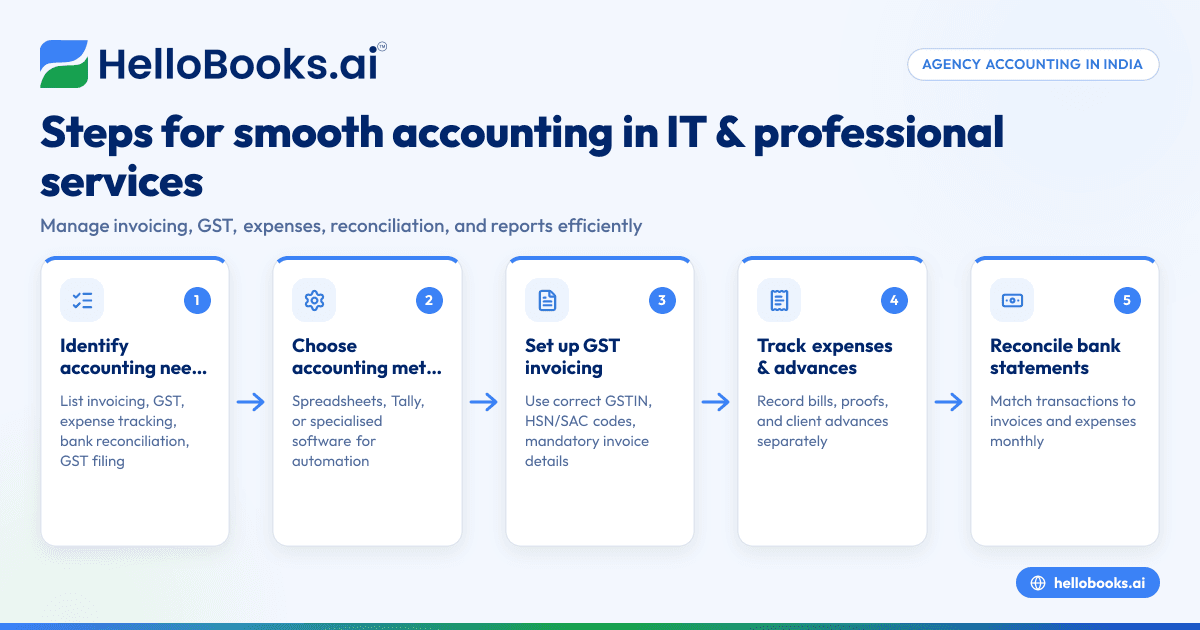
- Identify your agency’s accounting needs: List your core requirements such as client invoicing, GST invoicing, expense and advance tracking, bank reconciliation, and timely GST return filing. Consider your business size and client diversity.
- Choose an accounting method: Decide whether to maintain books in spreadsheets, Tally, or dedicated accounting software. Spreadsheets offer flexibility but risk manual errors; Tally is widely used but may be complex for some; software can automate invoicing, GST filing, and reconciliation.
- Set up GST invoicing correctly: Use your correct GSTIN, apply appropriate HSN or SAC codes, and include all mandatory invoice details. Proper GST invoicing ensures smooth GSTR-1 filing and helps with GSTR-2B reconciliation. See GST invoicing guidelines.
- Maintain accurate expense and advance records: Track all business expenses with bills and proofs of payment. Categorise expenses for tax and profitability analysis. Record client advances separately and issue tax invoices when services are delivered or advances adjusted.
- Reconcile bank statements monthly: Match bank transactions against invoices, advances, and expenses to spot discrepancies early.
- File GST returns on time: Prepare and submit GSTR-1 and GSTR-3B returns by the due dates to avoid penalties and maintain compliance.
- Review financial reports regularly: Analyse profit and loss statements, cash flow reports, receivables ageing, and expense summaries to monitor your agency’s financial health.
- Consider industry-specific accounting software: For IT and professional services agencies, specialised accounting tools can automate GST invoicing, filing, reconciliation, and reporting. Learn more about accounting software for agencies.
Example (fictional figures)
A digital agency in Pune invoiced a client ₹4,00,000 on 01/03/2024, assuming an 18% GST rate.
GST on invoice = ₹4,00,000 × 18% = ₹72,000
Total invoice amount = ₹4,00,000 + ₹72,000 = ₹4,72,000
In March, the agency paid ₹50,000 for office rent and ₹20,000 for software subscriptions.
The monthly bank statement shows total credits of ₹5,00,000 and debits of ₹75,000.
Reconciliation steps:
- Total invoiced amount including GST = ₹4,72,000
- Total expenses = ₹50,000 + ₹20,000 = ₹70,000
- Expected bank outflow = ₹70,000
- Bank debits = ₹75,000 (₹5,000 discrepancy to investigate)
GST return filing:
- Report ₹4,00,000 as taxable supply in GSTR-1
- Claim ITC on ₹70,000 expenses if eligible
This example highlights the importance of matching invoices, expenses, and bank statements for accurate accounting.
Common mistakes
- Mixing personal and business expenses: Prevent by maintaining separate bank accounts and clear expense categorisation.
- Incorrect GST invoicing details: Avoid by verifying GSTIN, HSN/SAC codes, and invoice formats according to GST invoicing guidelines.
- Delayed GST return filing: Set reminders and prepare returns early to prevent penalties.
- Ignoring bank reconciliation: Reconcile monthly to catch errors or fraud early.
- Using generic accounting methods unsuitable for agencies: Choose methods or software that handle multiple clients and project billing effectively.
- Not tracking advances or retentions properly: Maintain detailed records to avoid revenue recognition errors.
Refer to IT and professional services for tailored accounting practices.
Frequently asked questions
What are the best accounting practices for agencies?
Maintain detailed client-wise records, use GST-compliant invoicing, reconcile bank statements monthly, and file GST returns on time. Using software tailored for agencies can simplify these tasks.
Can agencies use Tally for GST compliance?
Yes, Tally supports GST invoicing and return filing but requires careful setup and regular updates. For simpler workflows, specialised agency accounting software may be preferable.
How do I handle GST on advances from clients?
GST applies on advances received. Record advances separately and issue tax invoices when services are delivered or advances adjusted.
Is it necessary to reconcile GSTR-2B with agency purchases?
Yes, reconciling GSTR-2B helps verify input tax credit eligibility and avoids mismatches during GST return filing.
What financial reports should an agency review regularly?
Profit and loss statements, cash flow reports, receivables ageing, and expense summaries help monitor financial health and identify issues early.
Refer to HelloBooks for India for more insights.
Key takeaways
- Agencies require accounting solutions tailored for multiple clients, GST compliance, and expense tracking.
- Correct GST invoicing and timely filing prevent compliance issues.
- Monthly bank reconciliation helps detect errors early.
- Separate personal and business finances to avoid confusion.
- Choose accounting methods or software suited for IT and professional services agencies.
- Track advances and retentions carefully to maintain accurate revenue records.
Start managing your agency’s accounting efficiently. Start on the Free plan (200 transactions a year, GSTR-1 and 3B filing for one GSTIN).