
Key takeaways
What this article covers, in order:
- Why this comes up / what goes wrong
- Step-by-step
- Example (fictional figures)
- Common mistakes
- Frequently asked questions
- Key takeaways
Ad agency accounting involves tracking client billing, media vendor expenses, staff salaries, and GST compliance to measure profitability and maintain cash flow. This article explains the step-by-step process Indian ad agencies should follow, highlights common mistakes, provides a detailed example with Indian figures, and answers frequently asked questions about ad agency accounting.
Why this comes up / what goes wrong
Owners and accountants at Indian ad agencies often manage multiple clients and projects simultaneously, each with different billing terms, advance payments, and timelines. They must accurately track client advances, media vendor payments, freelancer fees, and employee salaries. Many agencies still rely on spreadsheets, Tally, or manual bill books, which can lead to errors in transaction recording and delays in GST filing.
Ad agencies also face challenges in classifying expenses correctly under GST and managing input tax credit (ITC) on media buys. Without clear accounting, it becomes difficult to analyse profitability and manage cash flow effectively, which impacts business decisions.
Specific challenges include handling multiple GST rates for services and goods, reconciling client advances against invoices, and ensuring timely GST return filing. These issues are common in small and growing agencies that lack dedicated accounting teams.
Step-by-step
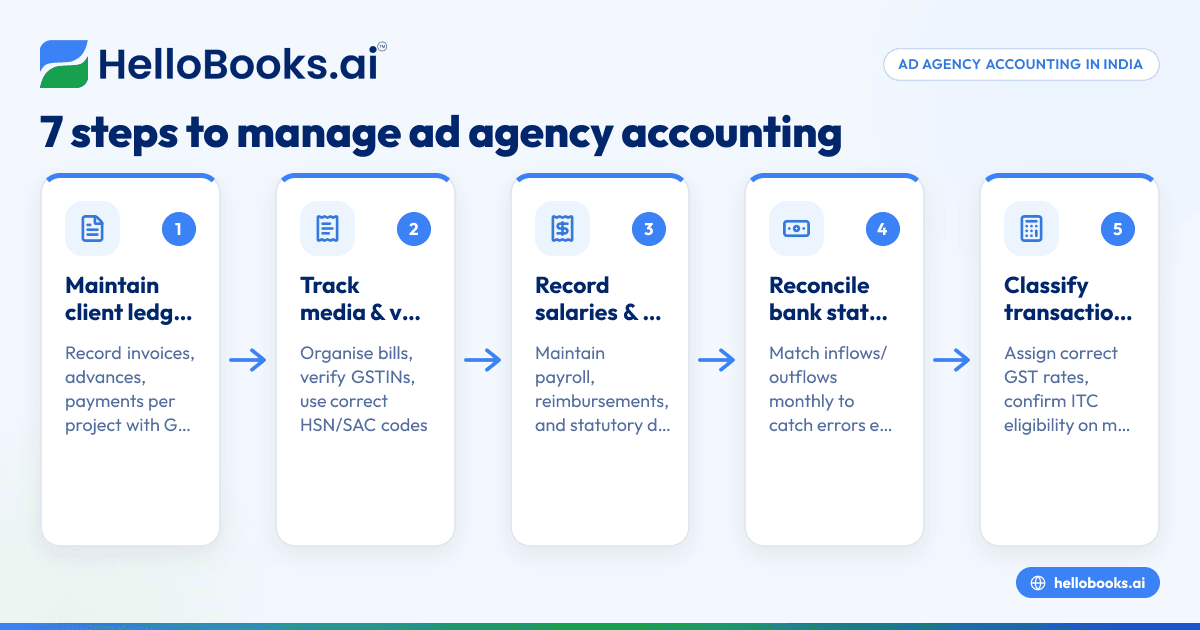
- Maintain a Client Ledger: Record all client invoices, advances received, and payments against each project. Check that invoice details such as client name, GSTIN, invoice date, and amounts match the agreed scope and rates.
- Track Media and Vendor Bills Separately: Keep vendor bills for media placements and freelancers organised. Verify vendor GSTINs and use correct HSN/SAC codes for GST compliance.
- Record Salaries and Employee Expenses: Maintain payroll records including salaries, reimbursements, and statutory deductions like TDS. Ensure salary payments are recorded in the correct accounting period.
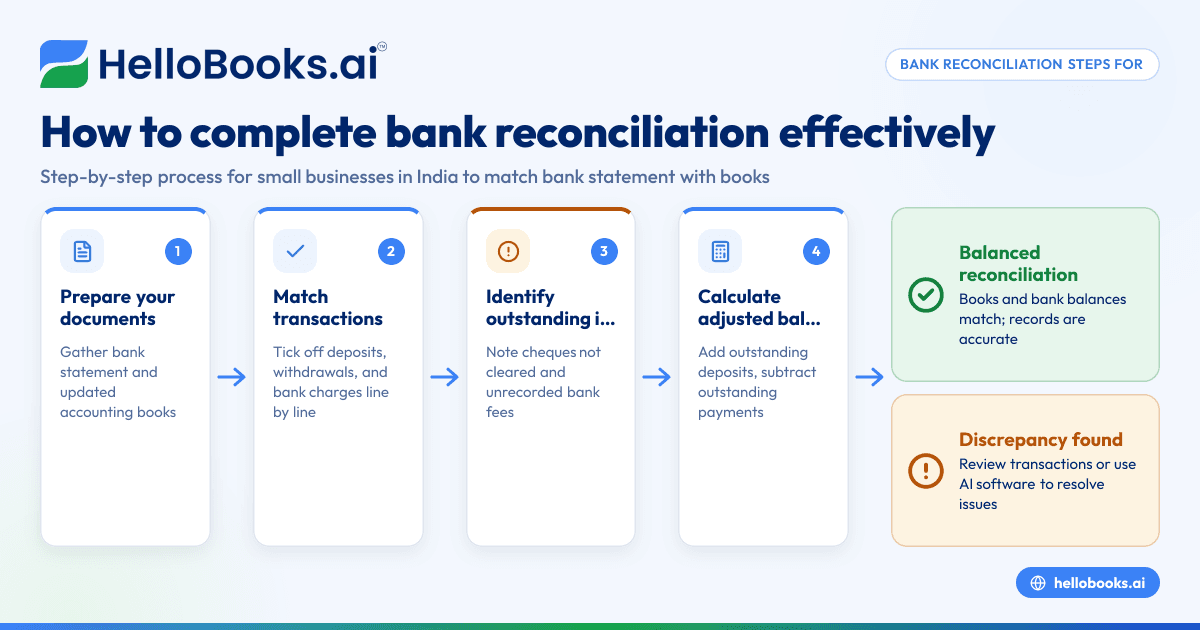
- Reconcile Bank Statements Monthly: Match all bank inflows and outflows with your recorded transactions to identify missing or duplicate entries early.
- Classify Transactions for GST: Assign the correct GST rates for services and goods. Confirm if media purchases qualify for ITC and record this appropriately.
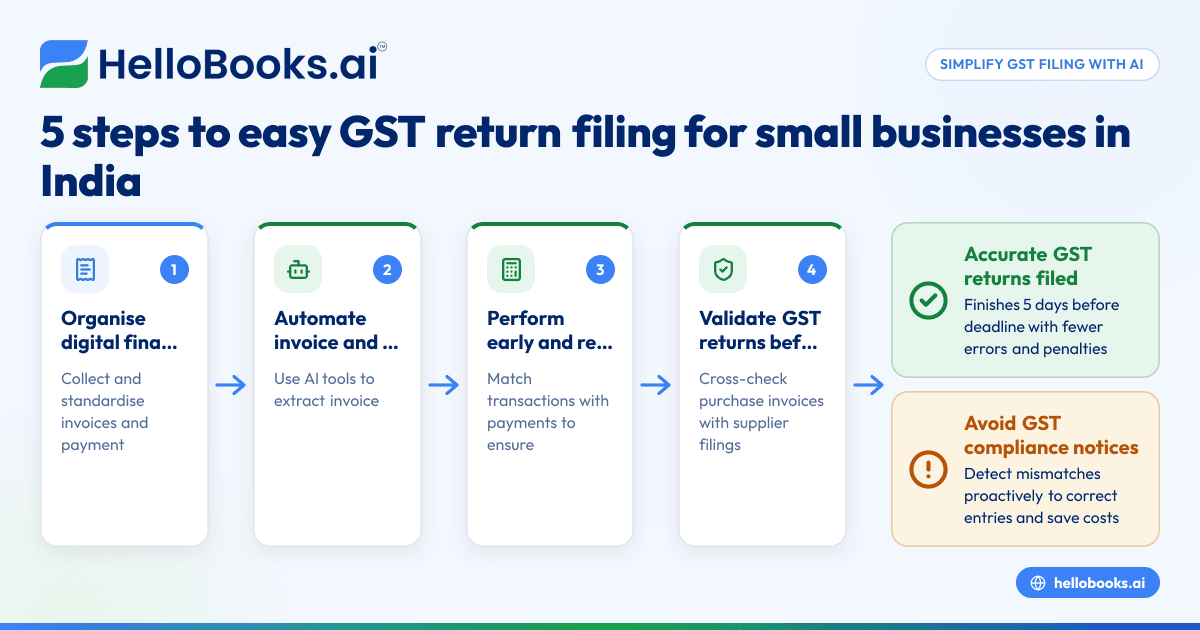
- Prepare Monthly GST Returns: Use your records to file GSTR-1 and GSTR-3B returns on time. Double-check invoice details, tax calculations, and reconcile ITC claims. Learn more about GST invoicing and compliance at GST invoicing.
- Review Profitability by Client and Project: Compare revenues and expenses project-wise to identify profitable accounts and areas needing cost control. For more on accounting for IT and professional services, see IT and professional services.
Example (fictional figures)
A digital ad agency in Pune bills Client A ₹5,00,000 on 10/03/2024 for campaign services. They received an advance of ₹2,00,000 on 01/03/2024. Media vendor bills total ₹1,50,000 plus 18% GST. Salaries for March are ₹1,20,000.
- Invoice amount: ₹5,00,000
- Advance received: ₹2,00,000
- Media vendor GST: ₹1,50,000 × 18% = ₹27,000
- Media vendor total: ₹1,50,000 + ₹27,000 = ₹1,77,000
- Salaries: ₹1,20,000
Accounting entries:
- Record ₹2,00,000 advance as liability until invoiced
- On invoice date, recognise revenue ₹5,00,000
- Record media vendor expense ₹1,77,000
- Record salary expense ₹1,20,000
GST treatment:
- Charge 18% GST on ₹5,00,000 invoice = ₹90,000
- Claim ITC of ₹27,000 on media vendor bills
This ensures accurate revenue recognition, expense tracking, and GST compliance.
Common mistakes
- Mixing client advances with revenue: Record advances as liabilities until invoiced to avoid overstating income. Prevent this by maintaining a separate ledger for advances.
- Ignoring GST compliance on media buys: Verify vendor GSTINs and claim ITC only on valid invoices. Use correct HSN/SAC codes to avoid GST filing issues.
- Delayed bank reconciliation: Monthly reconciliation prevents missing transactions and errors. Set a monthly schedule to review bank statements.
- Incorrect HSN/SAC classification: Using wrong codes can cause GST return rejections. Cross-check codes with official GST lists.
- Not tracking project-wise profitability: Without this, agencies cannot assess which clients or campaigns are profitable. Use project codes in your accounting system.
- Manual data entry errors: Manual bookkeeping increases errors and wastes time. For Indian agencies starting with accounting software, see HelloBooks for India.
Frequently asked questions
What GST rate applies to ad agency services?
Most advertising services attract 18% GST, but confirm the exact rate for your service type with a tax expert. Correct classification using SAC codes is essential for compliance. NEEDS EXPERT REVIEW
How should I treat client advances in accounting?
Client advances should be recorded as a liability when received and only recognised as revenue when the invoice is issued. This prevents inflating income prematurely.
Can I claim ITC on media vendor bills?
Yes, input tax credit can be claimed on valid GST invoices from media vendors, provided the agency uses the services for business purposes and the vendor GSTIN is correct.
How often should I reconcile bank statements?
Monthly reconciliation is recommended to ensure all transactions are recorded and to identify discrepancies early.
Is project-wise accounting necessary for ad agencies?
Yes, tracking income and expenses per project helps assess profitability and manage budgets effectively.
Key takeaways
- Keep detailed client and vendor ledgers to track advances, invoices, and expenses.
- Reconcile bank statements monthly to maintain accurate records.
- Classify transactions correctly for GST compliance and ITC claims.
- Avoid mixing client advances with revenue until invoiced.
- Monitor project-wise profitability for better business decisions.
- Use standard HSN/SAC codes and verify vendor GSTINs for smooth GST filing.
Start on the Free plan (200 transactions a year, GSTR-1 and 3B filing for one GSTIN) at HelloBooks pricing.