
Key takeaways
What this article covers, in order:
- Key takeaways
- Why accounts receivable follow up matters in United Kingdom
- What is a practical accounts receivable follow up process?
- Set up your receivables process before invoices go overdue
- How often should you follow up on overdue invoices?
- What should you say when chasing an overdue invoice?
Accounts receivable follow up in United Kingdom means having a clear, repeatable process to remind customers about unpaid invoices before and after the due date. Done well, it improves cash flow, cuts awkward chasing, and helps you get paid faster without damaging customer relationships.
Key takeaways
- A good follow-up process starts before the invoice becomes overdue.
- Clear payment terms, accurate invoices and regular reminders reduce late payments.
- Segmenting debtors by value, age and risk helps your team focus on the right accounts first.
- A simple follow-up schedule keeps communication consistent and easier to manage.
- Good records matter if a payment dispute grows into a formal recovery issue.
- Tools such as invoice software, bank reconciliation software and AI bookkeeping can reduce manual chasing work.
Why accounts receivable follow up matters in United Kingdom
If too many invoices sit unpaid, your business feels the strain quickly. Payroll, rent, supplier bills and VAT obligations do not wait for slow-paying customers. Even profitable businesses in London, Manchester or Birmingham can run into cash flow pressure when receivables are not actively managed.
Accounts receivable follow up is not just about sending a reminder once an invoice is late. It is a structured process that begins when you issue the invoice and continues until payment is received, queried, settled by instalment, or escalated.
For many small businesses, the real problem is inconsistency. One week, someone sends reminders. The next week, nobody checks aged debtors because the finance lead is busy closing the month. That is how £500 invoices turn into £5,000 problems.
A practical process helps you:
- reduce overdue balances
- improve cash forecasting
- identify payment disputes earlier
- protect customer relationships
- save staff time
- create an audit trail of communication
If your business still tracks invoices in spreadsheets or across several systems, overdue follow-up becomes harder than it needs to be. This is where accounting software for small business can help by keeping invoice status, payment receipts and reminders in one place.
What is a practical accounts receivable follow up process?
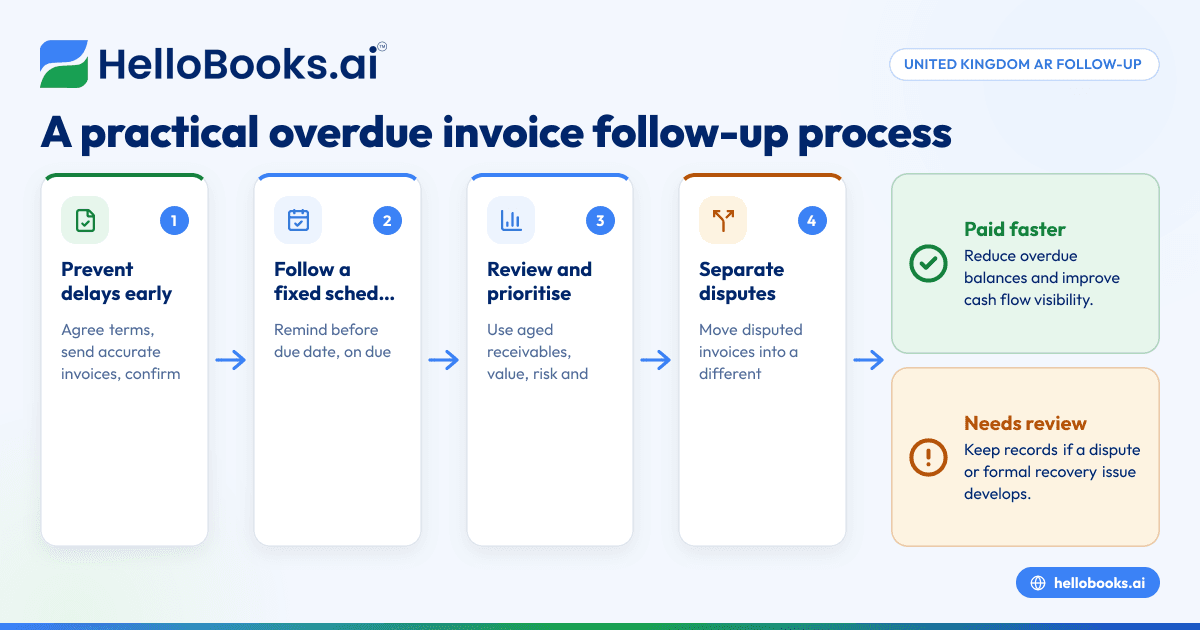
It is a simple schedule for checking due invoices, sending reminders, logging responses and escalating late accounts. The aim is to make chasing routine, polite and consistent, so fewer invoices slip through the cracks and more customers pay on time.
A practical process should be easy enough for your team to follow every week. It should not depend on one person remembering who owes what. It should also separate three different issues:
- customers who simply forgot to pay
- customers who have an invoice dispute
- customers who may have cash flow problems
Each group needs a different approach. A forgotten invoice may need one reminder. A disputed invoice may need a corrected document. A customer with payment difficulties may need a payment plan and tighter credit terms going forward.
The core parts of a good process
Every accounts receivable follow-up process should include:
- accurate invoice data
- clear payment terms
- a regular aged debt review
- set reminder dates
- named ownership for each account
- notes on calls and emails
- clear escalation rules
Without these basics, your team ends up chasing blind. That creates friction and delays.
Set up your receivables process before invoices go overdue
The best overdue follow up starts before the invoice is sent. If the invoice is wrong, missing a purchase order reference, sent to the wrong contact, or unclear on due date, you increase the chance of delay.
1. Agree payment terms early
Confirm payment terms before work begins or goods are delivered. Make sure the customer knows:
- the amount due
- the due date
- how to pay
- who receives the invoice
- who handles payment queries
Put those terms in your quote, contract or engagement letter where appropriate.
2. Send invoices promptly
A late invoice often becomes a late payment. Send invoices as soon as work is completed or according to the agreed billing schedule. Check that the invoice includes the correct legal entity name, address, VAT treatment where applicable, and any reference the customer needs for processing.
3. Make invoices easy to approve
Large customers often delay payment because internal approval takes time. If your invoice needs a purchase order number or named project contact, include it. If you know the accounts payable team needs extra documents, send them at the same time.
4. Confirm receipt for larger invoices
For higher-value invoices, it is worth confirming they were received and accepted into the customer’s payment run. This small step can prevent long delays later.
How often should you follow up on overdue invoices?
Start with a reminder before the due date, follow up on the due date, and then chase at set intervals such as 7, 14 and 21 days overdue. The exact timing depends on your terms, invoice value and customer risk, but consistency matters more than frequency.
That short answer works for most small businesses. The important point is to avoid random chasing. Customers respond better when your process is predictable and professional.
A simple follow-up schedule
Here is a practical schedule many UK businesses can adapt:
- 3 to 5 days before due date Send a friendly reminder with invoice copy attached.
- On the due date Confirm payment is scheduled and ask for the expected payment date if not.
- 7 days overdue Send a firmer reminder and ask whether there is any issue blocking payment.
- 14 days overdue Call the customer. Confirm status, note any dispute, and ask for a commitment date.
- 21 days overdue Escalate to a senior contact or account owner if no response.
- 30 days overdue and beyond Review whether to stop further credit, agree a payment plan, or escalate internally.
Your process should reflect the size of your business and customer base. If you issue many low-value invoices, automation matters more. If you have fewer but larger invoices, account-by-account follow up matters more.
Match the follow up to the customer
Not every customer should be treated the same way. Segment your receivables using:
- invoice value
- number of days overdue
- customer payment history
- strategic importance
- whether there is a live dispute
- whether part payment has been received
This helps your team focus on the accounts with the biggest cash impact first.
What should you say when chasing an overdue invoice?
Be polite, specific and direct. State the invoice number, amount, due date and payment link or bank details. Ask whether payment is already in progress or whether there is a problem to resolve, and always give a clear next step.
A vague email wastes time. A short, factual message usually works better than a long one. Customers should be able to understand what is due and what you need from them in seconds.
Example reminder structure
Your reminder should include:
- customer name
- invoice number
- invoice date
- due date
- amount due
- what action you need
- when you need a response
- how to contact you about any issue
Example pre-due reminder
Subject: Reminder: Invoice 1048 due on 18/10/2026
Hello Sarah,
Just a quick reminder that invoice 1048 for £1,250 is due on 18/10/2026. I have attached a copy for convenience. If payment is already arranged, please ignore this message. If you need anything from us to process it, please let me know.
Example 7-day overdue reminder
Subject: Overdue invoice 1048 - £1,250
Hello Sarah,
Invoice 1048 for £1,250 was due on 18/10/2026 and is now overdue. Please confirm the expected payment date. If there is any query on the invoice, let us know today so we can resolve it quickly.
Example call script
When calling, keep it simple:
- confirm you are speaking to the right person
- reference the invoice and amount
- ask if payment is scheduled
- ask if there is any issue preventing payment
- agree the next step and date
- record the outcome immediately
Build a weekly AR review routine
A weekly review stops debt from building up quietly. It also gives your team a fixed time to assign actions instead of reacting only when cash gets tight.
Use an aged receivables view
Review receivables by age buckets, such as:
- current
- 1 to 30 days overdue
- 31 to 60 days overdue
- 61 to 90 days overdue
- over 90 days overdue
Then look at each bucket by customer and invoice value. One £8,000 invoice may matter more than twelve £100 invoices. The aim is to prioritise work with the highest cash flow impact.
Assign clear ownership
Every overdue balance needs an owner. This may be:
- finance
- the business owner
- an account manager
- a project lead
Finance can send reminders, but commercial contacts often get faster responses on disputed or sensitive accounts.
Track promise dates
If a customer says they will pay on Friday, log that date and follow up the next working day if funds do not arrive. Broken payment promises are a risk signal. They should trigger quicker escalation.
How can ai accounts receivable help with follow up?
AI can help by flagging overdue risk, drafting reminders, spotting payment patterns and prioritising which invoices to chase first. It does not replace judgement, but it can reduce manual admin and help your team focus on the accounts most likely to delay payment.
This matters when your team is small and receivables review happens alongside many other jobs. Instead of opening multiple reports and scanning long debtor lists, an automated workflow can surface the invoices that need action today.
Where automation helps most
Reminder scheduling
Automated reminders reduce the chance that an invoice is missed because someone forgot to chase it.
Prioritisation
A system can highlight accounts that are high value, long overdue or showing changed payment behaviour.
Email drafting
Teams can send faster, more consistent reminders with less manual typing.
Cash flow visibility
If overdue balances are linked to bank receipts and invoice records, you get a clearer picture of expected inflows.
For growing businesses, this is where AI accounting software becomes practical rather than theoretical. It is not about replacing your finance process. It is about making a good process easier to run every week.
Handle disputes separately from standard follow up
One common mistake is treating every late invoice like a payment issue. Sometimes the customer has not paid because they disagree with the charge, are missing backup documents, or think the work is incomplete.
A disputed invoice should move into a separate workflow.
1. Identify the reason quickly
Ask for the exact issue in writing. Common causes include:
- incorrect amount
- missing purchase order number
- missing timesheets or proof of delivery
- VAT query
- billing to the wrong legal entity
- incomplete work sign-off
2. Pause standard chase messaging where needed
If there is a genuine dispute, repeated payment reminders may just irritate the customer. Instead, focus on resolving the issue and setting a deadline for the customer to confirm acceptance.
3. Reissue or correct documents fast
If the invoice is wrong, fix it promptly. Delays on your side make collection slower and weaken your position.
4. Keep a clear record
Log what the customer said, when they said it, and what evidence you sent back. Good notes matter if the issue drags on.
This article is general information, not tax or legal advice. If a dispute becomes serious or legal recovery is being considered, get professional advice.
Decide when to escalate
Not every overdue invoice needs senior attention. But some do. The trick is to define escalation points in advance so your team does not hesitate too long.
Signs an account should be escalated
Escalate when:
- the customer ignores repeated reminders
- a promised payment date is missed more than once
- the balance is large for your business
- several invoices are overdue at once
- the customer raises vague objections without specifics
- you suspect financial difficulty
- they keep ordering while old invoices remain unpaid
Escalation options
Your internal options may include:
- asking a senior manager to contact the client
- pausing further work or supply on credit terms
- requesting part payment
- agreeing a documented payment plan
- reviewing whether the account should remain on credit
Make sure any payment plan is written down clearly with amounts and dates. Then monitor it closely.
Keep records and protect customer data
Receivables follow up creates a lot of emails, call notes and customer information. Handle that data carefully and keep access limited to people who need it.
If you store customer contact details, payment history and correspondence, your business should handle that information in line with UK GDPR and the Data Protection Act 2018. If you send follow-up emails, keep messages relevant to the existing customer relationship and avoid adding unrelated marketing content. That helps keep collections communication clear and reduces compliance risk under PECR where electronic marketing rules may apply.
Practical record-keeping tips
- store invoices and reminder history in one system
- log calls immediately after they happen
- keep notes factual and professional
- avoid personal comments in debtor notes
- restrict access to finance records
- archive old records according to your retention policy
Metrics to track for better collections
You cannot improve follow up if you do not measure it. Start with a few practical metrics rather than building a huge reporting pack.
Useful AR metrics
Track:
- total overdue receivables
- overdue receivables as a percentage of total receivables
- average days to payment
- number of invoices over 30 days overdue
- top ten overdue customers by value
- broken payment promises
- disputed invoices as a percentage of overdue value
Review these monthly, and discuss trends rather than just single numbers. For example, if overdue balances are rising in one customer segment, you may need tighter credit checks or earlier reminders there.
A simple accounts receivable follow up checklist
If you want a starting point, use this checklist:
- Set clear payment terms before work starts.
- Send invoices promptly and accurately.
- Confirm invoice receipt for larger balances.
- Run an aged receivables report every week.
- Send reminders before and after due dates.
- Call accounts that are 14 days overdue.
- Separate disputes from normal collection follow up.
- Log every promise date and chase missed commitments.
- Escalate high-risk or high-value accounts quickly.
- Review trends and improve the process monthly.
For many small businesses, the biggest win is simply consistency. A modest, well-run process beats a perfect process that only happens when cash is already under pressure. If you want fewer missed reminders and a better view of unpaid invoices, combining invoicing with bank reconciliation software and expense management software can make day-to-day cash control much easier.
If you want a simpler way to manage invoicing, receivables and follow-up workflows, you can book a demo with HelloBooks or compare options on the pricing page.