
Key takeaways
What this article covers, in order:
- Key takeaways
- What is accounts receivable follow up in UAE?
- Why do invoices become overdue in the UAE?
- What is the best accounts receivable follow up process in UAE?
- Which channel should you use first: WhatsApp, email or calls?
- How often should you follow up on overdue invoices?
Getting paid on time in the UAE usually comes down to one thing: a clear, repeatable follow-up process. For most small businesses, the best approach is to start early, use the channels customers already respond to, and keep every reminder professional, documented and easy to act on.
Key takeaways
- Accounts receivable follow up in UAE works best when you set a fixed reminder schedule before invoices become seriously overdue.
- WhatsApp, email and phone calls can all work, but each should have a clear purpose and a written record.
- Most late payments happen because of approval delays, missing documents, disputed amounts or poor follow-up, not refusal to pay.
- A good process includes invoice checks, contact mapping, reminder templates, escalation rules and weekly review.
- Bilingual communication can help when your customer teams work in both Arabic and English.
- Tools such as invoice software, bank reconciliation software and AI bookkeeping can reduce manual chasing and missed follow-ups.
What is accounts receivable follow up in UAE?
Accounts receivable follow up in UAE is the process of reminding customers to pay invoices that are due or overdue, while keeping a clear audit trail of every message, call and promise date. In practice, this means checking invoice status, contacting the right person, resolving blockers quickly and escalating in a consistent way.
For a business in Dubai, Abu Dhabi or Sharjah, this process matters because payment delays often build quietly. One unpaid AED 8,000 invoice may seem manageable. Ten unpaid invoices across several customers can create a cash flow problem, delay supplier payments and make tax and reporting work harder.
A strong follow-up process is not about aggressive chasing. It is about making payment easy and removing friction. Many customers do intend to pay. The delay often sits somewhere between the invoice inbox, the approver, the finance team and the final payment run.
That is why accounts receivable follow up should be treated as an operating process, not an occasional admin task. You need a schedule, message templates, ownership and records. If your team relies on memory, scattered WhatsApp chats and inbox searches, overdue invoices will stay overdue.
Why do invoices become overdue in the UAE?
Most overdue invoices come from process gaps, not from a complete breakdown in the customer relationship. Once you know the cause, your follow-up becomes more effective.
Common reasons include:
1. The invoice never reached the right person
This is common when the invoice was sent only to a sales contact, not the finance or accounts payable team. It also happens when a customer has a central payment inbox that was never added.
2. A required document is missing
Some customers will not release payment until they have all supporting documents. This may include a purchase order, signed delivery note, contract reference or updated company details.
3. The customer has an internal approval delay
A project manager may confirm the work, but the invoice still needs approval from finance or management. This can add days or weeks if nobody follows up.
4. There is a dispute
The dispute may be real or minor. It could involve quantity, service dates, agreed pricing or VAT treatment. If you do not identify the issue early, the invoice can sit untouched.
5. Your follow-up is inconsistent
Many small businesses send one reminder, then stop. Or they send messages through different channels with no record. That makes it hard to know what happened and what to do next.
6. The customer pays in batches
Some UAE businesses have fixed payment cycles. If your invoice misses the cut-off, payment may move to the next cycle unless you follow up before it happens.
What is the best accounts receivable follow up process in UAE?
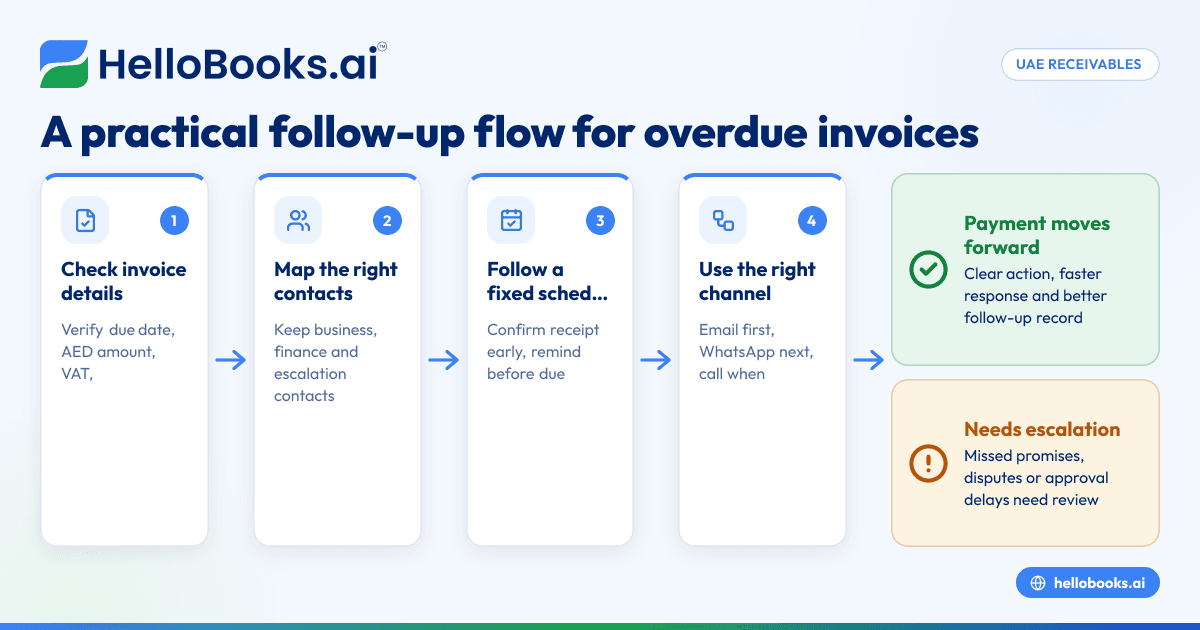
Use a fixed schedule: confirm receipt early, remind before due date, follow up on day 1 overdue, then escalate by WhatsApp, email and call over the next 7 to 21 days. Keep every message polite, specific and easy to act on.
A practical process should be simple enough for one person to run every week. It should also work if another team member needs to step in.
A 7-step process you can use
1. Clean the invoice before you chase it
Before any reminder goes out, check:
- Customer name and billing entity
- Invoice number and date
- Due date
- Amount in AED
- VAT details if applicable
- Purchase order or reference number
- Supporting documents attached
- Correct recipient email and phone number
If the invoice itself is wrong, follow-up will not fix it. It will only create more delay.
2. Map the right contacts
For each customer, keep at least three contacts where possible:
- Day-to-day business contact
- Accounts payable or finance contact
- Decision-maker or manager for escalation
In many UAE businesses, the person replying on WhatsApp may not control payments. You need to know who actually does.
3. Set a follow-up schedule
A simple schedule looks like this:
- 3 to 5 days after sending the invoice: confirm receipt.
- 2 days before due date: friendly reminder.
- 1 day after due date: overdue reminder by email.
- 3 to 5 days overdue: WhatsApp message and call.
- 7 to 10 days overdue: second escalation with clear payment request.
- 14 to 21 days overdue: senior escalation and account review.
Adjust the timing based on your invoice terms and customer history.
4. Use the right channel for the right job
Each channel has a role:
- Email: Best for formal reminders and documentation.
- WhatsApp: Best for quick visibility and short action-based messages.
- Phone call: Best when messages are ignored or there is a dispute.
Use all three together. A short WhatsApp after an email often gets faster attention.
5. Ask for one specific action
Do not send vague reminders like “Please check.” Instead ask for one concrete next step:
- Please confirm receipt.
- Please share expected payment date.
- Please confirm if any document is missing.
- Please connect us with your accounts payable contact.
- Please advise if there is any dispute on this invoice.
Specific questions get specific replies.
6. Log every response
Track:
- Date and time of contact
- Channel used
- Person contacted
- Response received
- Promised payment date
- Next action owner
This matters when invoices age beyond a week or two. Without notes, your team will repeat messages and miss commitments.
7. Review overdue invoices weekly
Run a weekly review by ageing bucket:
- Not yet due
- 1 to 7 days overdue
- 8 to 15 days overdue
- 16 to 30 days overdue
- Over 30 days overdue
This lets you focus energy where it matters most.
Which channel should you use first: WhatsApp, email or calls?
Start with email for a formal record, then use WhatsApp to bring attention to the email, and call when there is no response or a payment blocker. The best sequence is usually email first, WhatsApp second, call third.
That order works well because it balances professionalism and speed. Email gives you a clear trail. WhatsApp gets seen quickly. Calls help you uncover the real issue.
When email works best
Email is best when:
- You are sharing invoices or backup documents
- You want a formal reminder trail
- The customer has a finance or accounts payable inbox
- You need to confirm due dates or amounts in writing
Use a clear subject line like:
Invoice INV-2041 due on 18/10/2026 | AED 12,500
Keep the message short. State the invoice number, amount, due date and the action needed.
When WhatsApp works best
WhatsApp works best when:
- The customer is WhatsApp-first
- Emails are often missed
- You already have an active business conversation
- You need a quick acknowledgement
A useful WhatsApp message might be:
“Hello Ahmed, sharing a quick reminder on invoice INV-2041 for AED 12,500, due on 18/10/2026. We emailed the invoice earlier. Please let us know the expected payment date or if any document is needed. Thank you.”
Keep it short, polite and easy to reply to.
When phone calls work best
Calls are best when:
- The invoice is already overdue
- You are not getting clear replies
- There is a dispute to resolve
- The customer keeps promising payment without action
After every call, send a follow-up email or WhatsApp summary. That way the discussion becomes part of your record.
How often should you follow up on overdue invoices?
Follow up lightly before the due date, then more closely once the invoice is overdue. A good rule is every 2 to 5 days, depending on the amount, customer history and what the customer promised.
You do not need to message daily unless the customer asked you to check back on a specific date. Too many reminders can reduce response quality. Too few reminders tell the customer payment is not urgent.
A practical follow-up rhythm
For a first-time delay:
- Pre-due reminder
- Day 1 overdue email
- Day 3 overdue WhatsApp
- Day 5 overdue call
- Day 7 overdue escalation email
For repeat late payers:
- Confirm receipt early
- Follow up before due date
- Start overdue reminders immediately
- Escalate faster if previous promises were missed
If the customer gives a payment date, do not chase again before that date unless the amount is critical and the customer agreed to earlier confirmation.
Message templates for accounts receivable follow up UAE
Templates help your team stay consistent. They also reduce the stress of writing each reminder from scratch.
Email template: pre-due reminder
Subject: Reminder: Invoice INV-2041 due on 18/10/2026
Hello [Name],
A quick reminder that invoice INV-2041 for AED 12,500 is due on 18/10/2026.
Please let us know if you need any supporting documents or if there are any issues from your side.
Thank you,
[Your Name]
Email template: overdue reminder
Subject: Overdue invoice INV-2041 | AED 12,500
Hello [Name],
This is a reminder that invoice INV-2041 for AED 12,500 was due on 18/10/2026 and is now overdue.
Please share the expected payment date. If any document or clarification is needed, we can send it today.
Regards,
[Your Name]
WhatsApp template
Hello [Name], a quick reminder on invoice INV-2041 for AED 12,500, due on 18/10/2026 and now overdue. Please share the expected payment date, or let us know if anything is needed from our side. Thank you.
Call script
“Hello [Name], I am calling about invoice INV-2041 for AED 12,500. I wanted to check if the invoice is approved and whether you can share the expected payment date. If anything is pending from our side, we can send it right away.”
How do you handle customers who keep promising to pay?
Acknowledge the promise, record the date, and follow up exactly on that date with a short reminder. If promises are repeatedly missed, escalate to another contact and ask whether there is an approval or dispute issue.
The key is to move from general chasing to evidence-based follow-up. If a customer has missed two promised dates, stop sending the same friendly reminder to the same person.
A better escalation approach
After repeated missed promises:
- Summarise the history in writing.
- Mention the missed payment dates factually.
- Ask if there is any unresolved issue.
- Add the finance contact or manager if needed.
- Set one new action and one new date.
Example:
“Hello [Name], following our earlier conversations, payment was expected on 11/10/2026 and 15/10/2026, but we have not yet received confirmation. Please let us know by today if there is any issue holding payment for invoice INV-2041, AED 12,500, so we can resolve it quickly.”
Stay calm and professional. Do not accuse. Do not threaten unless you are ready to follow a formal internal escalation path.
How should you track accounts receivable follow up?
Track each invoice in one place with status, due date, last contact, next action and promised payment date. If your team uses separate spreadsheets, inboxes and chats, overdue invoices will slip through.
A simple tracker can live in your accounting system if it shows invoice status clearly. If not, even a structured spreadsheet is better than scattered notes.
Minimum fields to track
For each invoice, keep:
- Customer name
- Invoice number
- Invoice date
- Due date
- Amount in AED
- Ageing bucket
- Primary contact
- Accounts payable contact
- Last follow-up date
- Last channel used
- Promised payment date
- Dispute status
- Next action
- Owner
This structure helps one person step in if another is absent.
Why automation helps
As your volume grows, manual chasing becomes inconsistent. This is where AI accounting software or accounting software for small business can help by centralising invoices, reminders and payment status.
For teams handling many open invoices, ai accounts receivable workflows can flag overdue items, highlight missing follow-ups and reduce dependence on memory. The goal is not to remove human judgement. The goal is to make sure no invoice is forgotten.
If you also struggle to match incoming payments to invoices, bank reconciliation software saves time and helps close receivables faster.
What should you avoid when chasing overdue invoices?
Avoid emotional messages, vague reminders, missing records and long gaps between follow-ups. Most payment delays get worse when the supplier sounds frustrated but does not ask a clear question or set a next step.
Common mistakes
- Sending reminders without checking invoice accuracy
- Chasing only the sales contact
- Using different numbers or email addresses each time
- Forgetting to log promised payment dates
- Sending long messages with too much background
- Escalating too late
- Not confirming discussions after phone calls
Another mistake is mixing personal and business communication in a way that creates confusion. If follow-up happens on WhatsApp, keep it professional and tied to the invoice details.
Data handling and records
When customer details and payment conversations are stored digitally, be careful with access and sharing. Businesses in the UAE should handle personal data responsibly and in line with applicable data protection requirements, including the Federal PDPL where relevant. If your business is in a financial free zone such as DIFC or ADGM, check whether additional local rules apply to your operations.
A weekly accounts receivable routine for small UAE businesses
If you want a process that actually gets used, keep it simple. One weekly routine is enough for many small businesses.
Monday: review and prioritise
- Pull all unpaid invoices
- Sort by due date and amount
- Mark overdue and at-risk invoices
- Assign owners
Tuesday: send reminders
- Send pre-due reminders
- Send day 1 and day 3 overdue reminders
- Share documents where needed
Wednesday: WhatsApp follow-up
- Follow up on invoices with no email response
- Ask for payment date or missing-document requests
- Log responses
Thursday: calls and escalations
- Call customers with no reply
- Resolve disputes
- Escalate repeated delays
Friday: update the ledger
- Match payments received
- Close paid invoices
- Push unresolved invoices into next week’s actions