
Key takeaways
What this article covers, in order:
- Key takeaways
- Why accounts receivable follow up matters in India
- Common reasons customers delay payment
- Build an accounts receivable follow up process before invoices go overdue
- A practical accounts receivable follow up schedule
- How to follow up without hurting customer relationships
Accounts receivable follow up is the process of reminding customers about unpaid invoices and getting them paid on time. In India, good follow up is not about sending more reminders. It is about having a clear process, correct invoices, proof of delivery, and polite but firm communication that protects the relationship.
Key takeaways
- Accounts receivable follow up works best when you start before the invoice becomes overdue.
- A simple cadence by WhatsApp, email and phone can reduce delays without sounding aggressive.
- Most payment delays come from avoidable issues like wrong invoice details, missing PO numbers, GST mismatches or unclear approvals.
- Segmenting customers by amount, ageing and payment behaviour helps your team focus on the right accounts first.
- A standard escalation path keeps collections professional and reduces awkward back-and-forth between sales and finance.
- Automation can help track due dates, reminders, reconciliation and reports, especially if you still work in spreadsheets or Tally.
Why accounts receivable follow up matters in India
For many Indian businesses, sales look healthy on paper but cash is still tight. You may have ₹25 lakh in monthly billing, yet struggle to pay salaries, rent, vendors or GST on time because collections are delayed. That is why accounts receivable follow up matters. It turns booked revenue into actual cash.
This is common in trading, services, agencies, manufacturing and distribution businesses. A customer in Mumbai may ask for 30 days but pay in 52 days. A buyer in Pune may hold payment because the invoice did not mention the purchase order number. A large company in Bengaluru may process payments only on fixed weekly runs. Small delays across many invoices can create a serious cash flow gap.
Follow up also affects customer experience. If your process is messy, customers get duplicate reminders, wrong balances or repeated calls after they have already paid. That damages trust. A clean process does the opposite. It shows that your business is organised and easy to work with.
If your team still sends invoices manually, checks bank credits one by one and tracks dues in Excel, follow up becomes reactive. Using AI bookkeeping and a proper receivables workflow can make this much easier, but the foundation is still process discipline.
Common reasons customers delay payment
Before you tighten reminders, fix the reasons invoices get stuck. Many payment delays are operational, not intentional.
1. Invoice errors
A missing GSTIN, wrong legal entity name, incorrect address, wrong line item or tax calculation issue can stop payment. Even small errors can delay approval in larger companies.
2. Missing supporting documents
Some customers need a purchase order, work completion note, delivery challan, signed timesheet or email confirmation before they release payment.
3. No clarity on due dates
If your invoice says “due on receipt” but your sales team verbally promised 30 days, the customer will follow the verbal commitment. This confusion causes disputes.
4. Approval bottlenecks
In many Indian companies, the person using your product or service is not the person releasing payment. Finance, procurement and the final approver may all be different people.
5. Disputes on quality, quantity or scope
A customer may delay the whole payment because one item is disputed. If this is not tracked early, finance discovers it only after the due date has passed.
6. Poor internal handover
Sales closes the deal, operations delivers, and finance chases payment. If customer terms, promised dates and required documents are not shared properly, follow up starts weak.
Build an accounts receivable follow up process before invoices go overdue
The best accounts receivable follow up starts before the due date. That sounds obvious, but many businesses begin only after an invoice is 15 or 30 days overdue.
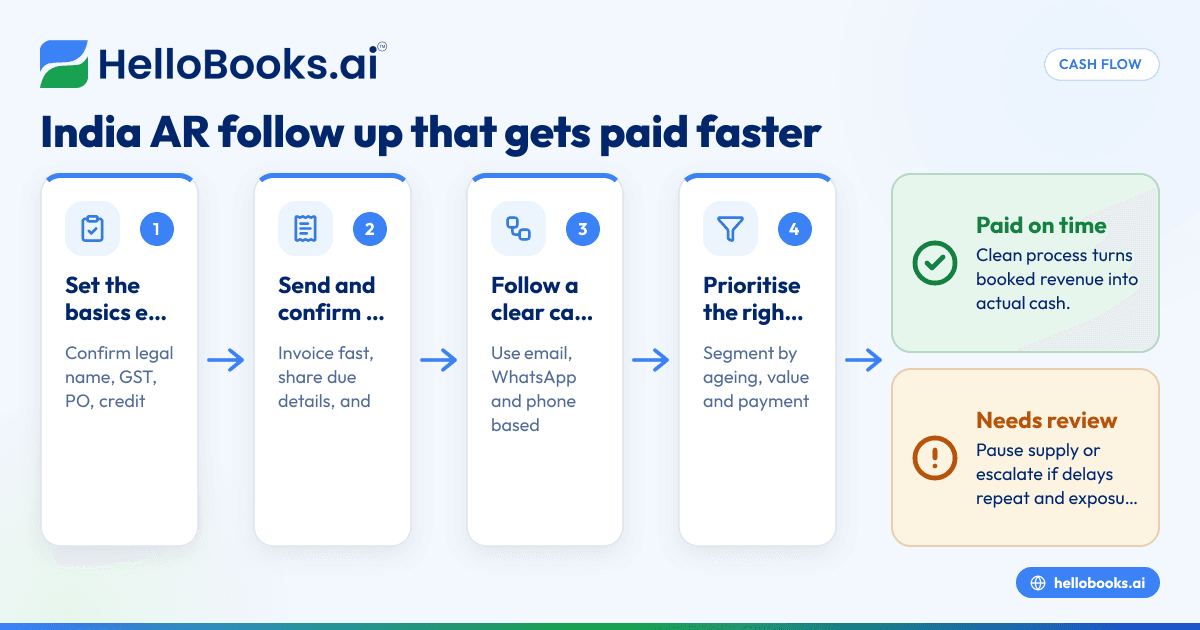
Set the basics at the start
Before you raise an invoice, make sure you have:
- Correct customer legal name and billing address
- GST details, where relevant
- Purchase order number, if required
- Agreed credit period in writing
- Billing contact and accounts payable contact
- Payment method details
- Any required supporting documents
This one-time discipline saves many future calls.
Send invoices correctly and fast
Invoice as soon as work is completed or goods are delivered. Do not wait until month-end if your process allows earlier billing. The later you invoice, the later you collect.
Use a clear subject line and message. Mention:
- Invoice number
- Invoice date
- Due date
- Amount due
- Payment link or bank details
- Contact person for billing questions
For businesses with GST and high invoice volumes, using invoice software or e-invoicing software can reduce manual errors and keep records consistent.
Confirm invoice receipt
This step is often skipped. A simple email or WhatsApp message asking, “Please confirm receipt and acceptance of invoice” can surface issues early. If a customer says they did not receive it, you know that before the due date.
A practical accounts receivable follow up schedule
You do not need a complex collections playbook. You need a simple, repeatable cadence that your team actually follows.
Suggested reminder timeline
Adjust this based on your business and customer type.
- 3 to 5 days before due date Send a friendly reminder with invoice number, amount and due date. The tone should be helpful, not pushy.
- On the due date Send a short note confirming the payment is due today. Include payment details and ask if anything is needed from your side.
- 3 days overdue Follow up by email or WhatsApp. Ask if payment has been processed and whether there are any blockers.
- 7 days overdue Make a phone call. Confirm status, expected payment date and whether finance needs any documents.
- 14 days overdue Send a firmer message. Mention the invoice age and request a committed payment date in writing.
- 21 to 30 days overdue Escalate internally and externally if needed. This may involve the customer’s finance manager, procurement contact or the account owner from your sales team.
Use the right channel in India
In India, WhatsApp is often the fastest business channel, especially for SMEs. But use it carefully. For first reminders and formal records, email is still important. For delayed invoices, phone calls are often the most effective.
A good pattern is:
- Email for official documentation
- WhatsApp for quick nudges
- Phone for clearing blockers and getting commitment
Keep records of all communication. This helps if there is later confusion or an internal handover.
How to follow up without hurting customer relationships
Many founders avoid collections because they do not want to sound rude. But late payment follow up does not have to be confrontational.
Focus on facts, not emotions
Avoid messages like “We have reminded you many times” or “This is very disappointing.” Instead, use simple facts:
- Invoice number
- Amount due
- Original due date
- Pending status
- Requested action
This keeps the conversation professional.
Separate the person from the issue
The customer contact may not be the cause of the delay. They may be waiting on internal approval. Stay respectful and ask what is needed to move payment forward.
Give an easy next step
Do not send vague reminders. Ask one clear question:
- Has payment been scheduled?
- Can you share the expected payment date?
- Do you need any document from our side?
- Should we coordinate with your accounts payable team?
This makes responses easier.
Know when sales should step in
In some cases, a finance-only follow up will not work. If the relationship owner is in sales or the founder’s office, involve them. But do this with coordination. Mixed messages from multiple people can confuse the customer.
Prioritise receivables using ageing and risk
Not every unpaid invoice deserves the same attention. Your team should know where to focus first.
Segment by ageing
Create ageing buckets such as:
- Not yet due
- 1 to 30 days overdue
- 31 to 60 days overdue
- 61 to 90 days overdue
- More than 90 days overdue
This helps you see where cash is stuck.
Segment by value
A ₹12,000 invoice should not get the same effort as a ₹4.5 lakh invoice. Prioritise high-value dues because they have a bigger cash impact.
Segment by customer behaviour
Track which customers:
- Usually pay on time
- Pay only after reminders
- Always dispute invoices
- Require PO and GRN matching
- Pay on fixed cycles only
With this information, your accounts receivable follow up becomes smarter. You can prevent delays instead of reacting each month.
Create standard message templates for your team
Templates save time and keep tone consistent. They also reduce the risk of overly aggressive or vague follow ups.
Friendly pre-due reminder
Hi [Name], sharing a reminder that Invoice [Number] for ₹[Amount] is due on [DD/MM/YYYY]. Please let us know if you need any document or support from our side.
Due date reminder
Hi [Name], this is a reminder that Invoice [Number] for ₹[Amount] is due today. Sharing the invoice again for convenience. Please confirm once payment is scheduled.
7-day overdue message
Hi [Name], Invoice [Number] for ₹[Amount], due on [DD/MM/YYYY], remains unpaid as of today. Please share the expected payment date, or let us know if any issue is holding it up.
Escalation message
Hi [Name], we are following up on Invoice [Number] for ₹[Amount], now overdue by [X] days. Please help us with a confirmed payment timeline today. If needed, we are happy to coordinate with your finance team directly.
Keep these messages polite and short. Avoid long paragraphs.
Tighten internal controls to improve collection speed
Collection problems often start inside your own business. A better process between sales, operations and finance can reduce overdue invoices significantly.
Align payment terms at the time of sale
Do not let sales promise loose or undocumented payment terms. Every deal should clearly record:
- Credit period
- Billing milestone
- Required documentation
- Customer approver
- Special payment conditions
Track disputes separately
If a customer disputes one line item, do not let the whole invoice disappear into a generic “pending” bucket. Log the dispute, owner, next step and due date for resolution.
Reconcile collections daily
One major reason follow up goes wrong is that the customer has paid, but your team has not matched the payment yet. Daily reconciliation prevents embarrassing reminders after payment.
This is where bank reconciliation software can help. It reduces manual matching work and gives the finance team a clearer view of outstanding dues.
Review receivables every week
A weekly 20-minute review can help a lot. Include finance, the business owner and sales lead if needed. Review:
- Top overdue invoices
- Collection commitments due this week
- Disputes needing action
- Customers to escalate
- Expected cash inflow
Metrics to track for better accounts receivable follow up
What gets measured gets managed. You do not need advanced dashboards to start.
Track these basics:
Collection efficiency by due bucket
How much did you collect from invoices that were not due, newly overdue and severely overdue?
Average days to collect
This shows how long customers actually take to pay, not just what the contract says.
Overdue percentage
What share of your receivables is overdue right now?
Promise-to-pay accuracy
How often do customers pay on the date they commit?
Dispute rate
How many invoices are delayed due to errors, missing documents or service issues?
Even a simple weekly report is useful. If you want a more structured workflow than Excel or fragmented Tally exports, accounting software in India can help centralise invoicing, collections and reporting.
When to escalate and when to pause supply
Escalation should be planned, not emotional.
Escalate when:
- The customer stops responding
- The payment date is repeatedly missed
- The invoice is overdue beyond your comfort level
- There is a pattern of delayed payments across multiple invoices
- Internal relationship owners are not able to move the account
Consider a credit hold when:
- A customer is significantly overdue
- New supplies will increase your exposure
- There is no clear payment commitment
- The customer has a history of broken commitments
This decision should involve business leadership, not just finance. For some strategic accounts, you may continue supply with safeguards. For others, a temporary hold may be the right move.
If your article or process touches tax treatment, interest charges or legal notices, remember that this is general information, not tax or legal advice. For account-specific cases, speak to your accountant or lawyer.
How automation makes accounts receivable follow up easier
Manual collections usually fail in the same way. Invoices are sent late. Reminders are inconsistent. Payment status is unclear. Collections depend on one person’s memory. That is risky.
Automation helps by:
- Sending invoices on time
- Tracking due dates automatically
- Triggering reminders by stage
- Updating payment status after reconciliation
- Showing ageing reports in one place
- Reducing duplicate follow ups after payment
For growing businesses, this matters even more when collections come through bank transfer, UPI or payment gateways and records are spread across email, spreadsheets and accounting tools.
If your finance team spends too much time on entries and follow ups, moving to AI accounting software or a better accounting software for small business setup can improve both speed and accuracy.
A simple 30-day improvement plan
If your receivables process feels messy, do not redesign everything at once. Start with these steps over the next 30 days.
Week 1: Clean your customer and invoice data
- Update billing contacts
- Confirm payment terms
- Fix invoice templates
- Create ageing buckets
Week 2: Start the reminder cadence
- Set pre-due reminders
- Standardise due-date and overdue messages
- Assign owners for top 20 overdue invoices
Week 3: Add a weekly review
- Review largest overdue accounts
- Track promised payment dates
- Resolve disputes and missing documents
Week 4: Improve reporting and reconciliation
- Reconcile receipts daily
- Measure overdue percentage
- Flag repeat late payers
- Decide where automation is needed
Small changes here can improve cash flow quickly. The goal is not to chase customers harder. The goal is to remove friction and create a process that customers can respond to easily.
If you want a simpler way to manage invoicing, reconciliation and receivables follow up, you can book a demo or compare plans on the pricing page.
Frequently asked questions
What is accounts receivable follow up?
Accounts receivable follow up is the process of tracking unpaid invoices and reminding customers to pay on time. It usually includes invoice confirmation, due date reminders, phone calls, dispute resolution and escalation for overdue amounts.
How often should I follow up on unpaid invoices?
A practical approach is to start 3 to 5 days before the due date, then follow up on the due date, at 3 days overdue, 7 days overdue and 14 days overdue. The exact timing depends on your industry, invoice size and customer relationship.