
Key takeaways
What this article covers, in order:
- Key takeaways
- Why do accounts receivable collection emails matter?
- What should an accounts receivable collection email include?
- When should you send payment reminder emails?
- Accounts receivable collection email templates in United States
- How do you make collection emails more effective?
Getting paid on time often comes down to one thing: a clear, consistent reminder sequence. The best accounts receivable collection email templates are short, polite, specific about the invoice, and timed so customers get a fair chance to pay before you escalate.
For small businesses in the United States, a simple process works best. Send reminders before and after the due date, include the invoice number, amount due, payment link, and a clear next step, then document every follow-up in your books.
Key takeaways
- Good collection emails are firm, professional, and easy to act on.
- A basic sequence includes a pre-due reminder, due-date email, and several past-due follow-ups.
- Every email should include the invoice number, due date, amount due, and payment instructions.
- Segment customers by risk, amount, and history so you do not over-message reliable payers.
- Keep a record of promises to pay, disputes, and payment dates for cleaner receivables reporting.
- Tools like invoice software and AI bookkeeping can reduce manual follow-up work.
Why do accounts receivable collection emails matter?
Collection emails help you turn open invoices into cash without damaging customer relationships. They create a written record, keep your team consistent, and make it easier for customers to pay quickly.
For many small businesses, late payments are not always about refusal. Sometimes the invoice went to the wrong contact. Sometimes a buyer needs a purchase order match. Sometimes the approver missed the email. A structured reminder sequence solves many of these problems before they become serious.
Email is also a practical channel in the United States because it fits how most finance teams work. A controller in Chicago or an office manager in Houston can forward the invoice internally, reply with a question, or send a remittance notice without starting a phone chain.
If you use accounts receivable collection email templates, you avoid rewriting the same message every week. That saves time and reduces inconsistency. It also helps your team sound professional, even when a payment is 30 or 45 days late.
What should an accounts receivable collection email include?
Every collection email should identify the invoice, state the amount due, and tell the customer exactly what to do next. Keep it clear and easy to scan.
A strong reminder email usually includes:
- Customer name or company name
- Invoice number
- Original invoice date
- Due date
- Amount due in USD
- Payment link or payment instructions
- Contact details for billing questions
- A short subject line
- A direct but courteous call to action
For example, if you run a design agency in Detroit and invoice a client $2,450, your reminder should not say, “Just following up.” It should say, “Invoice 1048 for $2,450 was due on 04/15/2026. Please submit payment here.”
That level of detail reduces back-and-forth. It also lowers the chance that the customer says they could not identify the bill.
Subject line examples that work
A good subject line is simple and specific. Avoid gimmicks or aggressive language.
Examples:
- Reminder: Invoice 1048 due on 04/15/2026
- Payment due today: Invoice 1048 for $2,450
- Past due: Invoice 1048, balance $2,450
- Second reminder: Invoice 1048 is 7 days past due
- Action needed: Past-due invoice 1048
When should you send payment reminder emails?
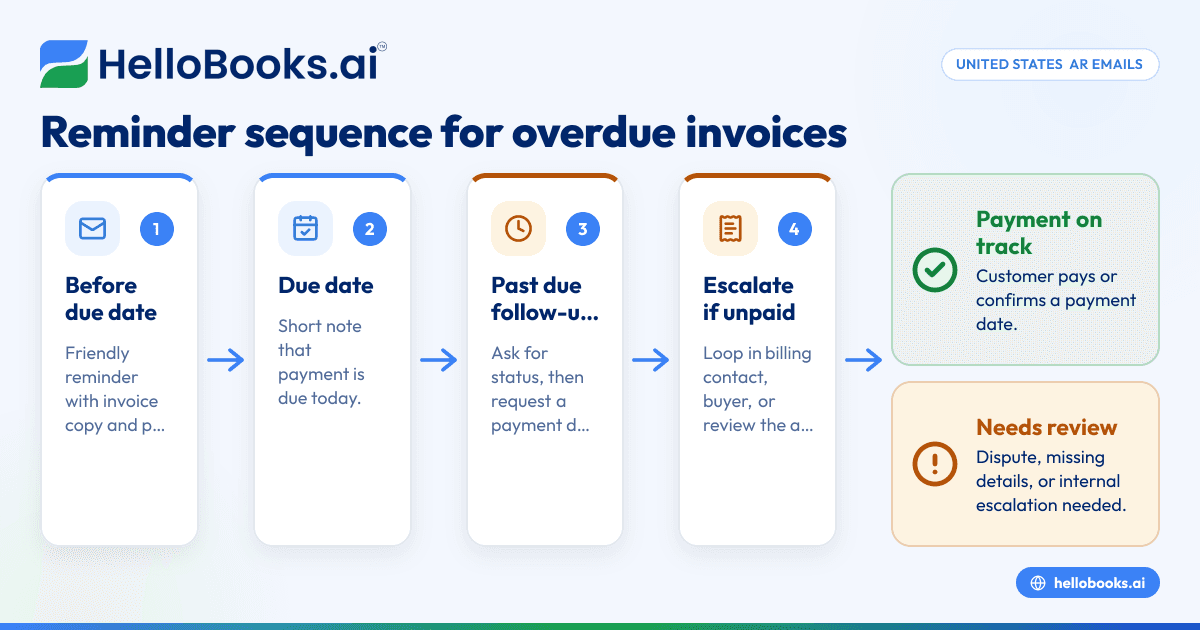
Send one reminder before the due date, one on the due date, and several after the due date if payment is still outstanding. Space them consistently and adjust for customer size, invoice amount, and past payment behavior.
A practical sequence for small businesses looks like this:
- 7 days before due date Friendly reminder with invoice copy and payment link.
- On the due date Short note that payment is due today.
- 3 days past due Polite follow-up asking for status.
- 7 days past due Firmer reminder with request for payment date.
- 14 days past due Escalation to the billing contact and original buyer.
- 21 to 30 days past due Final internal escalation, phone call, or account review.
This timeline is not a legal rule. It is an operating process. Your terms, customer contracts, and industry practices may justify a different sequence.
If your customers usually pay by ACH or card, shorter reminders may work well. If they pay by check or need internal approval, give a bit more room while still following up consistently.
Accounts receivable collection email templates in United States
Below is a practical reminder sequence you can use and adapt. Replace brackets with your details. Keep each email short. Most customers do not need a long explanation. They need the facts and a payment path.
1) Friendly reminder before due date
Subject: Reminder: Invoice [Invoice Number] due on [MM/DD/YYYY]
Hi [Customer Name],
I hope you are doing well. This is a friendly reminder that invoice [Invoice Number] for $[Amount] is due on [MM/DD/YYYY].
You can view and pay the invoice here: [Payment Link]
If payment has already been scheduled, please disregard this email. If you have any billing questions, reply here and we will help.
Thank you,
[Your Name]
[Company Name]
[Phone] | [Email]
2) Due date reminder
Subject: Payment due today: Invoice [Invoice Number] for $[Amount]
Hi [Customer Name],
This is a reminder that invoice [Invoice Number] for $[Amount] is due today, [MM/DD/YYYY].
Payment link: [Payment Link]
Please let us know once payment has been submitted, or reply if there are any questions about the invoice.
Thank you,
[Your Name]
[Company Name]
3) First past-due email
Subject: Past due: Invoice [Invoice Number], balance $[Amount]
Hi [Customer Name],
Our records show invoice [Invoice Number] for $[Amount] was due on [MM/DD/YYYY] and is now past due.
Please submit payment here: [Payment Link]
If payment is already in process, please reply with the scheduled payment date. If there is a problem with the invoice, let us know so we can resolve it quickly.
Thank you,
[Your Name]
[Company Name]
4) Second past-due email with request for date
Subject: Second reminder: Invoice [Invoice Number] is 7 days past due
Hi [Customer Name],
I am following up on invoice [Invoice Number] for $[Amount], which was due on [MM/DD/YYYY].
Please confirm one of the following today:
- Payment has been made
- Payment is scheduled for [Date]
- There is an issue we need to resolve
Payment link: [Payment Link]
We appreciate your prompt attention.
Best,
[Your Name]
5) Escalation email
Subject: Action needed: Past-due invoice [Invoice Number]
Hi [Customer Name],
Invoice [Invoice Number] for $[Amount] remains unpaid and is now [X] days past due.
Please reply with a payment date by [MM/DD/YYYY] or submit payment here: [Payment Link]
If another person handles accounts payable, please forward this message or share their contact details so we can follow up directly.
Thank you,
[Your Name]
[Company Name]
6) Final pre-escalation email
Subject: Final reminder before account review: Invoice [Invoice Number]
Hi [Customer Name],
This is our final reminder regarding invoice [Invoice Number] for $[Amount], originally due on [MM/DD/YYYY].
Please send payment or confirm a payment date by [MM/DD/YYYY]. If there is a dispute or documentation issue, reply today so we can review it.
Thank you,
[Your Name]
[Company Name]
How do you make collection emails more effective?
Use short messages, one clear action, and consistent timing. Customers respond faster when the email is easy to scan and gives them a direct way to pay.
After that, improve the process behind the email. Many overdue invoices happen because of weak internal controls, not weak wording.
Best practices for stronger response rates
1. Send invoices correctly the first time
Start with accurate billing details. Use the right legal business name, contact person, and email address. Include purchase order details if the customer requires them.
If the invoice itself is wrong, your reminder sequence will not fix the delay.
2. Include a payment link whenever possible
Reduce friction. If a customer has to search for bank instructions or ask for a copy of the invoice, payment gets delayed.
A direct pay-now link often outperforms a generic message with no clear next step.
3. Ask for a payment date, not just payment
A request like “Please confirm your payment date” is easier to answer than “Please pay immediately.” It gives you useful information and creates accountability.
4. Keep tone professional
Do not shame the customer. Do not use all caps. Do not threaten legal action unless you have decided to escalate and your wording has been reviewed appropriately.
For most small businesses, professional persistence works better than aggressive language.
5. Separate disputes from late payments
If the customer says the invoice amount is wrong, stop sending the same reminder email. Move the issue into a dispute workflow and assign it to the right person.
Otherwise, you risk frustrating a customer who may be willing to pay once the issue is fixed.
What if a customer says they never received the invoice?
Resend the invoice immediately, confirm the right billing contact, and restart follow-up based on the new send date if appropriate. The goal is to remove friction and document the next agreed step.
Then check your invoicing process. If this happens often, your accounts receivable process needs tighter controls.
A simple response template
Subject: Re: Invoice [Invoice Number]
Hi [Customer Name],
Thank you for letting us know. I have attached and resent invoice [Invoice Number] for $[Amount], originally dated [MM/DD/YYYY].
Please confirm that this is the correct billing contact and let us know the expected payment date. If another person handles accounts payable, please share their details and we will update our records.
Best,
[Your Name]
Internal checks to run
When a customer says they never got the invoice, verify:
- Was the invoice sent to the right email address?
- Did the message bounce?
- Was the invoice attached or linked properly?
- Did the customer require a portal upload?
- Was a purchase order missing?
- Did the email go only to the buyer, not accounts payable?
These checks matter because receivables problems often begin upstream in the billing process.
How should you segment your reminder sequence?
Segment by invoice size, customer history, and payment risk. A $300 invoice from a long-time customer should not get the same treatment as a $25,000 invoice that is already 15 days late.
Here are useful segments for small businesses:
By customer payment behavior
- Reliable payers: Light reminder cadence
- Occasionally late: Standard sequence
- Frequently late: Earlier follow-up and faster escalation
By invoice amount
Higher balances deserve more attention. A $50,000 invoice may justify a personal email and phone call. A $250 invoice may only need an automated reminder flow.
By issue type
Treat these separately:
- Administrative delay
- Missing documentation
- Pricing dispute
- Approval bottleneck
- Cash flow issue
This is where ai accounts receivable tools can help. They can group overdue invoices by risk, detect payment patterns, and suggest who needs a manual follow-up instead of another generic reminder.
How do you track collection emails and promises to pay?
Log each reminder, response, and promised payment date in one place. Good tracking helps your team follow up on facts, not memory.
A simple accounts receivable tracking workflow looks like this:
- Record the invoice date, due date, and amount.
- Log every reminder email sent.
- Note replies from the customer.
- Save any promised payment date.
- Mark disputes separately from normal overdue invoices.
- Reconcile payments against the open invoice balance.
If you are still doing this in spreadsheets, mistakes add up fast. It becomes harder to see who promised to pay last Friday, which invoices are truly disputed, and which customers are slipping from 15 days late to 45 days late.
That is why many businesses move from manual invoicing to accounting software in the USA or bank reconciliation software as they grow. Better systems make the reminder sequence more reliable because invoice status and bank activity stay up to date.
Common mistakes to avoid in collection emails
Even good templates fail when the process around them is messy. Avoid these common problems.
Sending vague emails
“Checking in on this” is not enough. State the invoice number, amount, and due date.
Waiting too long to follow up
If you wait until an invoice is 20 days late, you lose momentum. Early reminders feel normal. Late reminders feel reactive.
Overloading the customer with text
Long emails get ignored. Keep the message focused on one action.
Not escalating internally
If a customer has ignored three reminders, someone on your team should review the account. There may be a contract issue, a service issue, or a customer relationship issue.
Failing to update the books after payment
A customer may have paid, but if the payment is not matched correctly, your team may send a wrong reminder. Clean reconciliation matters. Tools such as expense management software and AI accounting software can help keep related finance records more organized, though your receivables workflow still needs clear ownership.
A practical workflow for small businesses
If you want a simple system that works, use this operating rhythm each week:
Monday: review open invoices
Look at all unpaid invoices by due date and amount. Identify what is due this week, what just went past due, and what needs escalation.
Tuesday: send reminders
Send the scheduled reminder batch. Personalize only where needed, such as large balances or key customers.
Wednesday: resolve exceptions
Handle disputes, missing documents, and requests for invoice copies. This work often clears invoices faster than another reminder.
Thursday: confirm promised payments
Follow up on anyone who gave a date but has not paid. A short message is enough.
Friday: reconcile cash received
Match incoming payments to open invoices. Update balances and stop reminders for paid accounts.
This kind of discipline matters more than having perfect templates. The best email cannot fix a process that nobody owns.
When your team grows, you may want tools that combine invoicing, payment tracking, reminders, and reporting. If you are evaluating a QuickBooks alternative or broader accounting software for small business, prioritize visibility into open invoices, follow-up history, and cash collection reporting.
A note on compliance and professionalism
Collection emails are usually straightforward business communications, but your process should still be professional and accurate. Do not misstate balances, invent penalties, or imply legal steps you have not actually approved.
If your reminders discuss tax treatment, fees, or formal collection actions, get advice from your accountant or attorney. This article is general information, not tax or legal advice.
A good standard is simple: be clear, be truthful, and document what happened.