
Key takeaways
What this article covers, in order:
- Key takeaways
- Why an accounts receivable call script matters
- What should you say on an accounts receivable call?
- Before the invoice is overdue: pre-due date call script
- After the invoice is overdue: payment reminder call script
- What if the customer gives an excuse?
If you need an accounts receivable call script, keep it short, polite, and specific. The goal is to confirm the invoice, remove any issue, and get a clear payment date without damaging the customer relationship.
Key takeaways
- A good accounts receivable call script focuses on facts, not pressure.
- Call before and after an invoice due date to reduce late payments.
- Always confirm three things: the invoice was received, approved, and scheduled for payment.
- Leave each call with a next step, date, and owner.
- Use email notes and call logs so your team can follow up consistently.
- Automation and AI bookkeeping tools can help track invoices and follow-ups.
Why an accounts receivable call script matters
Late payments hurt cash flow fast. A small business in Chicago or Houston can be profitable on paper and still feel squeezed because customers are paying 15, 30, or 45 days late.
That is why a repeatable accounts receivable call script helps. It gives your team a calm, professional way to follow up. It also reduces awkwardness. Instead of guessing what to say, you follow a process.
A strong script does four things:
- Confirms the customer got the invoice.
- Checks whether there is a problem.
- Asks for a payment date.
- Creates a record for the next follow-up.
This matters whether you send five invoices a month or five hundred. If you still manage receivables in spreadsheets, the handoff between invoicing, payment tracking, and collections can get messy. Many small businesses use invoice software and bank reconciliation software to keep that process tighter.
What should you say on an accounts receivable call?
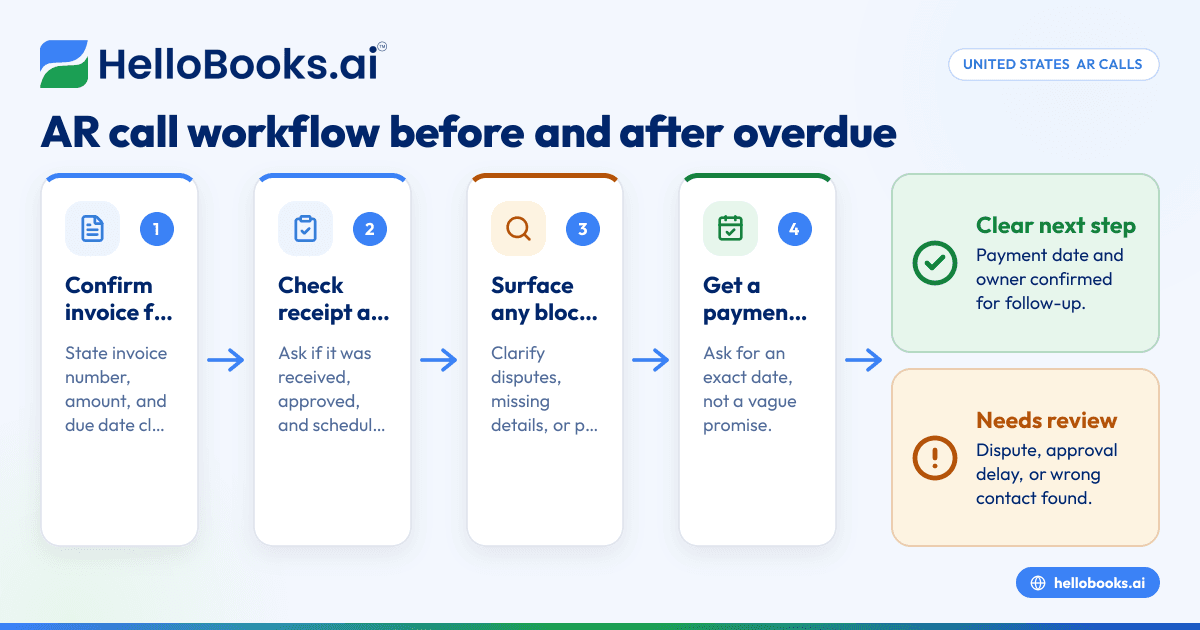
Start with the invoice facts, ask one simple question, and end with a commitment. Be polite and direct. Your goal is to collect information first, then payment timing.
A useful structure is:
- Introduce yourself and your company.
- Mention the invoice number, amount, and due date.
- Ask whether the invoice was received and approved.
- Ask if there is anything blocking payment.
- Request a payment date.
- Confirm the next step.
Here is the basic framework:
“Hi, this is [Name] from [Company]. I’m calling about invoice [number] for $[amount], dated [date], with a due date of [date]. I wanted to confirm it was received and ask whether payment has been scheduled.”
That one sentence works because it is neutral. It does not accuse the customer of being late. It also gives them the exact invoice details right away.
Before the invoice is overdue: pre-due date call script
Calling before the due date can prevent many late payments. This is especially helpful for larger invoices, new customers, or clients with longer internal approval steps.
When should you call before the due date?
For many small businesses, a pre-due date call makes sense:
- 5 to 7 business days before the due date for larger invoices
- 2 to 3 business days before the due date for routine invoices
- On the same day the invoice is sent for new accounts that need setup confirmation
You are not “chasing” payment at this stage. You are confirming process.
Pre-due date accounts receivable call script
Use this script when the invoice is not overdue yet:
“Hi, this is [Name] from [Company]. I’m calling about invoice [number] for $[amount], sent on [date] and due on [date]. I wanted to confirm you received it and see whether you need anything from us to process payment on time.”
If they say they received it, continue:
“Great, thank you. Has it already been approved, or is there anyone else involved in the payment process?”
If they say it is pending approval:
“Thanks for letting me know. Is there anything we can send over today to help move it along?”
If they confirm payment is scheduled:
“Perfect. Can I confirm the expected payment date for our records?”
Why this pre-due call works
This script does not sound aggressive. It sounds organized. That matters because many late payments are caused by workflow problems, not refusal to pay.
Common causes include:
- The invoice went to the wrong email address
- A purchase order is missing
- The amount does not match the customer’s records
- The approver is out of office
- The vendor setup is incomplete
- The invoice is sitting in a shared inbox
A short call surfaces these issues early.
After the invoice is overdue: payment reminder call script
Once the due date passes, your tone should still stay calm. The script should be firmer, but still professional.
How should you ask for overdue payment?
Be direct, respectful, and specific. State that the invoice is overdue, ask if there is any issue, and request an exact payment date. Avoid vague endings like “please pay soon.”
Use this simple structure in every overdue call:
- Reference the overdue invoice
- Ask if there is any dispute or issue
- Request the payment date
- Confirm what happens next
First overdue call script: 1 to 5 days late
“Hi, this is [Name] from [Company]. I’m calling about invoice [number] for $[amount], which was due on [date]. I wanted to check in and see whether there are any issues with the invoice, and when we can expect payment.”
If they say they will pay soon, do not stop there. Ask:
“Thank you. What date should I note for payment?”
If they say they need more time:
“I understand. Can we agree on a payment date, or would it help to discuss a partial payment?”
If they claim they never received it:
“No problem. I can resend it right after this call. What is the best email address, and who should be copied?”
Second overdue call script: 7 to 14 days late
At this stage, be more specific and create accountability.
“Hi, this is [Name] from [Company] following up on invoice [number] for $[amount], due on [date]. It is still showing as unpaid on our side. I wanted to confirm whether payment has been scheduled, and if not, what is preventing it from being released.”
Then ask:
“What date should I expect payment, and who on your side is responsible for approving it?”
This helps you identify whether you are speaking with the right person.
Third overdue call script: 15+ days late
If the invoice is significantly overdue, move from reminder to escalation.
“Hi, this is [Name] from [Company]. I’m following up again on invoice [number] for $[amount], now overdue since [date]. We have not yet received payment or a confirmed payment date. I need to understand whether there is a dispute, a processing issue, or a specific date we should expect payment.”
If necessary, add:
“If there is another contact in accounts payable or finance who handles this, please direct me there today.”
Keep your voice steady. Do not argue.
What if the customer gives an excuse?
Expect some common responses. Your script should help you answer without sounding combative.
“We never got the invoice.”
Say:
“Thanks for letting me know. I’ll resend it today while we’re on the phone. Can I confirm the best email address and the contact who needs to approve it?”
Then ask:
“Once I resend it, when should I follow up with you?”
“We are waiting on approval.”
Say:
“Understood. Who is handling the approval, and is there anything missing from our side?”
Then ask:
“What date do you expect the approval to be completed?”
“We are having cash flow issues.”
Say:
“I appreciate the update. Let’s talk through a realistic payment plan. What amount can be paid now, and when can the balance be cleared?”
If you offer payment plans, document them in writing after the call.
“There is a problem with the invoice.”
Say:
“Thanks for flagging that. Can you tell me exactly what needs to be corrected so we can resolve it today?”
Do not leave the issue vague. Get specifics.
How many times should you call?
For most small businesses, a simple call cadence works well.
Suggested AR call schedule
- Before due date: 3 to 7 business days before due date for larger or new invoices.
- Day 1 to 3 overdue: First reminder call.
- Day 7 overdue: Second call and email.
- Day 14 overdue: Escalation call to finance or accounts payable.
- Day 21+ overdue: Final internal review for stronger collection action.
Your cadence depends on invoice size, customer history, and your payment terms.
If you email and call, make sure your messages match. Keep records of call dates, promises made, and who you spoke with. This protects your team and improves handoffs.
What should you do right after every AR call?
Write down the payment date, issue, and next step before you hang up or immediately after. Then send a short follow-up email the same day so both sides have the same record.
A good call means little if no one logs the outcome. This is where process matters as much as persuasion.
Post-call note template
Use a simple internal format:
- Customer name
- Invoice number
- Amount: $[amount]
- Due date: [date]
- Person spoken to
- Summary of issue
- Promised payment date
- Next follow-up date
- Owner on your team
Post-call email template
Send something like this:
Subject: Follow-up on invoice [number]
Hi [Name],
Thank you for speaking with me today. This is a quick summary of our call regarding invoice [number] for $[amount], due on [date]. You mentioned that [summary of issue or status]. You also confirmed that payment is expected on [date].
Please let me know if you need anything from our side to complete processing.
Best,
[Your name]
This creates a paper trail without sounding threatening.
A simple accounts receivable workflow for small businesses
An accounts receivable call script works best inside a simple workflow. Without a process, your team may call too late, miss follow-ups, or duplicate work.
Build this 5-step workflow
- Send accurate invoices fast. Make sure invoice dates, amounts, line items, and payment terms are clear.
- Track due dates centrally. Do not rely on one person’s inbox or memory.
- Call before risk turns into delay. Prioritize larger invoices and slower-paying accounts.
- Log every touchpoint. Notes matter when multiple people handle collections.
- Match invoices to incoming payments daily. Good reconciliation keeps your AR aging accurate.
Small businesses often start with spreadsheets and then outgrow them. A better setup may include accounting software for small business, payment tracking, and expense management software in one workflow.
Can ai accounts receivable help with follow-ups?
Yes. ai accounts receivable tools can flag overdue invoices, suggest follow-up timing, and keep payment notes organized. They help teams stay consistent, but you still need a clear policy and a human review for sensitive accounts.
The biggest advantage is consistency. When your team is busy, follow-ups slip. An AI-supported workflow can surface invoices by risk, due date, or customer behavior.
For example, a system can help you:
- See which invoices are due this week
- Track promises to pay
- Spot customers with repeat delays
- Log notes from each follow-up
- Match payments against open invoices faster
That does not mean every call should sound robotic. Your script still needs empathy. But your process can be smarter and more reliable.
If you are evaluating AI accounting software or accounting software in the USA, look for strong invoicing visibility, clean audit trails, and simple follow-up tracking.
What mistakes make AR calls less effective?
The biggest mistakes are being vague, waiting too long, and ending without a date. Good AR calls are short and specific.
Below that, avoid sounding apologetic, emotional, or unprepared.
Common AR call mistakes
1. Not having the invoice details ready
Always have the invoice number, amount, date, and payment terms in front of you.
2. Asking weak questions
“Just checking in” is too soft on its own. Ask whether payment is scheduled and on what date.
3. Accepting vague promises
“Soon” is not a commitment. Ask for a calendar date.
4. Calling the wrong person
You may need accounts payable, a controller, or the original buyer. Find the actual owner.
5. Failing to document the call
If it is not logged, your team cannot act on it later.
6. Escalating too early
Start professionally. Escalate only when normal follow-up has clearly failed.
A practical AR call checklist
Before every call, review this checklist:
- Customer name and contact
- Invoice number
- Invoice amount in USD
- Invoice date
- Due date
- Any prior emails or call notes
- Dispute status, if any
- Your goal for the call
- The next follow-up date you want to set
Keep the call short. In most cases, two to four minutes is enough.
A note on compliance and customer communication
When you contact customers by phone or email about invoices, use normal business communication standards and respect opt-out and consent rules where they apply to your outreach practices. This article is general information, not legal or tax advice.
For most B2B invoice follow-up, the practical focus is professionalism, accuracy, and clear records. If your business handles sensitive escalations, involve your finance lead or legal counsel before changing collection language.
Frequently asked questions
What is the best accounts receivable call script for small businesses?
The best accounts receivable call script is short and specific. State the invoice number, amount, and due date, then ask whether payment has been scheduled. End by getting an exact payment date or the reason for delay.
When should I call a customer about an unpaid invoice?
A good time to call is a few business days before the due date for larger invoices, then again within 1 to 3 days after the invoice becomes overdue. Early contact helps catch approval issues before they become late payments.
How do I ask for payment without sounding rude?
Use neutral language and focus on facts. Ask whether the invoice was received, whether there is any issue, and when payment is expected. Avoid blame, sarcasm, or emotional language.
Should I email or call for overdue invoices?
Use both. Email creates a written record, while a call helps you find the real issue faster. A short phone call followed by a same-day email summary is often the most effective approach.
What if a customer keeps promising to pay but does not pay?
Document every promise and follow up on the exact date they gave. If delays continue, escalate to the right finance contact and review whether future work should require tighter payment terms.
If you want a simpler way to manage invoicing, payment tracking, and follow-ups, you can book a demo or compare options on our pricing page.