
Key takeaways
What this article covers, in order:
- Why this comes up / what goes wrong
- Step-by-step
- Example (fictional figures)
- Common mistakes
- Doing this in HelloBooks
- Frequently asked questions
An accounting system for manufacturing businesses must effectively manage complex inventory flows, raw material purchases, production costs, and GST compliance while reducing manual data entry. Manufacturing owners and accountants often face challenges such as inaccurate inventory tracking, time-consuming bill entry, and delayed GST filing, which lead to errors and financial risks.
Why this comes up / what goes wrong
Manufacturing businesses in India, such as an auto-components MSME in Pune, a packaging manufacturer in Ahmedabad, or a pump maker in Coimbatore, handle multiple raw material suppliers, production stages, and finished product lines. Many still use spreadsheets, Tally, or manual bill books. This causes problems like:
- Errors from manual entry of purchase bills and inventory data
- Difficulty matching supplier bills with inventory consumption and production
- Delays and mistakes in GST invoicing and filing returns like GSTR-1 and GSTR-3B
- Lack of real-time visibility into production costs, stock levels, and cash flow
These issues result in inaccurate financial reports, missed Input Tax Credit (ITC), compliance risks, and wasted time.
Step-by-step
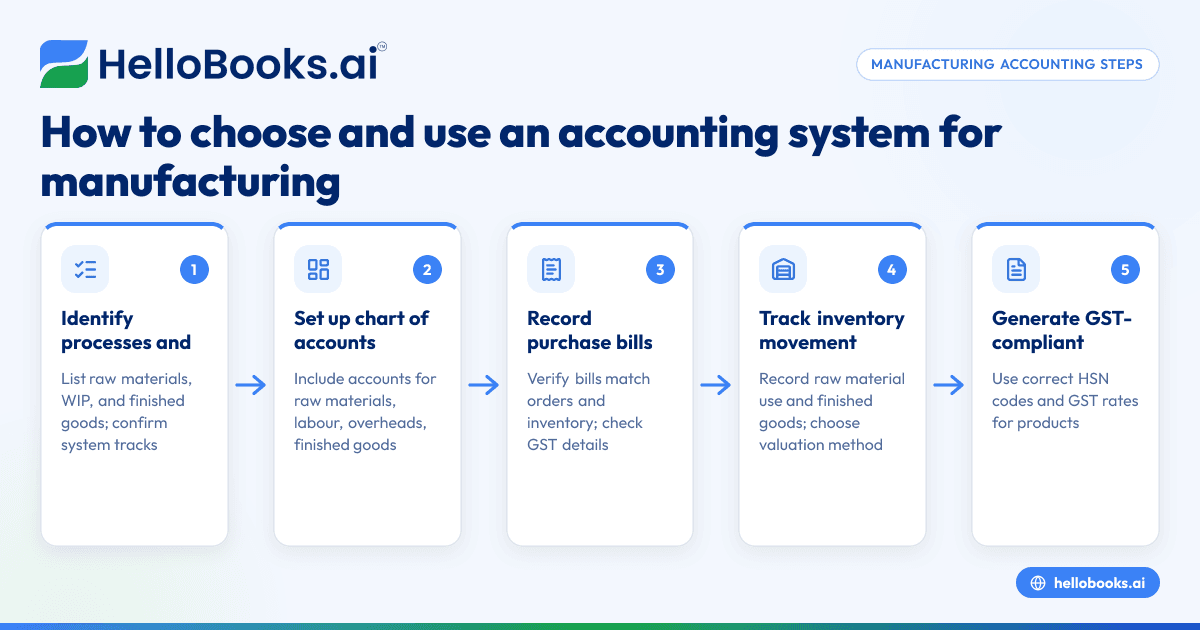
- Identify your manufacturing processes and inventory categories. List raw materials, work-in-progress (WIP), and finished goods specific to your business. Confirm your accounting system can track these separately.
- Create a chart of accounts tailored to manufacturing. Include purchase accounts for raw materials, labour, factory overheads, and finished goods stock.
- Record purchase bills accurately and promptly. Verify that supplier bills match purchase orders and inventory received, including correct GST details.
- Track inventory movement carefully. Record raw material consumption during production and additions to finished goods inventory. Choose and apply an inventory valuation method such as FIFO or weighted average.
- Generate GST-compliant sales invoices. Ensure correct HSN codes and GST rates for your manufactured products.
- Reconcile purchase bills with inventory and expenses regularly. Check for discrepancies between bills, stock received, and production usage.
- File GST returns on time using your accounting system. Prepare and submit GSTR-1 and GSTR-3B returns accurately to avoid penalties.
- Review financial reports frequently. Monitor profit margins by product, stock levels, and cash flow to make informed decisions.
For more details on manufacturing accounting, see Manufacturing.
Example (fictional figures)
An auto-components MSME in Pune purchases raw steel and plastic parts on 05/04/2024. The purchase bill value is ₹1,20,000 with an assumed GST rate of 18%.
Purchase price = ₹1,20,000
GST = ₹1,20,000 × 18% = ₹21,600
Total bill amount = ₹1,20,000 + ₹21,600 = ₹1,41,600
The company records this bill and adds the raw materials to inventory. Later, ₹50,000 worth of materials are consumed in production. Finished goods worth ₹80,000 are sold with 18% GST.
Sales value = ₹80,000
GST on sales = ₹80,000 × 18% = ₹14,400
Total invoice amount = ₹80,000 + ₹14,400 = ₹94,400
Before filing GSTR-1 and GSTR-3B, the company reconciles purchase bills with inventory used and sales invoices to ensure accuracy.
Common mistakes
- Mixing raw materials with finished goods in inventory tracking. Prevent this by creating distinct inventory categories.
- Entering purchase bills manually, leading to data errors. Use OCR scanning to capture bills accurately and reduce mistakes.
- Ignoring GST details on supplier bills, causing filing errors. Always verify GSTIN, invoice number, and tax rates.
- Delaying reconciliation of bills and inventory, missing discrepancies. Schedule monthly reconciliations to catch issues early.
- Using generic accounting software without manufacturing features. Choose systems that support inventory tracking and GST invoicing specific to manufacturing.
Learn more about GST invoicing best practices at GST invoicing.
Doing this in HelloBooks
HelloBooks provides OCR for purchase bills, enabling manufacturing businesses to capture supplier bills from photos or PDFs instead of manual entry. This feature auto-matches line items to existing inventory, reducing errors and saving time. To explore these capabilities, visit HelloBooks for India.
Frequently asked questions
What is the best accounting system for manufacturing businesses?
The best system accurately tracks raw materials, inventory, production costs, and GST compliance. It should support purchase bill capture, inventory valuation, GST invoicing, and filing. HelloBooks offers OCR for bills that helps reduce manual data entry.
How do I manage inventory in manufacturing accounting?
Separate raw materials, work-in-progress, and finished goods in your accounting system. Record consumption and additions carefully. Regularly reconcile inventory with purchase bills and production records to maintain accuracy.
Can I file GST returns directly from manufacturing accounting software?
Many accounting systems, including HelloBooks, support preparing and filing GSTR-1 and GSTR-3B returns for your GSTIN, simplifying compliance.
What common GST mistakes do manufacturing businesses make?
Common mistakes include incorrect HSN codes, mismatched supplier bills, and delayed filing. Regular reconciliation and accurate bill capture help prevent these errors.
Is Excel enough for manufacturing accounting?
Excel can work for small volumes but lacks automation for purchase bill entry, GST filing, and inventory tracking. Dedicated software reduces errors and saves time.
For more information, see Manufacturing.
Key takeaways
- Manufacturing accounting must track raw materials, production stages, finished goods, and GST accurately.
- Set up a manufacturing-specific chart of accounts and inventory categories.
- Capture purchase bills carefully and reconcile them with inventory regularly.
- Use software with OCR for bills to reduce manual data entry errors.
- File GSTR-1 and GSTR-3B returns on time to stay compliant.
- Review financial reports frequently to monitor costs and profitability.
Start managing your manufacturing accounts efficiently. Start on the Free plan (200 transactions a year, GSTR-1 and 3B filing for one GSTIN).