
Key takeaways
What this article covers, in order:
- Why this comes up / what goes wrong
- Step-by-step
- Example (fictional figures)
- Common mistakes
- Doing this in HelloBooks
- Frequently asked questions
Accounting for a daycare business means keeping track of all financial transactions related to your operations. This includes recording fees collected from parents, managing expenses like staff salaries, rent, utilities, and supplies, issuing GST-compliant invoices, reconciling your bank statements regularly to catch errors, and filing GST returns such as GSTR-1 and GSTR-3B on time. Proper accounting helps you understand your profitability, manage cash flow, and comply with GST regulations.
Why this comes up / what goes wrong
Many small daycare business owners start with manual bookkeeping methods such as bill books, Excel spreadsheets, or Tally. These methods often lead to challenges like missing or incorrect invoices, errors in GST calculations, delayed bank reconciliation, and difficulty in claiming input tax credit (ITC). Without organised accounting, you might lose track of payments or expenses, face cash flow issues, and risk penalties for late GST filing. These issues make it hard to assess your business performance or make informed decisions.
Step-by-step
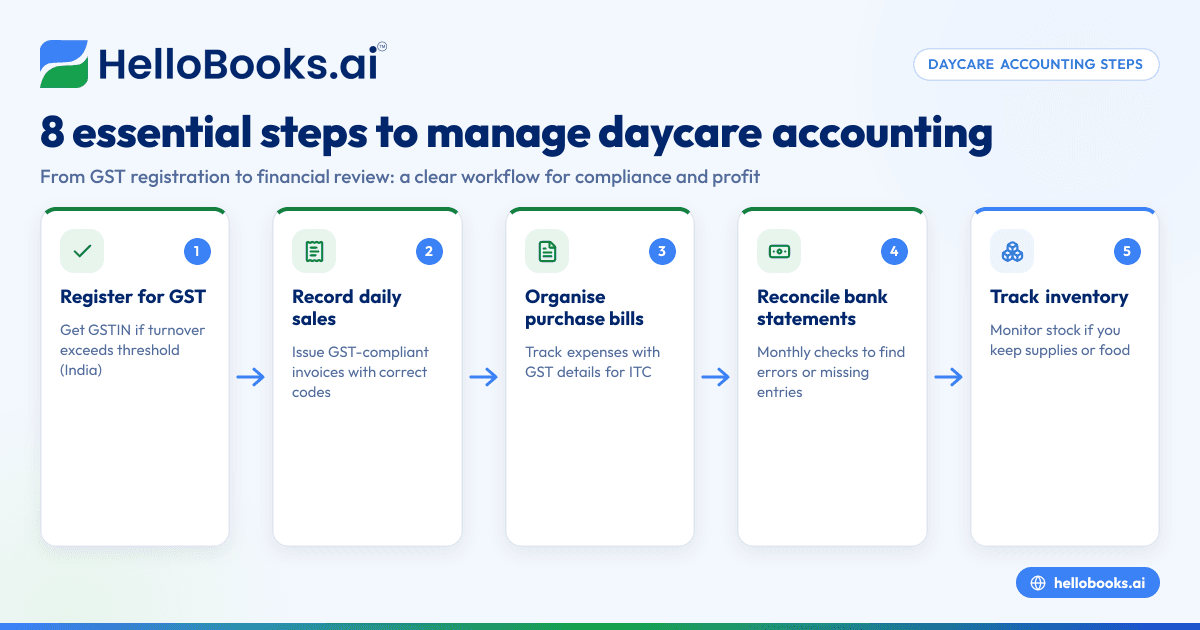
- Register for GST and get a GSTIN if applicable: If your daycare’s annual turnover exceeds the GST threshold, register for GST and obtain a GSTIN.
- Maintain daily sales records and issue GST-compliant invoices: Record all fees collected each day. Use the correct HSN or SAC codes for your services when issuing invoices.
- Collect and organise purchase bills: Keep all bills for expenses such as salaries, rent, utilities, and supplies. Ensure bills include GST details when applicable.
- Reconcile bank statements monthly: Compare your bank deposits and payments against your recorded transactions to identify any discrepancies or missing entries.
- Track inventory if relevant: If you stock items like stationery or food supplies, monitor their usage and stock levels.
- File monthly GST returns on time: Prepare and submit GSTR-1 (details of outward supplies) and GSTR-3B (summary return) each month.
- Claim Input Tax Credit (ITC): Match your purchase bills with GSTR-2B to claim eligible ITC on GST paid.
- Generate and review financial reports regularly: Look at profit and loss statements, cash flow reports, and balance sheets to monitor your daycare’s financial health.
Using GST invoicing software can help ensure your invoices are GST-compliant and accurate. For managing e-invoicing requirements, see e-invoicing (IRN and QR).
Example (fictional figures)
Consider a daycare business in March 2024 that collected fees amounting to ₹1,20,000. Assume an illustrative GST rate of 18%.
Fee collected = ₹1,20,000
GST on fees = ₹1,20,000 × 18% = ₹21,600
Total invoice amount = ₹1,20,000 + ₹21,600 = ₹1,41,600
Expenses for March:
- Salaries = ₹50,000 (no GST)
- Supplies purchase = ₹10,000 + 18% GST = ₹11,800
- Rent = ₹15,000 (no GST)
Total expenses = ₹50,000 + ₹11,800 + ₹15,000 = ₹76,800
Profit before tax = ₹1,20,000 (fees) - ₹76,800 (expenses) = ₹43,200
In this case, you file GSTR-1 showing ₹1,20,000 as taxable outward supply and claim ITC on ₹1,800 GST paid on supplies.
Common mistakes
- Not issuing GST invoices for fees: Prevent this by using invoicing software that automatically generates GST-compliant invoices.
- Ignoring or losing purchase bills: Organise bills immediately upon receipt. OCR scanning technology can capture bills from photos or PDFs to avoid manual errors.
- Mixing personal and business expenses: Maintain separate bank accounts and accounting records for business transactions.
- Delaying bank reconciliation: Schedule monthly reconciliation to detect errors or missing entries early.
- Missing GST return deadlines: Set reminders and use software tools to automate GST filing and avoid penalties.
Doing this in HelloBooks
HelloBooks offers OCR for purchase bills, allowing you to capture supplier bills from photos or PDFs instead of manual entry. This reduces errors and saves time in record-keeping, helping you maintain accurate expense records and simplify GST compliance. Learn more about this feature at HelloBooks for India.
Frequently asked questions
What GST rate applies to daycare services?
GST rates depend on the service classification under SAC codes. Daycare services may attract different GST rates; consult a tax expert or the official GST portal for your specific case. NEEDS EXPERT REVIEW
How do I maintain records if I use Tally or Excel?
You can continue using Tally or Excel but ensure you update records daily, keep all bills organised, and reconcile bank statements monthly. Consider integrating with software like HelloBooks for easier data capture and GST filing.
Can I claim ITC on expenses like rent and salaries?
Salaries and rent usually do not attract GST and are not eligible for ITC. Only GST paid on goods or services used in the business can be claimed as ITC.
What happens if I miss filing GSTR-1 or GSTR-3B?
Late filing can result in interest and penalties as per GST regulations. It is important to file returns on or before the due date to avoid additional costs.
How can I simplify invoice creation and GST filing?
Using GST invoicing software like HelloBooks ensures invoices are GST-compliant and helps automate GSTR-1 and GSTR-3B filing. See GST invoicing for more details.
Key takeaways
- Keep daily records of fee collections and issue GST-compliant invoices.
- Organise and track purchase bills accurately to claim ITC.
- Reconcile bank statements monthly to identify errors early.
- File GSTR-1 and GSTR-3B returns on time to avoid penalties.
- Use OCR technology to capture purchase bills and reduce manual data entry.
- Review financial reports regularly to monitor profitability and cash flow.
Start managing your daycare business accounting efficiently with HelloBooks. Start on the Free plan (200 transactions a year, GSTR-1 and 3B filing for one GSTIN).