


Key takeaways
What this article covers, in order:
- Why this comes up / what goes wrong
- Step-by-step
- Example (fictional figures)
- Common mistakes
- Doing this in HelloBooks
- Frequently asked questions
Accounting for advertising agencies involves managing client invoices, project expenses, and GST obligations carefully to keep finances accurate and compliant. Agencies often face challenges due to multiple clients with different billing terms, diverse expenses like media buying and freelancer payments, and the complexities of GST filing. This article covers why accounting issues arise, detailed steps to manage accounting effectively, a practical example with Indian figures, common mistakes to avoid, and how HelloBooks helps with purchase bill entry.
Why this comes up / what goes wrong
Small advertising agencies frequently struggle with accounting because they handle many clients with varied billing cycles and payment terms. They often record transactions manually in spreadsheets, Tally, or physical bill books, which increases the risk of errors and consumes time during reconciliation. Tracking expenses such as media costs, freelancer fees, travel, and subscriptions is essential but can be overlooked or poorly documented. GST compliance adds further complexity, especially when preparing GSTR-1 and GSTR-3B returns and reconciling input tax credit (ITC) claims. Without systematic processes, agencies risk delayed payments, incorrect tax filings, cash flow issues, and penalties.
Step-by-step
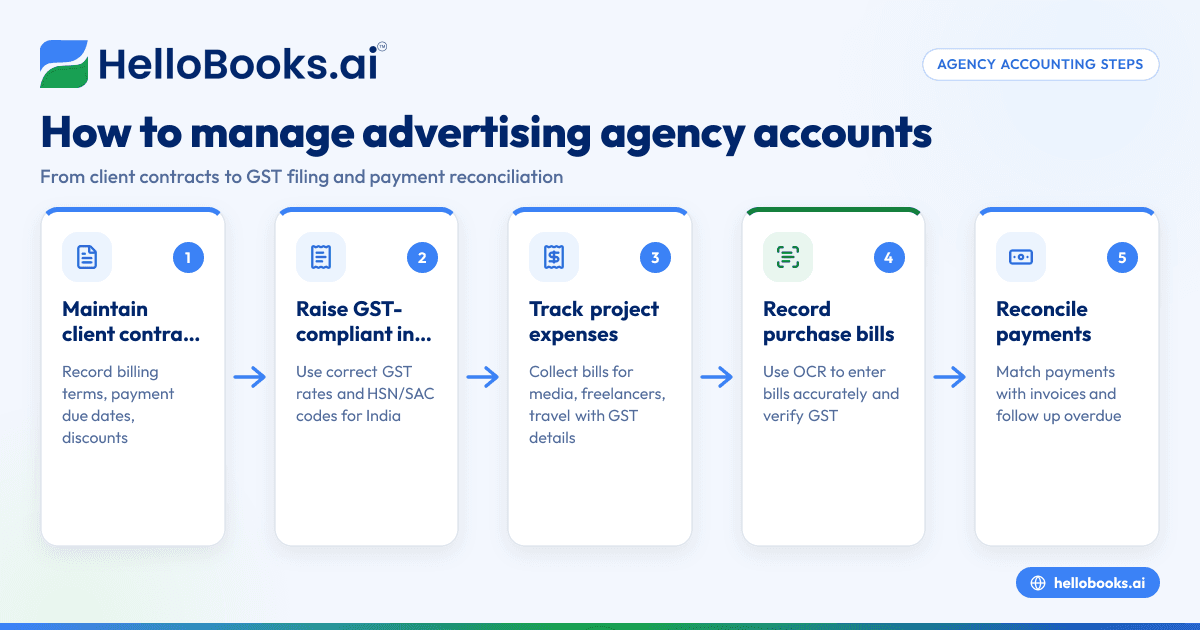
- Maintain Client Contracts and Billing Terms
- Record each client’s contract details, including billing frequency (monthly, milestone-based) and payment terms (due dates, advance payments).
- Check for agreed discounts, retainers, or milestone payments to invoice correctly.
- Raise GST-compliant Invoices for Services
- Prepare invoices with correct GST rates and appropriate HSN/SAC codes for advertising services.
- Ensure invoices include GSTIN, invoice number, date, and client details.
- Verify invoice details carefully before sending to clients.
- Track Project Expenses and Supplier Bills
- Collect all purchase bills related to campaigns, such as media buying, freelancer fees, travel, and software subscriptions.
- Check bills for GST details and supplier GSTIN to support input tax credit claims.
- Record Purchase Bills Accurately
- Enter supplier bills into your accounting system or spreadsheet.
- If possible, use OCR technology to capture bill details from photos or PDFs automatically, reducing manual errors.
- Verify bill amounts and GST components before recording.
- Reconcile Client Payments and Bank Statements
- Match payments received against issued invoices regularly.
- Follow up promptly on overdue payments to maintain cash flow.
- Prepare Monthly GST Returns (GSTR-1 and GSTR-3B)
- Compile details of outward supplies for GSTR-1 filing.
- Calculate GST liability including CGST, SGST, or IGST as applicable.
- File returns within the prescribed deadlines.
- Review Input Tax Credit (ITC) and Reconcile GSTR-2B
- Cross-check ITC claimed with supplier invoices and GSTR-2B data.
- Adjust any discrepancies before filing returns to avoid penalties.
- Generate Financial Reports
- Prepare profit and loss statements to monitor agency profitability.
- Track cash flow and outstanding receivables to manage working capital.
For more details on invoicing and e-invoicing, see GST invoicing and e-invoicing (IRN and QR).
Example (fictional figures)
ABC Advertising issued a client invoice on 01/04/2024 for ₹1,00,000 with 18% GST (assumed illustrative rate).
Invoice value = ₹1,00,000
GST = ₹1,00,000 × 18% = ₹18,000
Total invoice amount = ₹1,00,000 + ₹18,000 = ₹1,18,000
They received a media buying bill on 05/04/2024 for ₹40,000 plus 18% GST.
Bill amount = ₹40,000
GST on bill = ₹40,000 × 18% = ₹7,200
Total bill = ₹40,000 + ₹7,200 = ₹47,200
ABC Advertising records the bill using OCR to capture details automatically. When filing GST returns, they report ₹1,18,000 as outward supply and claim ₹7,200 as ITC.
Common mistakes
- Mixing client advances and revenue: Keep advances in separate ledger accounts to avoid overstating income. Always track advances distinctly.
- Ignoring GST details on purchase bills: Verify supplier GSTIN and GST amounts on bills carefully to claim ITC correctly.
- Delaying invoice issuance: Issue GST invoices promptly after service delivery to avoid late filing penalties.
- Manual data entry errors: Double-check all entries or use OCR to reduce mistakes and save time.
- Not reconciling payments regularly: Reconcile bank statements monthly to identify missing or delayed payments.
- Neglecting GSTR-2B reconciliation: Regularly compare ITC claims with GSTR-2B data to avoid discrepancies and notices.
See GST invoicing for invoicing tips.
Doing this in HelloBooks
HelloBooks offers OCR for purchase bills, allowing advertising agencies to capture supplier bills from photos or PDFs instead of manual entry. This feature saves time and reduces errors when recording expenses and claiming ITC. Learn more at HelloBooks for India.
Frequently asked questions
What GST rate applies to advertising services?
GST rates for advertising services typically fall under the 18% slab, but confirm the exact rate with a tax professional. Correct HSN/SAC codes must be used on invoices.
How can I track client payments efficiently?
Maintain a ledger or use accounting software to record invoices and payments. Regularly reconcile bank statements to ensure all payments are accounted for and follow up on overdue amounts.
What documents are needed for GST filing?
You need GST-compliant invoices issued and received, purchase bills with GST details, and bank statements for reconciliation. These documents support accurate GSTR-1 and GSTR-3B filings.
How does HelloBooks help with GST compliance?
HelloBooks supports GST invoicing and e-invoicing, helping you generate compliant invoices and file returns. Its OCR feature simplifies purchase bill entry for ITC claims.
Can I use Excel or Tally for agency accounting?
Yes, but manual processes can be error-prone and time-consuming. Using accounting software with automation features improves accuracy and saves time.
See also e-invoicing (IRN and QR).
Key takeaways
- Maintain clear client billing terms and issue GST-compliant invoices promptly.
- Track all project expenses with accurate purchase bills and GST details.
- Use OCR to capture supplier bills and reduce manual data entry errors.
- Reconcile client payments and bank statements regularly to maintain cash flow.
- File GST returns timely and reconcile ITC claims with GSTR-2B.
- HelloBooks OCR feature helps automate purchase bill entry for advertising agencies.
Start managing your agency accounting more efficiently. Start on the Free plan (200 transactions a year, GSTR-1 and 3B filing for one GSTIN).


